
Covering Your First BJJ Class Without Overteaching
Quick answer: If your instructor asks you to cover a class, agree on the lesson and your responsibilities before students arrive. Teach material you can explain accurately, leave time to observe practice, and refer questions you cannot answer back to the head coach. A good substitute session fits the academy's plan and ends on time.
Imagine the message arriving at lunch: the coach needs someone to cover tonight's fundamentals class. You know the scheduled guard pass. You have never been the person responsible for the timer, the new student, and the pair drifting toward the wall at the same time.
Knowing the movement is only part of the assignment. The rest is making a room of different people able to practice it without guessing what you want.
This article concerns an adult class you have been authorized and prepared to cover. It does not decide who is qualified to teach at a particular academy. Agree on that with the person responsible for the program, including any support you need before accepting.
Get a handover that goes beyond the move's name
Ask what students covered in the previous session and what the head coach wants them to practice tonight. A lesson on passing half guard can mean several different starts. You need the actual position and the intended stopping point.
Confirm the class duration, the expected student level, and whether anyone else will assist. Ask how new arrivals are introduced and which academy procedures you are responsible for following. Get the appropriate contact details and know who to call if a situation exceeds your role.
BJJ Fanatics' 2017 article on teaching a first class advises following the instructor's curriculum when one is supplied and avoiding an attempt to teach too much. Those are sensible starting recommendations. The handover turns them into something specific for tonight's room.
Write down what you have agreed. If you are uncertain about running live rounds or accommodating a new student, resolve it before class. Being helpful does not require silently accepting responsibilities you do not yet know how to handle.
Rehearse the demonstration with a real partner
Walk through the lesson with someone before students gather. Check that your partner knows the starting grips and the response you need them to provide. A demonstration can become confusing if they improvise an escape you haven't discussed.
Explain the task aloud once. Notice where you use a hand gesture instead of a clear description, or where you say this leg while both legs are hidden from the audience. Rotate the pair so students can see the detail rather than asking them to imagine it.
Plan a simple finish to the demonstration. Show where the attempt ends and how partners return to the start. If you omit the reset, beginners may spend more time negotiating the setup than practicing.
Your demonstration partner should be able to stop or ask for an adjustment too. Agree on that before using them in front of the room. There is no need to apply a submission forcefully to make an explanation convincing, and a partner's tap should end the action immediately.
Write a clock plan with room to watch
Use the academy's normal structure unless the head coach asks for a change. Within that structure, reserve time for students to attempt the task while you observe.
Here is a hypothetical sixty-minute arrangement to discuss with the coach: five minutes for arrival and orientation, ten for the approved warm-up, ten for demonstration and initial questions, fifteen for paired practice, fifteen for the agreed positional work, and five to finish. These numbers are an example, not a recommended formula for every academy.
The useful part is having a latest start time for each block. If the demonstration runs long, simplify the next explanation rather than borrowing time indefinitely from the students' practice.
Keep a clock where you can see it without looking at your phone throughout the lesson. Tell the assistant, if you have one, when you want a time reminder. Finishing on time matters to the next class and to people who have rides or children waiting outside.
Make the first practice instruction unambiguous
Before partners begin, give them enough information to start without reconstructing your demonstration from memory. State who goes first, the allowed response, and how they will switch.
Check these points aloud:
Where both partners begin, including the grips already in place.
What the practicing student is trying to accomplish.
What the partner should do during this first stage.
When to stop, reset, and change roles.
Then watch a pair begin. If the first attempt starts in an entirely different position, correct the setup for the room before everyone rehearses a different lesson.
Use ordinary language alongside any technical name. Our BJJ terminology glossary is useful background, but the new student cannot consult it while holding someone's sleeve. Explain the term at the moment it matters. Avoid adding a second nickname merely to show that you know one.
Circulate before adding another technique
Once practice starts, leave the center of the room and see what students are doing. Check both roles. The person providing the response may be confused even when the person practicing appears confident.
Look for a repeated problem. If several pairs are starting with the wrong leg trapped, pause briefly and clarify that one detail. If one pair has a question, help them without automatically recalling everybody to the middle.
Ask before physically repositioning a student. A verbal cue or another demonstration may be enough. Give them an opportunity to try the correction rather than taking over the entire repetition yourself.
Resist rewarding fast completion with unrelated material. An experienced student can often explore the assigned problem more carefully, or work on a variation approved by the head coach. The solution to one bored person is not necessarily a second lesson that leaves the rest of the room behind. Our drilling guide offers ways to think about the practice task without continually expanding the move list.
Answer the question you were actually asked
A student's question may concern a small missing step. Don't respond with a tour of every counter you know. Ask them to show where they became stuck, then address that point.
If they ask why a different grip might work, explain what you can support from the lesson. You can acknowledge an alternative without abandoning the assigned sequence. A class can stay focused while making room for a reasonable question.
When you don't know, say so. Record the question and refer it to the head coach or another appropriate instructor. Do not invent a tournament rule, a medical explanation, or a historical reason to keep the room moving. A clear limit is more useful than an answer students will have to unlearn.
The BJJ Fanatics first-class article makes the same general recommendation about admitting uncertainty and following up. Put that into practice by keeping the unanswered question after class. Saying you will check is only useful if the question reaches someone who can actually answer it.
Keep responsibility for the room during live work
If the head coach has approved live or positional work, explain its boundaries before starting the timer. Tell students what positions are involved and when you expect a reset. Confirm that partners know how to stop.
For a first substitute class, discuss whether you should remain out of the rounds so you can supervise. You cannot closely watch the far side of the room while someone is holding you in closed guard. An assistant's presence may change the arrangement, but make that responsibility explicit.
Pause action that needs attention. That can include pairs getting too close, students using an unapproved action, or someone appearing unable to follow the task. You don't need to deliver a public reprimand to redirect the practice.
A student who chooses to sit out should have an ordinary way to do so. Don't use their decision as an impromptu toughness lesson. If there is an injury concern or another situation outside your competence, follow the academy's procedures and involve the appropriate person instead of trying to diagnose it on the mat.
Our training-partner guide can help you explain the expectations for a cooperative round before pairing students.
Hand the class back with useful observations
After students leave, send the head coach a short account through the academy's normal channel. Explain what you covered and whether you changed the plan. Include unanswered questions and any matter that needs their attention.
Keep observations concrete. Several beginners started the pass with the wrong knee forward is more useful than the class needs better fundamentals. One pair needed the reset explained again is clearer than people weren't listening.
Avoid turning the handover into a ranking of students. You are reporting on a session, not assigning permanent labels after an hour. Keep personal matters private and share them only with the people responsible for handling them.
Ask for feedback about your teaching. If the coach or an assistant watched, request one specific point to improve before the next assignment. You might need a better viewing angle, a shorter demonstration, or clearer partner instructions. That is enough to work on without redesigning your entire teaching style after one evening.
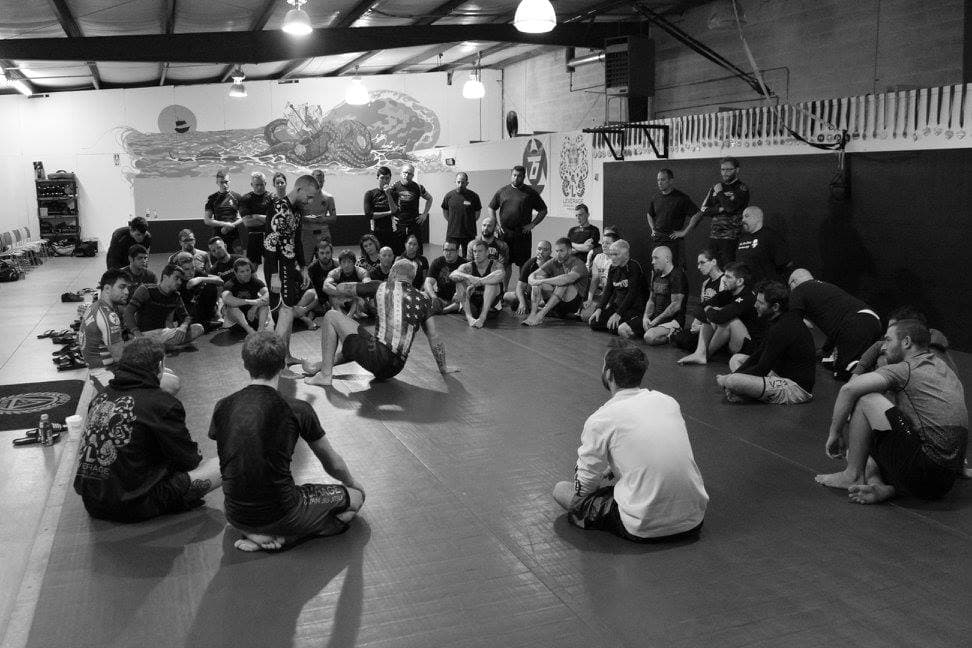
Main photo: BJJ Fanatics; archival seminar instruction photograph.
The takeaway
Covering a class works best when the assignment is clear before the room fills. Agree on the lesson, rehearse its starting position, and leave enough time to observe students practicing. Keep unanswered questions intact rather than filling the silence with guesses.
The head coach should be able to resume the program knowing what happened. Finish at the agreed time, pass along the relevant observations, and make your next teaching adjustment specific. Nobody needs a substitute instructor to display their entire jiu-jitsu vocabulary in one class.
Keep the beginner's experience in view
Read our beginner's guide to BJJ to revisit the questions a first-time student may bring into the room before they can follow the technical lesson.
FAQ
What belt do I need to cover a BJJ class? This article does not set a universal rank requirement. The academy's responsible instructor must decide who is qualified, authorized, and adequately supported for its particular program and students.
How many techniques should I teach? Follow the agreed lesson plan and preserve practice time. A narrow lesson students can attempt clearly is a better aim than hitting an arbitrary number of demonstrations.
What should I do if I cannot answer a student's question? Say you are unsure, record the question accurately, and refer it to the appropriate instructor. Follow up instead of inventing an answer to protect your appearance of expertise.
Should I roll while covering class? Agree on supervision with the head coach beforehand. If you are responsible for watching the whole room, joining a round may prevent you from doing that job adequately.
Related Posts
What to Do After a BJJ Seminar: A One-Week Follow-Up
Turn a BJJ seminar into a useful week of practice. Organize your notes, mark missing details, choose one task, and follow the host's recording rules.
Better BJJ Rounds When Your Partner Is a Different Size
A weight gap changes a BJJ round. Use clear starting positions, agreed tasks, and controlled resets so training partners of different sizes get useful work.
Bring a problem to your first BJJ private lesson
Make a BJJ private lesson useful: choose a specific problem, send relevant footage, confirm booking details, and leave with a focused practice plan.
Comments (0)
Loading comments...