
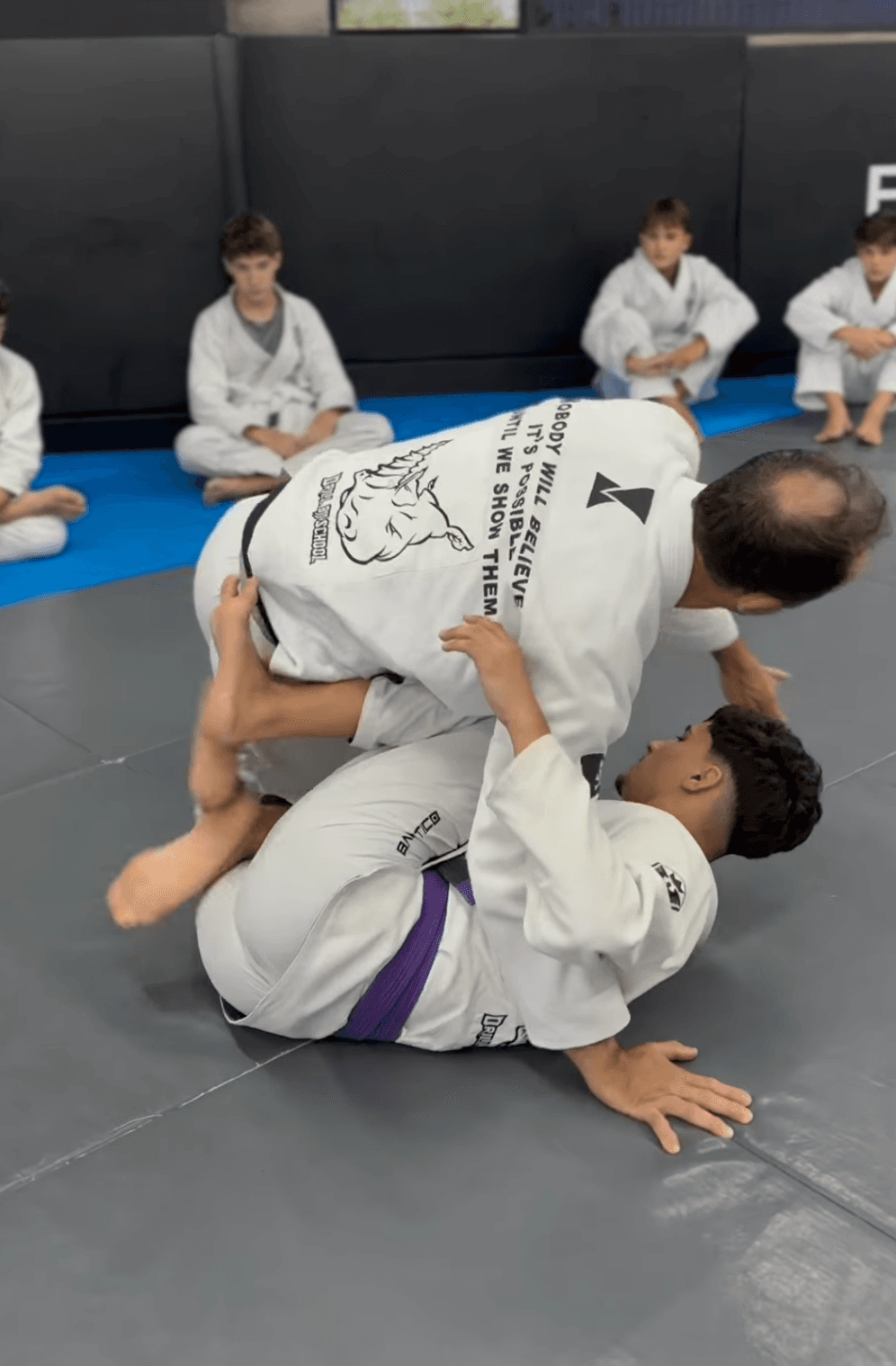
Drilling in BJJ: what transfers to your rolls and what doesn't
Quick answer: Drilling only transfers to rolling when there's a decision in it. Pure cooperative repetition builds a movement you can perform on a compliant partner and nowhere else. Add resistance, a live start, a constraint, or a partner who's genuinely trying to stop you, and the same technique starts showing up in your rounds. Use the five minutes after class, pick one position for several weeks, and stop counting reps.
Count how many times you've hit the armbar you drilled on Tuesday in an actual round. For most people the number is zero, and it has been zero for months.
That's not a talent problem. It's a design problem, and the sport is currently in the middle of a loud, unresolved argument about how to fix it.
The argument you're standing in the middle of
For decades the default class looked the same everywhere: warm-up, instructor shows a move, partner up, ten each side, next move, ten each side, then rolls. It went largely unquestioned, because it worked well enough and because that's how everyone's coach had done it.
Then a group of coaches started applying skill-acquisition research (ecological dynamics, the constraints-led approach, the work of researchers like Michael Turvey and Rob Gray) to grappling, and argued that cooperative repetition is close to worthless. The most visible of them is Greg Souders, a black belt who runs Standard Jiu Jitsu in Rockville, Maryland and teaches classes with no technique demonstration and no drilling at all, only designed games with live resistance.
This is not a fringe position anymore. It's also not a settled one. Both camps have world champions.
The case for reps, at its strongest
No serious coach defends mindless repetition. Even John Danaher, whose instructionals are built on precise technical detail, has argued publicly that drilling for numbers is the wrong target and that the point of a rep is to feel what mechanical efficiency in a position actually feels like, then chase that feeling into progressively harder tests.
The real defense of repetition is narrower and better: some movements have a coordination cost you have to pay before you can use them under pressure. A granby roll, a technical stand-up, a hip heist, a berimbolo entry, an armbar from an inverted position. If you've never done the movement at all, your first fifty attempts under resistance are just flailing, and you'll conclude the technique doesn't work when what happened is you couldn't perform it.
There's also a competition argument. Eight weeks out from a bracket, needing one specific sweep to be reliable, focused repetition of that sequence is a defensible use of the clock. No one has proposed a discovery-based method that installs a named technique faster.
The case for games
The ecological argument runs like this. Skill isn't a movement pattern you store and retrieve; it's your ability to pick up the right information in a live environment and organize a response. Rehearse a movement in an environment containing none of that information — no resistance, no timing, no decision — and you're training a different skill from the one you need.
Souders, on the B Team's podcast in 2025, put his own method plainly: everything stays live, unscripted, uncooperative, and the coach's job is to design the constraints rather than to demonstrate the answer. Instead of showing a rear naked choke, you build a game where the attacker must control the hands and the defender must free them, and the mechanics of strangling get discovered rather than taught.
The strongest evidence for it is the thing every experienced grappler already knows: the techniques you own are almost never the ones you drilled the most. They're the ones you got stuck in, failed at repeatedly against someone good, and eventually solved.
Where the evidence leaves you
The answer is that this is unresolved, and the loudest version of each side is the weakest version.
Plenty of high-level competitors think the eco camp has renamed something old. Gui Mendes was asked about it and, as reported by BJJDOC in January 2025, answered:
You guys and these crazy names. Just say drilling with reaction. We use this training style since the days we were living in Brazil. — Gui Mendes
Two-time world champion Dante Leon made a sharper version of the same point on the Immortal Podcast, reported by BJJDOC in March 2026: he agreed static closed-guard armbar reps are a waste of a purple belt's time, said he'd known that for fifteen years without needing a theory for it, and argued that constraint games are drilling — dynamic drilling with a task attached, but drilling.
The counter-counterpoint is fair too. If reactive drilling was always the norm, a lot of gyms didn't get the memo. Ten reps each side is still what most rooms run on a Tuesday.
Where that leaves you as a student: stop asking which camp is right and start asking whether the thing you did tonight contained a decision. If your partner did nothing, you rehearsed. If your partner did something, you trained.
Positional sparring is what nearly everyone agrees on
Here's the practical convergence. Whatever they call it, good coaches from both camps spend a large share of mat time on constrained live rounds: start in a specific position, one person tries to achieve something, the other tries to stop it, reset when it resolves.
Three minutes. You start in bottom side control, your only job is to get to your knees or recover guard. Their only job is to hold you. Reset when you escape or every 45 seconds, whichever comes first.
That's a rep count in the dozens, every one of them against resistance, every one containing a decision. It's also the closest thing jiu-jitsu has to a free lunch. If your gym doesn't program it, you can run it yourself in open mat, and you should.
The five minutes after class
Most gyms let the mat sit empty for a few minutes between the end of class and whatever's next. That window is the most useful training time in your week and hardly anyone uses it.
Grab one partner, agree on the same position for a month, and run three rounds of two minutes. Same start, same objective, alternating. That's about 24 focused minutes a week on one problem, which is more concentrated exposure than you'll get in six months of following the curriculum.
Log it, because you will not remember. Two lines in your training log, covering the position, what failed and what you'll try next, turns a scattered month into a training block. We've written separately about keeping a BJJ training journal; the mechanism isn't mystical, people who keep one just stop re-solving the same problem.
What to work on at each belt
White belt. Escapes, and the raw movements. Bridge and shrimp are boring and you need them. Spend your after-class time on getting out of mount and side control, because you're going to be under everyone for a year, and because the fastest way to enjoy jiu-jitsu is to stop panicking on the bottom.
Blue belt. Pick two positions and stay there. This is the belt where people start collecting techniques from Instagram and end up with a game made of unrelated parts. If you're not sure what to pick, our guide on building a BJJ game walks through choosing a top game and a bottom game and connecting them.
Purple belt. Transitions and failure recovery. You have techniques. What you lack is what happens when they don't work. Design your rounds around your worst-case position rather than your favorite one.
Brown and black. Refinement and specific problems: this person's grip, that person's frame, the pass you can't stop. You're not learning moves anymore, you're debugging.
Solo drills, timers, and the most wasted hour in BJJ
Solo drilling has a short list. Hip escapes, technical stand-up, granby rolls, bridging, forward and backward rolls, sit-outs. Movements with no partner in them. Ten minutes before class, done properly, will noticeably improve how you move under someone in about six weeks.
Everything past that list is mat-flopping theater. Shadow-drilling an armbar against an imaginary opponent trains you to do an armbar against an imaginary opponent. There's no information in the air.
Use a clock. Not for reps. For rounds. A phone timer with 2:00 work and 0:20 rest turns loose after-class messing around into structured practice, and the interval is what forces you to reset rather than drift into a chat about someone's shoulder.
And the wasted hour: drilling a technique you cannot land on a resisting partner at your own level. If you've never once hit it live, more cooperative reps will not fix that, because the thing failing is not your movement, it's your entry, your timing, or your read. Take the same technique into a positional round and let it fail there instead. Failing live is information. Succeeding dead is not.
The takeaway
Drilling isn't dead and games aren't magic. The variable that predicts transfer is whether your partner was doing something you had to respond to, and almost every argument in this debate is really an argument about how much resistance to add and when.
If you want a rule you can use tonight: keep cooperative reps for movements you physically can't perform yet, and put everything else into constrained live rounds. Pick one position. Stay on it for a month, not a week. Use the five minutes after class. Write down what happened.
The people who improve fastest at your gym aren't training more hours than you. They're training on fewer problems, for longer, against someone who's genuinely trying to stop them.
Keep track of what you're working on
A month of focused work on one position is worth a year of drilling whatever was shown that night, but only if you remember what you did. Log your training on Let's Roll →
FAQ
How much should I drill versus roll in BJJ? There's no validated ratio, and coaches disagree loudly. A more useful question is how much of your mat time contains resistance and a decision. If you're doing several rounds a week of constrained positional sparring on one specific problem, plus normal rolling, you're getting what drilling is supposed to provide, whatever the split says.
Is drilling useless in BJJ? No, but cooperative repetition is heavily overrated. It's genuinely useful for movements you can't yet physically perform (inversions, granby rolls, complex entries) and for tightening a specific sequence before a competition. It's close to useless for making a technique work on someone who's fighting back, because it contains none of the information you need in that moment.
What is the ecological approach in jiu-jitsu? A coaching method drawn from ecological psychology and the constraints-led approach, most visibly pushed in BJJ by Greg Souders of Standard Jiu Jitsu. Instead of demonstrating and drilling techniques, the coach designs live games with constraints that make the correct solution likely to be discovered. It's genuinely contested — supporters cite skill-acquisition research, critics argue it's reactive drilling with new vocabulary.
What should a white belt drill? Escapes and basic movement. Getting out of mount and side control, recovering guard, technical stand-up, bridging and hip escapes. Run them as short positional rounds rather than cooperative reps wherever you can, and pick one escape to work on for a month instead of a new one every week.
Related Posts

Mikey Musumeci gives up the belt to make room for MMA
Musumeci is vacating his UFC BJJ title to focus on MMA training. What he is leaving, what continues, and why the transition matters.
IBJJF membership: finish the paperwork before the deadline
IBJJF membership and tournament entry are separate steps. Plan documents, professor approval, renewals, and junior accounts before registration closes.
Choosing a BJJ seminar worth your time and travel
Choose a BJJ seminar by the subject, teaching format, access, and total cost. Know what to ask the host before buying a ticket.
Comments (0)
Loading comments...