
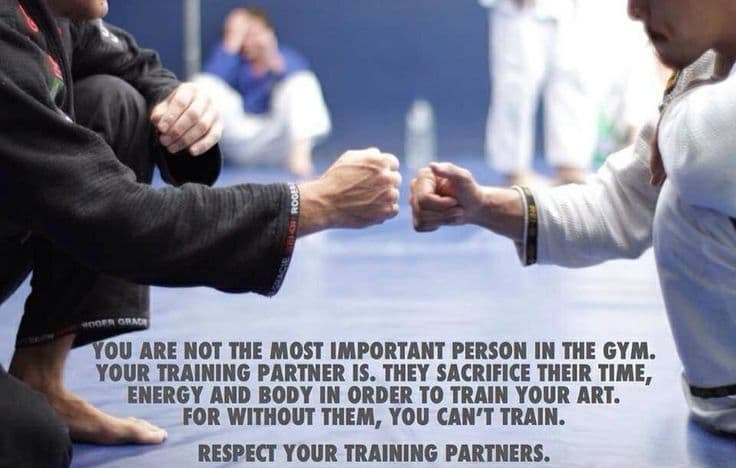
Better BJJ Rounds When Your Partner Is a Different Size
Quick answer: A large size difference is a reason to agree on the round before it starts. Pick one position, define an endpoint, and let either person stop or change the task. You can have useful resistance without treating every exchange as an absolute-division match.
Consider a hypothetical Tuesday class: a 145-pound blue belt and a 220-pound purple belt are the last two people without partners. Both want to train. Neither wants five minutes of the larger person apologizing while still pinning the smaller person flat.
A vague promise to go light leaves too much room for interpretation. The smaller partner might mean no crushing top pressure. The larger partner might mean no submissions. They can keep that promise, technically, and still have a miserable round.
Give the round a job. The following formats are practice suggestions to discuss with your coach, not universal pairings or a promise that any two bodies belong together. You are allowed to choose someone else.
Agree on what the round can actually test
Size is one part of the pairing. Experience, familiarity, and each person's ability to follow the agreed task matter too. Don't assume a belt color answers all those questions.
In his 2009 discussion of sparring partners, Stephan Kesting recommends spending substantial time with people near your skill level. He also describes starting in a disadvantageous position to make work with a less experienced partner useful. That is a coaching recommendation, not a scientific formula for allocating rounds.
For a mismatched pair, start with something both can explain in one sentence. Perhaps the bottom player wants to recover a seated guard while the top player practices following the hips without settling into a heavy pin.
If the larger partner wants to rehearse full competition pressure and the smaller partner wants relaxed guard movement, those are different sessions. Find different partners rather than making somebody compromise after the timer starts. An honest refusal saves everyone a pointless negotiation during the round.
Change the assignment before you change the speed
Going slowly does not automatically make a position comfortable. Someone can apply an overwhelming amount of weight very slowly. Someone can also move quickly without giving the other person a chance to organize a response.
Instead of estimating percentages of effort, agree on observable limits. A coach might approve a round that ends when the passer clears both legs, before a settled chest-to-chest pin. Another pair might begin with the smaller person on top and practice maintaining a passing position against active guard recovery.
Neither version requires someone to pretend a technique worked. The guard player can stop the pass. The passer can deny a recovery. What changes is where the exchange ends and which actions belong in the task.
Try a short trial rather than committing to the entire class timer. After a minute, stop and ask whether both people got attempts at their assignment. If one person spent the whole time immobilized, change the start or narrow the task. Simply promising to be nicer is not a useful adjustment.
Our guide to drilling BJJ gives more context for choosing a task that both partners can practice honestly.
A passing round can finish before the pin
Here is one example for partners who already know the position and have a coach's approval. Start with the smaller player in seated guard and the larger player at a comfortable passing distance. Agree that there are no submissions or takedowns in this particular task.
The passer tries to get beyond the legs with control. The guard player tries to keep the passer in front and regain the agreed starting distance. Reset when either endpoint happens. Ask the instructor to settle what counts before beginning; don't turn each reset into a scoring appeal.
That ending matters. It gives the passer a real obstacle without automatically adding several minutes of top pressure to every successful attempt. It also gives the guard player repeated chances to solve the entry rather than one attempt followed by a long pin.
Switch roles if both people want to. A size difference does not mean the smaller partner must spend every practice round underneath. Our guide to becoming a better guard passer offers a broader place to organize the passing questions that come out of this work.
Give the larger partner a demanding defensive task
Making a round useful for the smaller person should not require the larger person to become a training dummy. Ask the coach for a defensive problem that creates genuine decisions without needing a strength contest.
For example, begin with the larger partner seated and the smaller partner working from top. Agree on a limited guard-retention task: keep the passer in front, recover the starting relationship after losing an angle, and reset when the pass is established. Leave submissions out while learning the format.
The larger player now has something to accomplish. They should not secretly add wrestling up, gripping at maximum effort, or a submission threat because the smaller person has begun succeeding. Those can be different rounds, agreed separately.
In BJJ Fanatics' article on being a good training partner, the author advises adjusting work with smaller and less experienced partners and using appropriate resistance while drilling. The practical point here is more specific: keep the agreed problem intact long enough for both people to work on it.
Make the reset easier to call than the argument
A reset should be a normal part of the practice. If asking for one feels like admitting defeat, the format has already acquired an unwanted scoreboard.
Set these details while you can still hear each other:
Name the starting position and who begins in each role.
Describe the two endpoints in plain language.
Agree that either person can stop immediately, including between those endpoints.
Decide when to switch roles or choose a different partner.
Tap whenever you need to stop. You do not need a submission to justify it, and the other person should release and pause immediately. The same applies to a clear verbal stop.
After a reset, return to the actual starting arrangement. Drifting into better grips each time quietly changes the experiment. If those grips are the thing you want to practice, say so and make them part of the next round. Avoid a running debate over whether the last repetition was a win.
Don't attach a lecture to every successful repetition
The larger partner may also be the more experienced one. That can be useful, but it does not make every pause a teaching slot.
Allow several attempts before offering feedback, unless something needs to stop right away. If the smaller person finally keeps their knee between you and their torso, let that result stand. Explaining that you could have crushed through it under different rules gives them no new information.
Likewise, the smaller partner should not treat every difficult exchange as proof that the other person broke the agreement. Name the actual action: the round continued after the pass, a grip wasn't part of the start, or the pressure felt beyond what you wanted. Specific feedback gives someone a chance to adjust.
For a recurring problem, bring the coach into the conversation. Our training-partner guide covers the wider responsibilities, but no article can referee a round it did not see. The instructor standing beside your mat has information this page does not.
Record the position, not a result against a body weight
A training note that says you survived a bigger person is hard to use next week. It doesn't tell you where the round became difficult or what you managed to change.
A better note might describe a hypothetical passing exchange: the first step went past your feet, you turned late, and the second attempt improved after you started facing the passer sooner. Those details give your coach something to inspect. The partner's weight does not need to become the headline.
For the passer, record what the guard actually denied. Perhaps you could move the feet but lost the angle whenever the bottom player sat up. That is a question about your sequence, even if you could have held the person down under a different agreement.
Keep counts modest if you use them. Three resets from the same start can be enough to identify a question worth asking. There is no validated number in this article that guarantees progress, and the session does not need a spreadsheet to justify itself.
Some pairings should end after the first trial
You can try a reasonable format and discover that the pairing still doesn't work. Maybe the larger partner cannot yet regulate pressure. Maybe the smaller partner dislikes the position. Maybe both are tired and keep abandoning the rules.
Stop, choose a different task, or change partners. Nobody owes another member access to their body because the room has an odd number of people. A coach can help with alternatives, including observation or a different drill.
This applies in both directions. The larger person is allowed to decline being the designated practice partner for everybody's experimental guard. They can ask for a round that meets their own training needs too.
A good pairing is repeatable by agreement. If one person consistently dreads it, calling the discomfort a character lesson won't improve the practice. Keep the conversation ordinary and private. There is no need to announce who is too big, too small, or insufficiently tough to the whole academy.
Main photo: BJJ Fanatics; training-partner article photograph.
The takeaway
A size gap becomes easier to manage when the round has a visible beginning and ending. Choose a position both partners understand, set the boundaries before starting, and make stopping routine. The examples above are options for a coach to adapt, not instructions to accept a pairing you don't want.
Judge the session by whether both people got useful attempts at the agreed task. If the answer is no, change the task or the partner. You do not need to turn a Tuesday training round into an argument about whether technique beats size.
Find a room with suitable training options
Use the gym directory to explore nearby academies, then ask how coaches organize partner selection and positional rounds for members of different sizes.
FAQ
Should the bigger partner always start on bottom? No. Starting underneath is one option, not a permanent assignment. Choose roles around the work both people want, and switch or change partners when that pairing no longer serves them.
Does a slow round solve a large weight difference? Not by itself. Discuss pressure, allowed actions, and endpoints as well as speed. Someone moving slowly can still make a position feel overwhelming to the other person.
Can I decline a much larger or smaller partner? Yes. You can decline any round. A short, respectful answer is enough, and your coach can help arrange another pairing or a different practice task.
Should we count taps during these rounds? For the examples here, submissions are excluded so partners can focus on the agreed position. If you choose another format, settle its rules beforehand rather than adding submission attempts halfway through.
Related Posts
Covering Your First BJJ Class Without Overteaching
Cover an adult BJJ class with a plan agreed by the head coach. Keep the lesson focused, supervise partners, and leave clear handover notes afterward.

What to Do After a BJJ Seminar: A One-Week Follow-Up
Turn a BJJ seminar into a useful week of practice. Organize your notes, mark missing details, choose one task, and follow the host's recording rules.
Bring a problem to your first BJJ private lesson
Make a BJJ private lesson useful: choose a specific problem, send relevant footage, confirm booking details, and leave with a focused practice plan.
Comments (0)
Loading comments...