
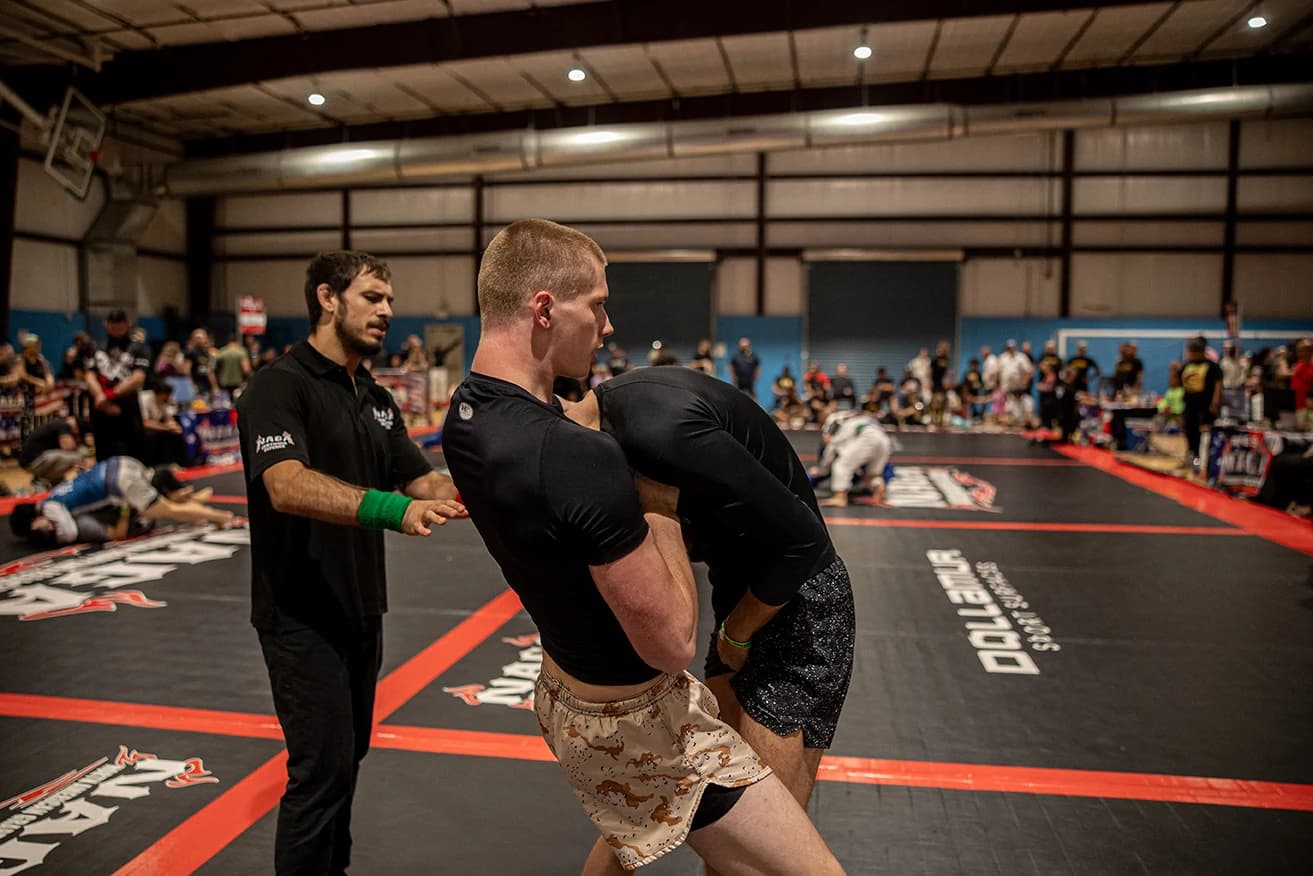
Your head position is part of the BJJ grip fight
Quick answer: Head position is a relationship between two people, not a single height or direction to copy. Describe where the head is, what it touches, and which movement it obstructs before asking how to improve it. Use a coach-led example and a counterexample instead of treating one placement as correct in every position.
A hand can keep the same grip while the rest of an exchange changes around it. In an imagined passing sequence, the passer’s head moves away from the defender’s upper body; a space appears, and the defender brings an arm between them. Looking only at the hands would leave an important part of that sequence out.
It would still be too quick to declare the head movement the cause. Perhaps the defender had already made space, or another contact changed at the same time. I want a description that lets a coach examine those possibilities before the explanation hardens into a rule.
Describe the relationship before calling it good posture
Begin with the bodies you can identify. Name who is on top, who is underneath, and what the hands and legs are doing. Then locate each head relative to the other person’s shoulder, torso, and the mat. A phrase such as keeping the head low leaves most of that arrangement unspecified.
BJJ Mental Models’ head-position explanation distinguishes several functions, including using the head as a frame, post, or temporary replacement for another contact. Those are different questions to investigate. Naming a function helps explain why a placement belongs in one position rather than another.
For example, a proposed note might say that the passer’s head remains beside a shoulder while a hand changes grips. It records an arrangement without yet deciding that the arrangement was effective. Another person can check the description, which gives you a firmer starting point for the next question.
A still photograph cannot explain the next movement
Two moments can look similar and lead to different outcomes because the available movements differ. When reviewing a coach’s demonstration, include the moment before a contact is made and the moment after it changes. Ask what the partner could do in each moment. Do not select the neatest still and make it responsible for everything that followed.
An original observation exercise can be very small. Watch one exchange with the sound off, write a description of the head contact, then replay it with the explanation. Compare the instructor’s stated purpose with what you were able to identify. A missing detail is a useful question, not evidence that the teaching was wrong.
If the footage hides the contact, leave that part uncertain. The camera may show where the athlete is looking without showing the surface supporting the head. Those are not interchangeable observations, and a confident description cannot recover a view the camera never supplied.
Passing gives the head question a specific setting
Atos publishes an André Galvão lesson on head position while passing, identified as part of a fundamentals class taught on October 23, 2023. That public listing establishes the subject and class context. It does not make every passing sequence an example of the same placement.
When your own instructor demonstrates a pass, ask which part of that particular sequence depends on the head contact. Does it belong during the initial approach, a change of grips, or the final control? Keep the answer attached to the point in the lesson where it was given.
Then ask about a limit. If the defender changes their orientation or creates a different contact, does the instruction still apply? This keeps a useful detail from becoming an instruction to drive the head toward a location after the rest of the position has already moved somewhere else.
Stand-up has its own reference points
USA Wrestling’s Folkstyle Level 3 curriculum includes head position with the underhook among its teaching topics. That is a useful reminder that an upper-body grip is studied alongside the surrounding position. It is not proof that an underhook alone decides a wrestling or BJJ exchange.
For an upright demonstration, start by describing the stance and the location of the arms before focusing on the heads. A view from the opposite side can make the same arrangement look unfamiliar. Ask the coach to identify the near and far sides rather than carrying over a direction from the camera angle.
Our underhook explanation gives that arm relationship more attention. The head question adds a second part to the description. It should help you understand the teacher’s example, rather than encouraging you to recreate a standing collision from a paragraph or a paused video.
Change one part of the explanation before changing several
A coach can help turn a vague impression into something observable. Suppose an original teaching example compares two controlled demonstrations in which a hand contact stays consistent and the head contact changes. Ask the instructor which other differences matter before concluding that the changed contact explains the result.
Use a few questions to keep the comparison honest:
Which contact stayed the same, and how do we know?
What movement became available to the partner?
Did the change happen before or after that movement began?
What detail would make the explanation stop applying?
This is a proposal for asking better questions during supervised learning, not an independent experiment to force on a resisting partner. The instructor chooses the starting arrangement and suitable practice. You are trying to isolate an explanation, not to prove a point by escalating contact until someone agrees with it.
Space can be described without prescribing pressure
An explanation can identify the space a head occupies without telling a reader to apply force through the neck. Keep those tasks separate. If an instructor uses a particular contact during a demonstration, ask how that contact is established, how it is released, and what the partner should report if the arrangement is uncomfortable.
I prefer an observation such as the defender’s arm could enter after this contact moved to a claim that somebody simply needed more pressure. The first points toward a visible change. The second can mean several different things, and adding effort does not clarify which explanation was intended.
A partner’s discomfort is a reason to stop and speak with the coach, not a useful measurement of whether the technique is working. Prose cannot assess someone’s neck or decide how much contact is suitable. Learn the physical detail in the class, and keep your notes focused on what the instructor actually explained.
Compare the explanation with a different position
A broad principle becomes more useful when you can say where it stops. Ask the coach whether an instruction from a passing example belongs in the same way during another position. You do not need a catalogue of exceptions. One carefully chosen counterexample can show which part of the original instruction depended on the original arrangement.
Imagine that a student has summarized a lesson as always keeping the head in front. Before trying to follow that phrase everywhere, the teacher asks what front means after the two athletes turn. The problem may be the student’s wording rather than the original lesson. Rewrite the note using the opponent’s body as the reference.
That is a worthwhile correction. A short cue can help during practice, but it should expand into a clear description afterward. If you cannot explain which person and contact the cue refers to, it may be too broad to carry into another class without asking again.
Keep the useful question for the next lesson
A workable training note can contain the starting position, one observed contact, and the question left unresolved. It does not need an anatomical theory or a verdict on the instructor. In the next suitable class, show the coach the note and ask whether it describes the arrangement accurately before asking for a correction.
For video review, our match-watching guide helps separate visible action from a conclusion the recording cannot establish. Use that distinction here. Seeing a head move before a grip fails is a sequence you can record; determining what produced the failure may require a better angle or a controlled demonstration.
The next useful result may be discovering that the original explanation was incomplete. Perhaps a hand changed earlier than you noticed. Keep that discovery. A better description gives the next lesson somewhere to begin, while defending the first explanation only preserves a sentence you can no longer support.
The takeaway
Put head position into the description of an exchange alongside the hands and legs. State the contact and the movement it appears to affect, then ask the coach to explain the relationship in that particular position.
Keep one counterexample beside the useful cue. It gives the instruction a boundary and makes the next question more precise. Neither a photograph nor a paragraph can replace learning the actual contact with an instructor and a cooperative partner.
Ask about the contact in class
Find an academy through Let’s Roll’s gym directory and ask an instructor to show where head position fits into the specific technique being taught.
FAQ
Is there one correct head position for all of BJJ? Treat the position, the other person’s contacts, and the intended movement as part of the question. A cue from one demonstration needs context before being applied somewhere else.
What should I write down about head position? Record where each person is, what the head touches, and what changed before the movement you are studying. Leave hidden or uncertain contacts marked as uncertain.
Does more pressure fix poor head position? More effort does not explain an unclear arrangement. Ask the coach what contact the lesson requires and how it should be established and released; stop if a partner is uncomfortable.
Can match footage prove that head placement caused a result? Footage can establish a visible sequence without proving the cause. A different angle or a coach-led demonstration may be needed to examine competing explanations.

Nina Okada
Nina Okada explains positions the way a good training partner does: one problem at a time, with the limits of the explanation said out loud. She is careful about the difference between what footage shows and what it only suggests.
Related Posts
Lasso guard: know when to keep the sleeve and when to leave
A lasso hook can buy time or trap you in a grip battle. Give the free leg a purpose, keep useful sleeve control, and recognize when to change guards.
Spider guard: give each foot a job
Make spider guard easier to read. Learn how sleeve tension, different foot positions, and the passer's posture shape your next sweep or transition.
The seated arm drag starts before you pull the arm
The seated arm drag needs more than a wrist grip. Study the arm connection, hip movement, and reactions that open a back take or a route to top position.
Comments (0)
Loading comments...