

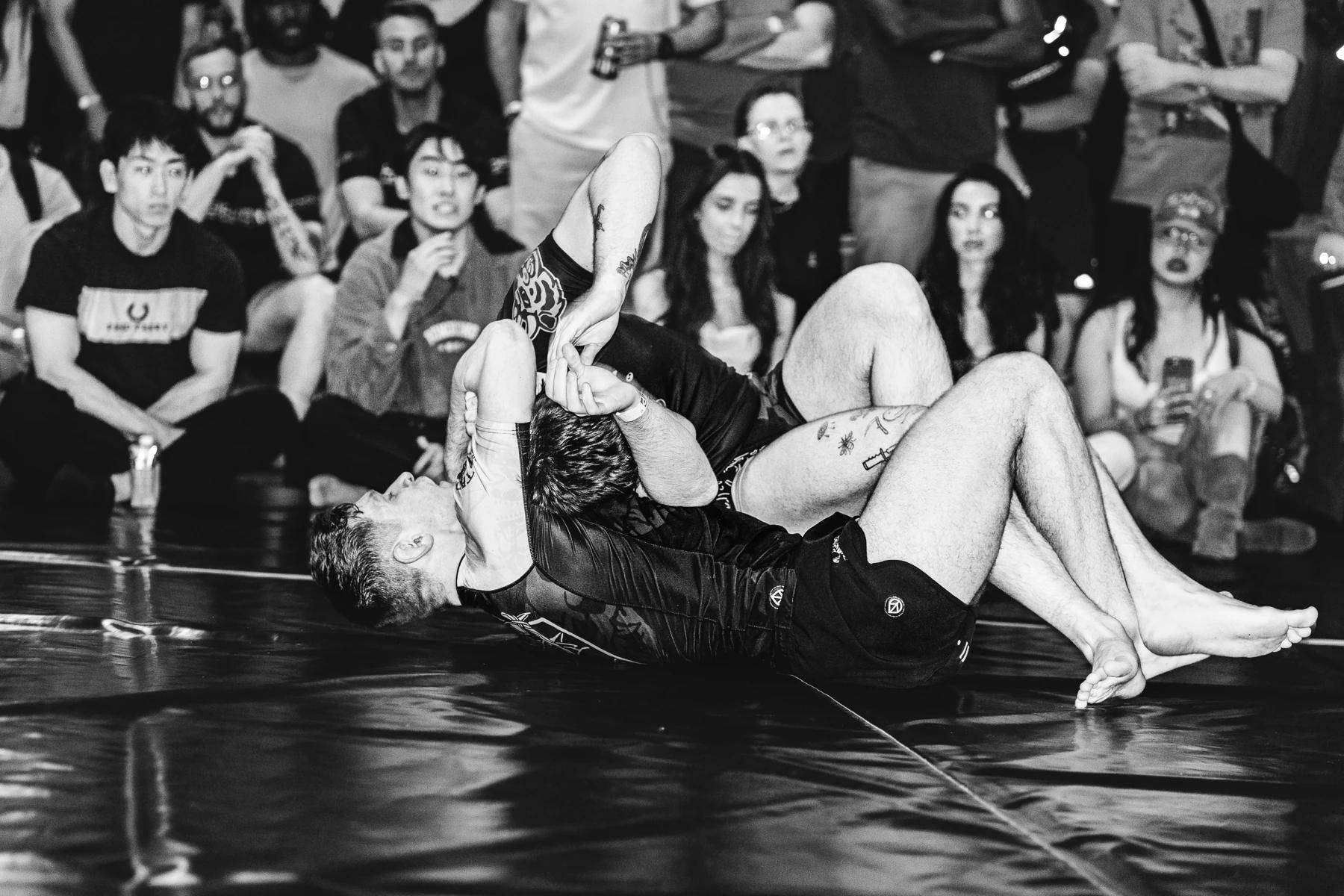
The highlight has one great advantage over the match: it already knows which bit mattered. The first-time viewer gets the whole untidy business, including a pair of trouser grips that seem to have acquired their own mortgage. It helps to have a smaller job than understanding everything at once.
Give yourself one exchange to follow. Notice the arrangement at the beginning, what each athlete changes, and the information available at the end. Then check the call and score rather than trying to squeeze all three jobs into the moment somebody moves quickly. That is an editorial viewing method, not a referee qualification.
The explorer supplies three invented Adult black belt gi timelines under the June 2024 book currently linked on the IBJJF rules page. They are complete fictional examples, with their calls expressly stated. There is no real athlete’s performance hiding behind the letters A and B, and no claim that a tool can settle a disputed broadcast.
See the exchange, then check the call
Match observation explorer
Three original hypothetical timelines. Reveal one moment at a time and compare visible movement with information that is still missing. Calls and results are stated parts of the fiction; this tool does not decide an unseen match. All complete timelines are available below, including without JavaScript.
Rule reference: A pass from guard or half guard needs three seconds’ control in side control or north–south (3.1/4.2). A side-control reversal is not a sweep (4.6). Submission: 2.1. Adult black belt gi; June 2024 IBJJF book. Calls below are fictional. Read the official linked book.
Choose a timeline to begin.
Selections stay on this page. No answers, match footage, or personal information are requested.
Read every complete timeline
A pass: the movement arrives before the confirmation
Invented Adult black belt gi match. A and B begin level at 0 points, 0 advantages, and 0 penalties. A is on top of B’s open guard. This example contains no submission, foul, interruption, or other scoring action. Clock labels are time remaining.
7:10 remaining
- Observed
- B is on their back with both legs between the two torsos. A is standing in front of those legs.
- Still to check
- The start supplies context. There is no pass to record yet.
- Confirmation supplied by the example
- The example’s scoreboard still reads A 0, B 0.
7:06 remaining
- Observed
- A clears both legs and reaches alongside B’s torso. B stays on their back; neither of A’s legs is trapped.
- Still to check
- This is the arrival. Keep watching the same exchange rather than treating this frame as the completed award.
- Confirmation supplied by the example
- No referee award or scoreboard change is supplied at this moment.
7:03 remaining
- Observed
- A has continuously controlled the same side-control arrangement since 7:06. The camera has shown the whole interval.
- Still to check
- The longer view adds evidence about continuity. It still belongs in the observation column until the call is shown.
- Confirmation supplied by the example
- The scenario has not supplied an official signal yet.
7:02 remaining
- Observed
- The camera includes the referee and scoreboard as well as the athletes.
- Still to check
- Keep the time of the action separate from the later time at which its award becomes visible.
- Confirmation supplied by the example
- Supplied referee call: A receives three pass points. Board: A 3, B 0; advantages and penalties stay 0–0.
Review: A useful note retains both 7:06, when the new arrangement appeared, and 7:02, when this example confirmed the award. A later board update does not move the original action to a later moment.
IBJJF rule reference: Articles 3.1 and 4.2. The event, athletes, times, actions, and calls here are invented for this exercise.
A reversal: the starting arrangement changes the question
A separate invented Adult black belt gi match. A leads B by 3–0, with advantages and penalties 0–0. A begins in side control, alongside B’s torso, with no leg held between B’s legs. No submission, foul, or other scoring action occurs in this passage.
6:40 remaining
- Observed
- A is on top, alongside B. B’s legs are outside A’s legs rather than forming a guard around either leg.
- Still to check
- Save the starting arrangement before following the roll. The end of an exchange cannot supply its beginning.
- Confirmation supplied by the example
- The supplied board reads A 3, B 0.
6:37 remaining
- Observed
- B bridges and turns with A. B emerges on top, alongside A’s torso.
- Still to check
- The top and bottom roles have changed. Calling the movement a reversal describes that change without assigning a score.
- Confirmation supplied by the example
- No referee award is supplied during the turn.
6:33 remaining
- Observed
- B remains on top. A separate camera view shows the referee and the board clearly.
- Still to check
- The new top position does not erase the side-control start recorded at 6:40.
- Confirmation supplied by the example
- Supplied call: no points or advantages for this reversal. Board: A 3, B 0; other categories unchanged.
6:30 remaining
- Observed
- The athletes continue from the new arrangement with B on top.
- Still to check
- You can describe an escape from the original pin and a change of roles while retaining the confirmed score.
- Confirmation supplied by the example
- This passage ends without a new award. It does not supply the eventual match winner.
Review: Compare the first and last frame, then restore the middle. “B came on top” is a useful observation. A different beginning would require a different rule question; this record keeps its actual beginning attached.
IBJJF rule reference: Article 4.6. The event, athletes, times, actions, and calls here are invented for this exercise.
An attack: the result needs its own evidence
A third invented Adult black belt gi match. B leads A by 3–0; advantages and penalties are 0–0. A begins behind B and attacks a legal collar choke. The camera initially obscures the hands. The later result is expressly supplied rather than inferred from the grip.
1:12 remaining
- Observed
- A is behind B with an arm crossing near the collar. The hands are hidden by the camera angle.
- Still to check
- The setup identifies the attack for this fictional exercise. This particular frame would not establish the exact grip by itself.
- Confirmation supplied by the example
- The supplied scoreboard reads A 0, B 3. No finish has been confirmed.
1:10 remaining
- Observed
- B brings a hand toward A’s forearm. The athletes are still moving.
- Still to check
- A hand movement alone is not enough here to label a tap. Keep watching rather than writing the ending early.
- Confirmation supplied by the example
- No stoppage or result is supplied at this moment.
1:08 remaining
- Observed
- The wider view clearly shows B tapping repeatedly on A’s arm.
- Still to check
- Record the visible tap separately from the earlier attempt. The referee and final announcement still add information.
- Confirmation supplied by the example
- This moment supplies a visible tap; the next moment supplies the official result.
1:07 remaining
- Observed
- The referee stops the action. A releases the attack and both athletes separate.
- Still to check
- Keep the ending attached to this match rather than copying the earlier points lead into a result label.
- Confirmation supplied by the example
- Supplied official result: A wins by submission. The earlier A 0, B 3 snapshot remains context.
Review: A complete record separates attempted attack, visible tap, referee stop, and announced result. It need not claim when the grip became effective or what B was feeling.
IBJJF rule reference: Article 2.1. The event, athletes, times, actions, and calls here are invented for this exercise.
Establish what the broadcast is actually showing
Before following a grip, find the event name and the division. Read whether this is gi or no-gi, and identify the actual match rather than relying on the title of a repost. A clip can begin after the important transition or finish before the official announcement. Make a note of that limit at the start; it will save you inventing a beginning later.
For IBJJF footage, use the official results archive to locate the named event and year, then check its published divisions and placings. A placing can confirm the recorded event outcome; it cannot show the action missing from a cropped match video.
Give the athletes stable labels. Their names are best when the graphic identifies them clearly. If you are making a private viewing note and cannot read the names, use a visible description that survives a camera change. Left and right will fail the first time the athletes circle. Top and bottom will fail the first time they swap roles. Keep an athlete’s identity separate from their current position.
Find the competition clock and distinguish it from the video player’s elapsed time. A useful replay note might say video 04:18, match clock 6:37 remaining. Those two references let you return to the same passage even when an introduction or an interview occupies the beginning of the recording. If the clock is absent, write that instead of estimating a precise match time.
Find the arrangement before chasing the technique name
A beginner does not need a name for every grip variation to follow a meaningful change. Start with the two bodies. Who is standing? Who is on the ground? Where are the legs between them? Has someone moved alongside the torso, or remained in front of the legs? Use the position guide when a label would help you describe that picture.
Then add a verb to the next picture. A moved around the legs. B caught a leg again. B turned and came on top. These descriptions give you a sequence you can check on a replay. A prestigious technique name adds little if it makes you miss that the opponent recovered the original arrangement a moment later.
Watch the person responding as well as the person moving. In an imagined passing exchange, the top athlete steps sideways and the bottom athlete follows with their knees. The step is visible; so is the response that prevents the picture from changing. You can follow that small contest without knowing which fashionable name belongs to either person’s preferred guard.
Give observations and confirmations separate space
Use three short headings on paper: seen, still to check, and confirmed. Under seen, describe the action without supplying a motive. Under still to check, record the missing angle, earlier position, or later signal. Under confirmed, put the information the broadcast actually supplies. Keeping an empty space is useful. It shows where the evidence stops.
For an original example, imagine the camera shows A beside B at 7:06 remaining. You can record that arrangement. You cannot reconstruct the previous ten seconds from that frame. If the next shot shows a referee signal and a changed board, record those separately. The later information can complete your note without changing what the first image showed.
This also gives commentary a sensible place. A commentator’s explanation can tell you what to replay or which rule to consult. Mark it as an explanation attributed to the commentary until you can check the relevant evidence. A confident voice can be helpful; it does not make an obscured hand visible.
Stay long enough to see what the movement becomes
The explorer’s first timeline separates arrival, continued control, and the later award. Its second restores the start of a reversal before looking at its outcome. Its third keeps an attempted attack, visible tap, stoppage, and official result in order. Open a complete timeline first, or reveal the moments gradually and notice which unanswered question the next moment resolves.
The rule note identifies the relevant IBJJF sections. Our BJJ rules guide explains the scoring system in detail. Here the job is to preserve the evidence needed to ask the right question. Do not pause at a striking image and assume everything before and after it is administrative clutter. Sometimes that clutter is exactly what distinguishes an attempt from its recorded outcome.
For a real replay, mark the start before scrubbing forward. Stop after the next stable arrangement or interruption, then describe the whole passage in one sentence. If your sentence requires an action the footage never showed, replace that claim with a question. This makes a short viewing note more useful than a long argument about an isolated screenshot.
Read the board as a separate piece of evidence
IBJJF separates points, advantages, and penalties; submission can override a points lead (Articles 2–7). The explorer supplies fictional calls. Read each category separately before describing who leads. Preserve the graphic’s own labels so someone returning to the recording can check the same information.
When a broadcast shows its board clearly, read the labels as well as the numbers. Record which athlete belongs to which row or column. A colored uniform and a colored graphic may look suggestively related; verify the graphic’s actual identity labels before attaching somebody else’s lead to the athlete you are following. If the labels are unreadable, keep that uncertainty attached to the snapshot.
Take a second look when the board returns after a replay. Note what changed and whether the broadcast included the corresponding signal or explanation. A new number confirms that the displayed board differs from your earlier snapshot. If the intervening action was off camera, it does not establish the exact reason by itself. Keep the event’s final result separate from a graphic captured earlier in the match.
Give the quiet passage a small, visible question
A period with little travel can be hard to follow because the camera gives you fewer obvious landmarks. Narrow the task. Watch whether one athlete changes a hand contact, moves a knee, or turns their hips before the larger movement. Choose something you can actually see from that angle. You do not have to announce that a battle of wills is taking place every time two people stay in the same place.
Avoid assigning a mental state to fill the silence. Tired, frightened, comfortable, and deliberately waiting are interpretations that a distant shot may not distinguish. You can say that the athlete remained in the arrangement for the passage you watched. You can say the camera hid the hands. Those statements leave room for a better angle or the athlete’s own later explanation.
Likewise, spectators need not turn a quiet exchange into their own penalty hearing. Record any actual referee intervention when it occurs. If you want to understand that decision, replay the preceding action and consult the applicable rule. Your viewing note becomes more precise when it identifies the question instead of pretending that frustration supplies the answer.
Use the replay to answer one missing connection
Solomon Dixon’s Southside Jiu Jitsu Club study guide recommends mapping positions with the clock, revisiting the setups before changes, and bringing a specific clip to a coach. Those are the narrow coaching ideas used here. This guide’s three-column notes and fictional observation timelines are original editorial exercises, rather than Southside’s prescribed study system.
Choose the missing connection before hitting replay. If the question is how B returned a leg between the bodies, watch that leg and the space it enters. If the question is whether the broadcast showed an award, watch the referee and board around that moment. Switching the question halfway through often leaves you with several interesting impressions and the same unanswered question.
Slow playback can make an order of movement easier to inspect. It cannot recover pixels outside the frame or turn a blocked view into a clean one. Return to normal speed before describing the exchange as a whole. Keep the earlier and later frames together so the replay remains a passage from a match, rather than a collection of poses selected to support your first guess.
Finish with a note another person could check
A usable final note identifies the recording, the relevant time, and the sequence you saw. Add the official information available in that recording, then the question that remains. For an original fictional note: at video 04:18, B comes on top from the earlier side-control start; the next board shot is unchanged; check the starting arrangement against the sweep definition. The note gives somebody a place to look.
Keep suggestions for your own training separate. A sequence that interests you can become a question for your instructor about a position you already practise. Watching a competition attack does not supply instruction in applying it. Bring the clip and ask which detail matters for the task your class is learning, rather than attempting to reconstruct a finish from a broadcast angle.
You can also stop at being a spectator. Follow an athlete, enjoy a scramble, and leave an unclear call unresolved. The practical standard is modest: describe the passage you saw, attach the information that confirms its recorded outcome, and say where the view ran out. That is enough to make the next match easier to follow without requiring a running commentary of your own.
Common questions
Do I need to train BJJ before watching a match?
No. Start with the athletes’ identities, the event, and the changing body arrangements. You can follow who moved where and check the displayed result while learning the vocabulary gradually. Use the position guide for unfamiliar labels instead of trying to learn every technique name during one exchange.
Why did coming on top leave the scoreboard unchanged?
Rewatch the beginning and the later call. The explorer’s reversal example supplies both so you can compare the action with the rule note. In a real recording, a final top position alone leaves too much missing to decide what happened. Use the applicable rulebook and retain any unresolved camera limit.
Can these timelines tell me who should win a real match?
No. A, B, their clock readings, and all three outcomes are invented for observation practice. The tool reveals supplied information; it does not evaluate uploaded footage, combine position values, or produce an official decision. A real event’s result needs its own verified record.
What should I do when the grip or referee is off camera?
Write down what is missing and check whether another part of the recording supplies it. If it does not, leave that point open. A short note that admits an obscured view is easier to check than an elaborate explanation built from a frame that never showed the relevant detail.
How can I follow a replay with no visible scoreboard?
Follow the changing positions and keep a sequence of visible actions using the video player’s time. Mark the score as unavailable. If the recording shows a final announcement, record that separately. A useful description of the exchange does not need an invented running score.
What should I write after a second viewing?
Add the detail that answers your original question, or say that the question remains open. Keep the first note and correct its uncertain wording. Rewatching the same exchange provides another look at one event; it does not turn that event into evidence of a repeated habit.
Sources & accuracy notes
Sources checked . These are original worked observation examples for the named division and ruleset. Read the visible action alongside the stated official indication. The tool explains selected cases; it does not score an unseen match or establish technique permission.
- IBJJF: currently linked rulebookJune 2024 rulebook, Articles 2–7; bounded examples use 3.1, 4.2, and 4.6.
- Solomon Dixon, Southside Jiu Jitsu Club: How to Study BJJ Matches Like a CoachThe academy’s published study advice supports clocked position notes, attention to setups, and a specific question for a coach.
- IBJJF official results archiveEvent/year links lead to published division placings. Those records supply result context, rather than evidence of an unseen match action. Checked November 1, 2026.
Found a factual error or a rule that has changed? Send a correction to support@letsroll.co.