
ADCC scoring: points, penalties, and the two match phases
Quick answer: ADCC combines submission victories with positional points, negative points, and referee decisions. The scoring phase depends on the event and whether the match is a final. At Worlds, an ordinary qualifying match begins with five minutes without points, while a final’s opening ten minutes can already include negative points.
The first half of an ADCC match is not always a penalty-free period. A final and an earlier tournament round can display similar positions while applying different scoring conditions. That difference becomes decisive when an athlete sits down, disengages, or tries to protect a narrow lead.
Reading the scoreboard starts with identifying the match. The World Championship, Trials, national events, and amateur divisions do not all share a clock. Once that is established, the points are easier to understand as consequences of particular actions rather than mysterious additions beside a name.
Identify the event before starting the clock
The official championship regulations give World Championship qualifying matches ten minutes of regulation. Their first five minutes are without points, followed by five with positive and negative points. A tied match can receive one five-minute overtime.
Worlds finals, absolute finals, and the superfight use twenty-minute regulation periods. Their first ten minutes have no positive points, but negative points can count. Positive and negative points operate during the second ten minutes and during the listed overtime periods.
Trials use shorter clocks: six-minute qualifying matches and eight-minute finals, with their corresponding overtime provisions. National and Open championship clocks are also listed separately. Those durations are part of the format, rather than a reason to assume every event carrying ADCC branding runs like a Worlds final.
For a replay, write the match category beside the start time. A move at minute four means something different in a six-minute qualifier than in a twenty-minute final. The elapsed time is useful only when the relevant scoring phase is attached to it.
A position must be established before it scores
The rules require a position to be established for at least three seconds, with the athlete outside submission danger, before positive points are awarded. Reaching a position and qualifying for its score are related but separate events.
That distinction explains why an apparent takedown can fail to produce an immediate number. If the athlete who lands on top is caught in a submission, the scoring condition has not been completed simply because the opponent’s back touched the mat. The threat must be resolved and the required control established.
A useful viewing habit is to continue watching after the landing. Locate the opponent’s legs and arms, check whether the new top player is defending a submission, and follow the stabilization. A short clip ending at the impact may omit the part that explains the scoreboard.
The same care applies to a rapid chain of positions. ADCC’s regulations specify how established positions and continuous transitions are treated. Counting every momentary arrival as another score will produce a personal total that the official system never awarded.
The fixed values are not the IBJJF values
A guard pass is worth three points under the stated conditions. Mount is worth two. Back control with the accepted hooks or body triangle is worth three. Knee on stomach carries two, with its own placement and control requirements.
Those numbers differ from the values many gi competitors know. In particular, bringing an automatic four-point mount or back-control expectation from IBJJF into an ADCC match can make a correct scoreboard appear wrong.
ADCC also specifies that passing directly to mount or knee on stomach awards the guard-pass points for that transition, rather than automatically accumulating every familiar position value. The precise sequence matters alongside the final position.
A compact reference helps during a replay:
Guard pass: three points when its conditions are met.
Mount: two points under the published requirements.
Back control: three points with qualifying hooks or a body triangle.
Takedowns and sweeps: two or four depending on the resulting position and control.
The ADCC introduction provides the wider tournament context. These values explain the arithmetic within that competition, rather than a universal ranking of which grappling positions matter most.
Takedowns and sweeps can have two different values
A takedown ending in guard or half guard can earn two points. A clean takedown ending beyond the guard can earn four, provided the published control, body-position, and submission-safety conditions are satisfied.
Sweeps have a similar two-or-four distinction based on where the athlete finishes and establishes control. The rules also address reversals from positions such as mount or side control. ADCC’s treatment should therefore be read directly rather than replaced with another federation’s definition of a sweep.
A hypothetical example makes the distinction visible. An athlete who reverses to the top inside the opponent’s guard is solving a different scoring condition from one who completes the movement beyond the legs with the required control. The word sweep alone does not tell the spectator which value applies.
The regulations also ask whether the change occurred in continuous motion and who initiated the action. If one athlete voluntarily attacks a submission and ends underneath, the other does not automatically receive sweep points merely for finding themselves on top. The cause of the positional change belongs in the explanation.
Guard pulling needs the entry and the phase
The negative-point provisions cover voluntarily moving from standing to a non-standing position and remaining down for three seconds or more. They also contain specific examples and exceptions involving genuine takedown attempts before a guard pull.
That makes a still image of a seated athlete insufficient evidence of a penalty. The viewer needs the entry, its duration, the preceding attempt, and the phase in which negatives are active. Omitting any of those can change the interpretation.
For a final, remember that negative points can count during the opening half even while positive points are unavailable. Waiting for the positive-scoring phase before considering penalties would miss a condition already in effect.
A competitor should clarify these details using the event’s actual instructions. The UFC BJJ comparison shows why another promotion’s requirement for immediate action after a guard pull should not be substituted here. Similar-looking entries can be governed by different language and different scoring consequences.
Passivity and disengagement can alter a narrow match
ADCC’s regulations describe negative points for disengaging, backing away, and avoiding renewed engagement. They also set out a warning process for passivity, with further penalties possible after the initial negative point.
The practical consequence is that a competitor’s lead cannot be understood only by counting positive actions. Negative points can change the margin, and the opponent may be able to win a close contest without producing the same positional sequence that created the original lead.
For viewers, follow the referee’s communication. A pause can be used to inform the athlete and coach about a negative point. That intervention is part of the match, rather than a distraction to skip because no submission happened during it.
Avoid guessing that every retreat is a penalty or every defensive action is passivity. The officials evaluate the actual conduct under the rules. A spectator can identify a possible issue and compare it with the referee’s call without turning a disagreement into an allegation about the athlete or the officiating team.
Boundaries do not give athletes permission to stop
The championship regulations describe a ten-by-ten-meter area without a cage or fence. When the exchange leaves that area, the referee can stop the action and restore an established position in the center according to the restart provisions.
The rule also tells athletes not to stop independently on leaving the area. The referee controls the interruption. That matters when a scramble crosses the visual boundary before the command arrives: an athlete assuming the exchange is over can create a new problem for themselves.
Boundary movement can also interact with penalties, particularly when a competitor repeatedly flees engagement or a submission. The location alone does not settle the issue; the action, referee instruction, and relevant provision need to be considered together.
A useful replay preserves enough surrounding mat to see where the athletes are. A tightly cropped finishing clip can hide both the boundary and the official’s signal. The match-review guide offers a method for keeping one exchange and its context together.
A tied score still has a decision procedure
Submission remains the direct route to ending the match. Without a finish, positional and negative points can determine the winner. If the relevant score remains tied, the applicable overtime and referee-decision procedures complete the format.
World Championship qualifying matches permit one five-minute overtime. The listed finals, absolute finals, and superfight can have ten-minute overtime periods, with a maximum of two. Those provisions should not be applied to a beginner bracket whose own schedule uses different durations.
The rules also identify referee selection based on dominance when the match finishes without points separating the athletes. A level display therefore does not mean the organizer has forgotten to provide a way to choose a winner.
For a personal scorecard, keep three records: the active phase, the awarded positive and negative points, and the strongest offensive exchanges if a decision becomes necessary. That is more useful than replacing the actual scoreboard with a count of every movement that looked promising.
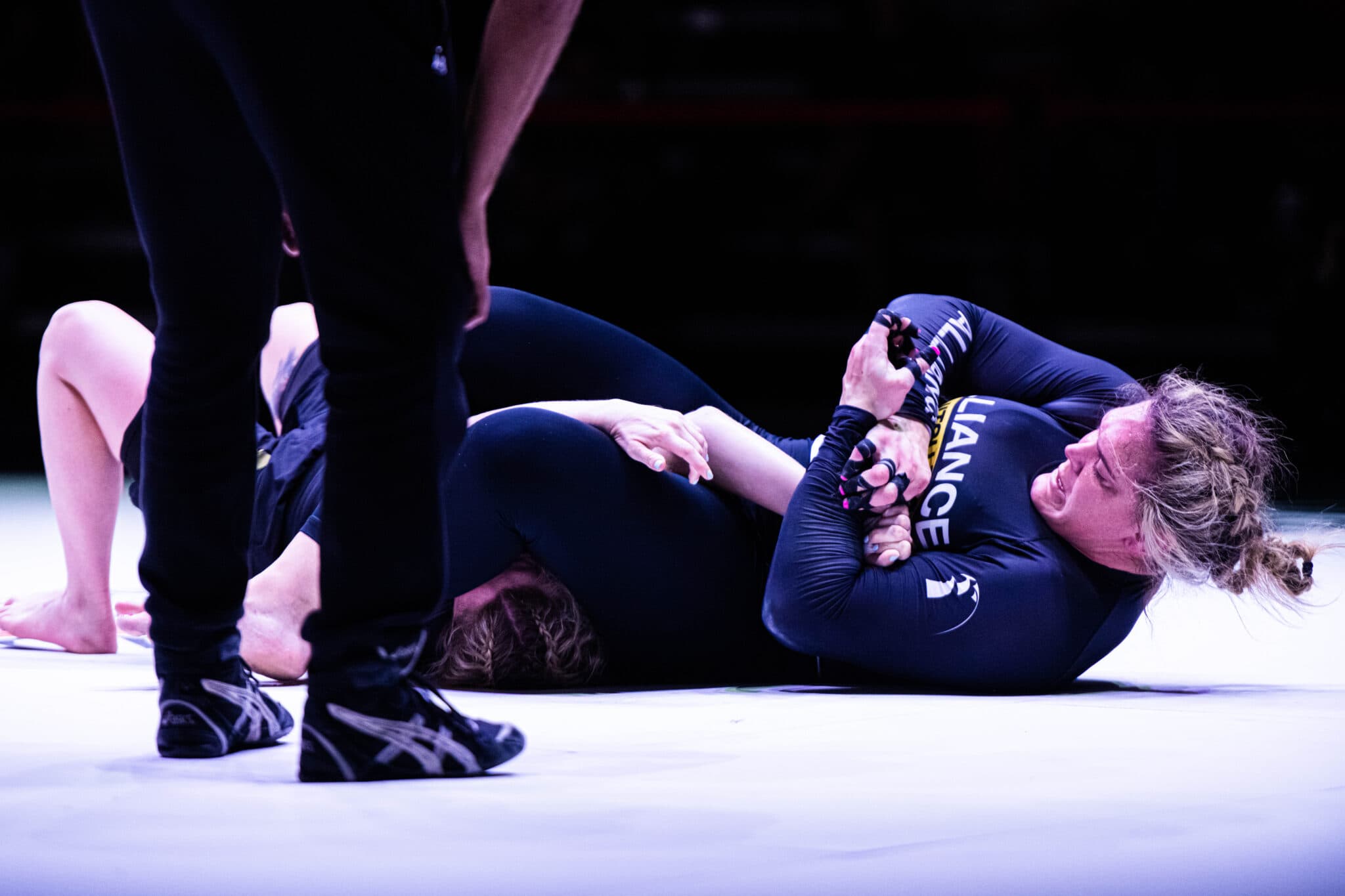
Main photo: Archive: grappling exchange at ADCC 2022 — ADCC official photo archive; photographer not identified on source page.
The takeaway
ADCC scoring becomes easier to follow when the event type, clock, and phase are identified first. Positive points require particular positions and control conditions; negative points can matter before the first positive score is available, especially in finals.
Keep the entry and continuation of an exchange together. A landing, seated position, or trip to the boundary is not a complete explanation by itself. The rules attach consequences to how the position developed and what the athlete established afterward.
Check the format before entering
Use the tournament directory to find an event, then read its division rules. Preparing for the actual clock and scoring conditions is more useful than copying the format of a favorite Worlds replay.
FAQ
Are there no points in the first half of every ADCC match? The details differ. World Championship qualifying matches begin with five minutes without points. Finals begin with ten minutes without positive points, while negative points can already count during that opening phase.
How many points is an ADCC guard pass? A qualifying guard pass earns three points. The athlete must satisfy the published establishment and submission-safety conditions. A brief arrival beyond the legs does not automatically complete those requirements.
Is mount worth four points in ADCC? No. Mount is worth two under the championship rules, while qualifying back control is worth three. Those values should not be replaced with IBJJF’s familiar four-point expectations.
Do all ADCC events use Worlds match times? No. Trials, national and Open events, and beginner or intermediate categories can have different durations. Identify the specific event and division before applying a regulation or overtime clock.

Tess Hanley
Tess Hanley reads the rulebooks, the entry fees and the fine print. When a federation or a gym changes something, her first question is who ends up paying for it.
Related Posts

Lucas “Hulk” Barbosa’s best work is in the details
Lucas Barbosa’s nickname explains the first impression. His gi world title, no-gi record, and 2022 ADCC final give viewers more to study.

João Miyao’s record deserves its own first name
João Miyao’s adult world title and 2026 Master1 results tell a distinct story, even when his brother appears beside him on the podium.

Jena Bishop made time for a second sporting life
Jena Bishop’s 2026 PFL title followed a deliberate move from championship jiu-jitsu into learning a different sport.
Comments (0)
Loading comments...