
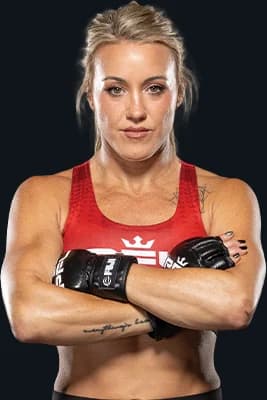
Jena Bishop made time for a second sporting life
Quick answer: Jena Bishop is a jiu-jitsu black belt under JW Wright and the 2017 adult black belt No-Gi Worlds lightweight champion. On October 16, 2026, she beat Liz Carmouche by unanimous decision to become the inaugural PFL women’s flyweight world champion. Her transition began with a decision to make time for skills her grappling titles could not supply.
In February 2021, Jena Bishop told BJJ Heroes that she had long wanted to try mixed martial arts. The difficulty was finding room for it without taking time away from jiu-jitsu. She already had a championship career in one sport, and learning another would require some of the hours that supported it.
Five years later, three judges in Chicago returned the same score: 48–47 for Bishop over Liz Carmouche. The PFL’s official report named her its first women’s flyweight world champion. A third-round rear-naked choke attempt had not finished the fight. She still won after five rounds.
The space between those two moments is the interesting part. Her jiu-jitsu remained useful throughout it. Becoming an MMA fighter also meant allowing the rest of her game time to develop.
There was already a substantial career to leave room around
Bishop did not enter MMA with an unfinished introduction to grappling. The official 2017 No-Gi Worlds results list Jena Rae Bishop first in female adult black belt lightweight, representing Gracie Humaita. Heather Raftery took silver; Karen Antunes and Michelle Nicolini occupied the bronze places.
Her competitive work also extended beyond the IBJJF. In February 2019, she won the under-60 kg division at the second ADCC North American Trials in Burbank. Nikki Sullivan finished second and Hannah Sharp third. ADCC’s results identify Bishop among the athletes who qualified for that year’s world championship.
Those achievements matter to the later decision because jiu-jitsu was already providing serious competitive work. A second sport had to fit around something real. Leaving hours for striking and wrestling meant choosing what to do with time that could otherwise have gone toward the next grappling event.
The earlier titles also remain achievements in their own right. They are part of Bishop’s sporting life before MMA, rather than preliminary qualifications whose only value appears after a later belt.
The pause created time to reconsider the schedule
In her February 2021 interview with BJJ Heroes, Bishop explained that the interruption to jiu-jitsu events during the pandemic gave her time to evaluate what she wanted. She had been helping Cat Zingano prepare for a Bellator fight and cornered her. Bishop credited their conversations with helping her decide to pursue MMA.
That account has a practical center: time became available, and a training relationship put the new sport within reach. She was not simply announcing that a successful ground game would work in a cage. She was reorganizing the work around the possibility.
I find that part more revealing than a prediction about how quickly a grappler ought to succeed. A long-established skill can make the next project possible while competing with it for attention. Keeping all the old commitments and adding several new ones would be a different decision from making room.
Bishop said she was enjoying learning and had committed to seeing how far MMA could take her. At that point, the commitment was a plan for the work ahead. The eventual title was still years away.
Her list of teachers explained what the change required
The 2021 interview named Adam Pryde for striking, Jose Cital for boxing, and Justin Flores for wrestling. Bishop continued jiu-jitsu with Johnny Faria at Alliance San Diego. She also identified Zingano and Angela Hill as encouraging figures during the transition.
The different teaching roles give the decision some shape. Bishop could arrive at a jiu-jitsu session with a world title behind her and spend another part of the week working on material that title did not cover. Expertise in one room can coexist with a large learning task in another.
That is a useful way to read her MMA career. A failed entry or a defended submission does not erase the grappling credentials. It identifies a problem inside a sport with additional ways for an opponent to respond. Wrestling toward a takedown while strikes are possible is its own task; possessing a strong position after getting there is another.
The broader transition appears elsewhere in our coverage of Mackenzie Dern. The athletes have different careers, but both invite a closer question than whether jiu-jitsu works: how does this competitor create the conditions in which it can do its work?
The 2025 semifinal required a second round of answers
Bishop’s June 2025 PFL semifinal against Ekaterina Shakalova is a useful place to see the ground game inside a longer fight. PFL’s contemporary account describes Shakalova escaping early submission attempts and surviving a first round that included positions on both sides of the exchange.
In the second, Bishop secured a takedown, reached mount, and moved to the back. The official finish was a rear-naked choke at 2:07 of that round. The result put her into the 2025 World Tournament final.
The first round belongs beside the finish. The opponent had escaped and continued working. Bishop had to reach another useful position before the choke that ended the fight became available. A single finishing image leaves out that repeated effort.
For someone arriving from jiu-jitsu, it is a recognizable tension in a different setting. Getting close to a submission creates an opportunity, but the next exchange still has to be contested. Shakalova’s escapes did not stop the eventual finish from happening. They explain why it took more than the first attempt.
Carmouche won their first final
The 2025 final ended differently. PFL’s official account records Carmouche stopping Bishop at 2:56 of the third round on August 15. Carmouche won that year’s women’s flyweight World Tournament title.
The two fights also resist a simple claim that one woman possessed the answer to the other’s grappling. Carmouche survived Bishop’s submission threats in 2025 and finished the fight with strikes. Their next meeting would give both another chance to decide where the exchanges took place and what followed from them.
That uncertainty was still present before Chicago. The earlier result supplied context for the matchup. It could not decide the rematch in advance.
The title arrived after the choke had been defended
On October 16, Bishop’s third-round rear-naked choke threatened a finish, but Carmouche survived. PFL’s report describes Bishop recovering from a difficult opening round and using her ground game through the rest of the fight. All three judges awarded her the five-round decision.
The belt was the inaugural PFL women’s flyweight world championship. Carmouche’s 2025 success had been the World Tournament title. They were successive opportunities within the promotion, with a different winner on each occasion.
The decision is a fitting result to keep in a profile of a decorated grappler. Her most valuable work did not have to end in a tap to affect the fight. Carmouche’s defense remained part of the contest through its final bell.
I would watch the rematch beyond the nearly completed choke. What does each woman have to do after that danger passes? Which positions can Bishop return to? A submission specialist’s career includes all the time between attacks, including the periods when an opponent makes finishing difficult.
A new title does not make the earlier choice simple
The PFL athlete profile identifies Bishop as a black belt under JW Wright, from St. Charles, Missouri, with Alliance San Diego as her fight camp. It lists her age as 40 in October 2026. Those facts put the championship well beyond the usual shorthand of a promising young prospect changing sports.
What her account offers is a documented choice to learn. The championship gives that choice a major later result, while leaving the years of work between them intact. It is possible to appreciate the title without pretending the destination was obvious when she began making room for it.
For readers comparing grappling and MMA, keep three questions beside the footage:
How does the fight reach the ground, and who chooses the first useful position?
What changes when the initial submission is defended?
What work continues before another attack becomes possible?
The takeaway
Jena Bishop brought a No-Gi Worlds title and an ADCC Trials victory into MMA. She also brought a public willingness to spend time learning from teachers in other parts of the sport. The 2026 PFL championship followed both the existing skill and the additional work.
Her Chicago win is worth following through the decision, including Carmouche’s escapes. Bishop’s jiu-jitsu mattered without producing the final tap. That leaves a fuller picture of the career than a finishing clip could provide.
Find the class that fits your next step
Compare schools through Let’s Roll’s gym directory and ask which program matches your current experience and the skills you want to learn.
FAQ
What did Jena Bishop win in jiu-jitsu? Her record includes the 2017 IBJJF adult black belt No-Gi Worlds lightweight title and the under-60 kg division at the second 2019 ADCC North American Trials in Burbank.
Who awarded Jena Bishop her black belt? JW Wright, according to her official PFL biography. She represented Gracie Humaita in earlier grappling results and later trained with Alliance San Diego.
Did Jena Bishop beat Liz Carmouche in 2026? Yes. She won their October 16 PFL Chicago title fight by unanimous decision, with all three judges scoring it 48–47. Carmouche had won their August 2025 World Tournament final by third-round stoppage.
Did the 2026 championship end by submission? No. Carmouche survived a third-round rear-naked choke attempt, and the fight lasted five rounds. Bishop became the inaugural PFL women’s flyweight world champion by decision.

Rafael Moura
Rafael Moura profiles competitors as people with lives outside the bracket. Some of those stories are comebacks. Most are not, and he does not force them.
Related Posts
ADCC 2026 results: the stories that survived the predictions
ADCC 2026 results from Krakow: Jaworski, Maciel, Crevar, Pena, the women's champions, and the superfight outcome, with official podiums and match context.
Xande Ribeiro: from absolute titles to the masters mat
Explore Xande Ribeiro's absolute Worlds victories, two ADCC titles, Six Blades, and the distinction between his 2022 Worlds farewell and later masters gold.
Bernardo Faria: the champion who kept asking questions
Follow Bernardo Faria from Juiz de Fora and Alliance to the 2015 Worlds and BJJ Fanatics, with context on his competition game and move into teaching.
Comments (0)
Loading comments...