
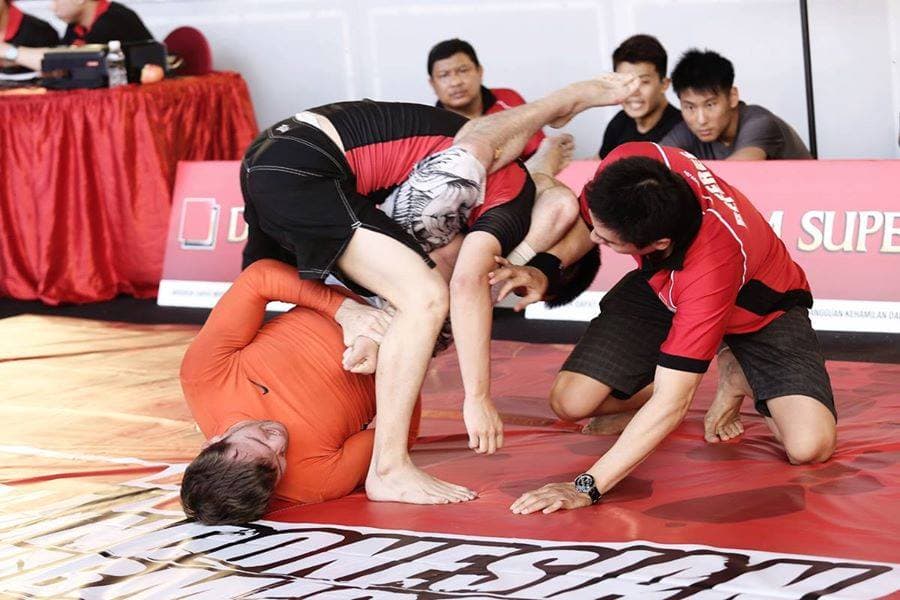
Your match video ends at the tap. Start your review earlier.
Quick answer: Watch the complete match once, then choose an exchange and work backward from its outcome. Record what the footage shows separately from what you remember or infer. Take a short, timestamped question to your coach and agree on one position to revisit in practice.
The tap is easy to find. The decision you can usefully change may be much harder to locate. If every review starts with the final submission, the answer can become another late escape while the route into the problem goes untouched.
Try treating the recording as evidence with limits. It contains actions, some visible positions and perhaps useful sound. It does not contain an explanation simply because you know how the match ended. The process below is a practical review method to adapt with your coach, not a claim that one procedure has been validated for every grappler.
Watch the sequence before diagnosing the frame
Begin with one uninterrupted viewing at normal speed. Notice where the major positional changes occur and when the pace changes. Keep the sound if it helps you understand the score or the instructions you were receiving.
Do not stop at every hand placement yet. A still image can suggest that an opening was available while concealing how quickly it disappeared. You need the movement around a frame before deciding whether it represents a choice you could reasonably have made.
After this first pass, write a short sequence in ordinary language. For a hypothetical match, that might be establishing guard, losing a sleeve, recovering a knee inside, then conceding a pass. You are making a map that will let you find the relevant exchanges again.
Mark gaps as gaps. If someone walked in front of the camera, the footage does not establish what happened behind them. Your memory may help identify a possibility, but keep that account separate. A complete-looking timeline is less useful than an honest one with an unresolved moment.
Make three different kinds of note
Separate observation, memory and interpretation. These categories can appear together without becoming the same thing. The distinction lets a coach assess how much weight to give each part of your explanation.
For example, suppose you release a collar grip just before the opponent changes position. The video may show the release clearly. You may remember tired fingers. You might interpret the release as a consequence of that fatigue. Only the first of those statements comes directly from the image.
Use a simple format:
Visible: the collar grip opens before the opponent moves past it.
Remembered: your fingers felt tired at that point.
Proposed explanation: fatigue contributed to the release.
Question: was another grip available, or had the position already changed?
This is an illustrative example, not a report of a real match. Its value is that the explanation remains open to correction. You may discover that you deliberately changed grips and then missed the next connection. A conditioning plan would not address the same problem as learning when to make that change.
Find an earlier choice without inventing a single cause
Choose one important exchange and move backward in stages. If it ended in an armbar, locate when the arm became isolated, then when the opponent established the position that made that isolation possible. Stop at a point your coach thinks you can meaningfully study.
Do not keep rewinding until the first contact becomes the explanation for everything. A match contains later decisions, adjustments and opportunities for both people. Identifying an earlier problem does not prove that the eventual result was inevitable from that point.
The useful distinction may be between not knowing an answer and not recognizing the moment to use it. You can know a technique in a familiar drill and fail to identify its starting conditions in a match. Ask your coach whether the review suggests a missing option, a missed cue, or an execution problem.
Keep the question tied to the clip. If the important grip is hidden, say which parts remain uncertain. You can reconstruct possibilities in training without deciding that the most convincing reconstruction is definitely what happened on competition day.
Include the exchanges that worked
A review made only of mistakes can lose information about how you reached useful positions. Record a successful entry or recovery along with the failures. Then continue watching long enough to see what you did with the improvement.
Suppose you complete a sweep and immediately allow the opponent to establish a comfortable guard. The sweep worked. The transition afterward needs a separate question. Describing the whole exchange as bad jiu-jitsu would hide the difference between those two tasks.
A win deserves the same scrutiny. Repeatedly escaping a position before eventually finding a submission does not make the recurring position irrelevant. A loss likewise does not erase an entry that you executed as intended. Keep the outcome and the particular decisions on separate lines.
You do not have to find an equal number of positives and negatives. This is not a balance exercise for its own sake. Record what affected the match, including useful actions you might want to reproduce and successful outcomes that depended on a recovery you would rather not need again.
Ask what the quiet stretch was waiting for
A long period without a score or submission can still contain decisions worth reviewing. Look at the contact each person keeps, the positions they decline to enter, and whether either athlete changes the available space.
Then add the match context you can verify. Were you ahead or behind? How much time remained? Which rules applied? If the video cannot establish those facts, use reliable event information or your coach's notes instead of estimating from the eventual result.
A pause does not by itself prove deliberate stalling, fear or exhaustion. It might reflect a planned wait for a response, uncertainty about the next step, or a detail the camera cannot show. Describe the observable action before assigning a reason.
This can give you a better question than asking how to be more aggressive. Perhaps you maintained a position without identifying a next action. Perhaps a useful opening appeared and closed before you reacted. Those are narrower problems that can be discussed and recreated. A verdict about your personality cannot be drilled in the same way.
Give your coach enough context to disagree with you
Send the complete recording if requested and identify a small number of timestamps. Include the event, division and ruleset, then state the question you want help with. Keep the lead-in to the exchange rather than cutting directly to the difficult final position.
Jeff Meszaros recommends reviewing recorded matches with students in his 2018 Grapplearts tournament-coaching article. The suggestion is useful here because you and the coach bring different information: you can describe your intention while the coach compares it with the action.
Present your explanation as an explanation to examine. If you have already decided that a lack of strength caused the loss, you may overlook a positional answer the coach can identify. Ask what evidence would support or weaken your first interpretation.
Agree on the review arrangements too. A short question after class and a detailed analysis session are different requests. Find out when the coach has time, what format they prefer, and whether a longer review needs booking. The length of the video is not necessarily the amount of work involved in answering it.
Recreate the decision, then test the explanation
Choose a starting position with the coach's help. Begin early enough that the relevant choice is still available, while keeping the exercise close enough to the exchange that you can encounter the problem repeatedly. Use a willing partner and a clearly agreed task.
Change one useful detail before changing several. If you suspect a grip change created the opening, ask how to hold the other conditions reasonably steady while comparing options. This is a practical way to investigate your explanation, not a controlled scientific experiment that proves a universal rule.
Stephan Kesting's account of developing his omoplata material revisits old competition footage and identifies control details he would handle differently. It illustrates the modest value of keeping an exchange available for another look. The recording supplies something to examine; it does not perform the correction for you.
Use the drilling guide to frame the follow-up with your instructor. A correction that works in one cooperative attempt is an initial result. Ask how to explore it under suitable resistance and later in ordinary rounds without treating the first successful repetition as a finished answer.
Finish with an assignment you can find again
Keep the timestamp, your current interpretation and the agreed practice task together. A training journal can hold those three details without becoming a transcript of the match. Include an uncertainty if it would change the next step.
For instance, your note might say that the camera does not show the far-hand grip, so the coach wants to compare two possible starting arrangements. That is enough to begin the next conversation. There is no benefit in making the note sound more certain than the evidence.
After practicing, return to the clip once. Ask whether the new work changes how you understand the original exchange. If the explanation no longer fits, revise it. You are trying to choose better practice, not protect the first diagnosis because you wrote it down.
Leave the other questions available for later. A match can produce more observations than you can sensibly address in one week. Choose the next assignment with your coach, and keep the rest in a short list rather than carrying an entire review into every round.
Main photo: Grapplearts / How to Coach at BJJ Tournaments.
The takeaway
A useful review separates the result from the decisions that produced it. Watch the sequence, distinguish visible evidence from memory, and identify one exchange worth discussing. Wins contain questions too, and a hidden grip should remain unknown until you have a sound basis for saying more.
Finish with a timestamp and a practice task agreed with your coach. If the follow-up exposes a weakness in your explanation, change the explanation. The point of keeping the recording is that you can return to the evidence when your understanding improves.
Plan the next test deliberately
Browse upcoming tournaments when you are ready to consider another event. Confirm its rules and entry terms, and discuss what you want to test with your coach.
FAQ
Should I review a loss immediately? You can record a few factual notes while you remember them, then choose a time when you can watch carefully. This method does not require an immediate review or a fixed waiting period.
Do I need paid video-analysis software? The process here needs a player, timestamps and notes. Additional software may help with sharing or organizing clips, but choose it for a specific task rather than assuming it supplies the analysis.
What if I remember something the camera cannot show? Record it as a memory and explain the limitation. It may help your coach consider possibilities, but it should not quietly become visible proof of a grip, intention or cause.
How many corrections should I take into training? Start with one manageable assignment agreed with your coach. Keep the other questions for later so the review gives the next session a clear task rather than several competing instructions.

Nina Okada
Nina Okada explains positions the way a good training partner does: one problem at a time, with the limits of the explanation said out loud. She is careful about the difference between what footage shows and what it only suggests.
Related Posts
Demian Maia made the route to the back worth watching
Demian Maia won ADCC gold and challenged for two UFC titles. Revisit his routes to the back, major submissions, and the fights that tested his grappling.
ADCC 2026 results: the stories that survived the predictions
ADCC 2026 results from Krakow: Jaworski, Maciel, Crevar, Pena, the women's champions, and the superfight outcome, with official podiums and match context.
Xande Ribeiro: from absolute titles to the masters mat
Explore Xande Ribeiro's absolute Worlds victories, two ADCC titles, Six Blades, and the distinction between his 2022 Worlds farewell and later masters gold.
Comments (0)
Loading comments...