
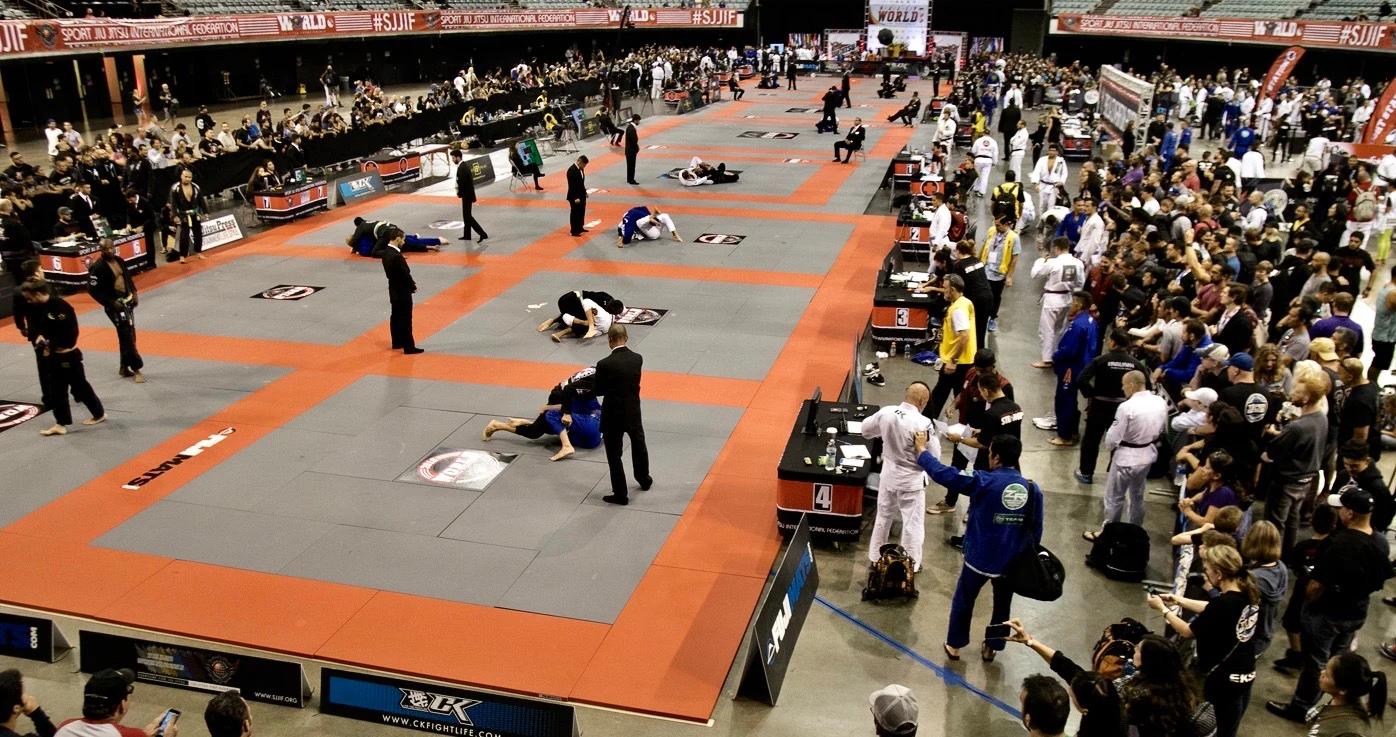
SJJIF overtime starts when the score is tied
Quick answer: The standard SJJIF rules send a tied score into sudden death. An awarded score or submission ends the extension, and a negative point against one athlete can also decide it. Check which rules your event is running before you rehearse the last minute.
A 2–2 score sends you back to work after the horn in standard SJJIF competition. Imagine your coach saw you nearly pass twice. Their account gives you something to discuss at practice. The referee restarts the tied match after regulation. SJJIF rulebook, articles 42 and 46
The detail I’d work on first is the restart. You’ve spent the last part of the match in a position you recognize, watching the remaining seconds. Now you have another exchange to manage and a penalty can settle it. It helps to have one action you can start on a signal.
Read the heading on the event entry
The Sport Jiu-Jitsu International Federation publishes its standard rules alongside separate documents for invitational and submission-only events. The title matters because a federation name can appear on several formats. On the 2026 Tokyo No-Gi Worlds listing, the organizer identifies the championship and publishes event-specific information alongside the entry. That is the place to begin if you are checking a particular tournament. SJJIF rules and event formats · 2026 Tokyo No-Gi Worlds listing
I’d copy the event name and link into the team chat before asking everyone to look at the overtime section. That prevents a well-meaning teammate from answering with the rules from a different bracket. Make the question specific enough to resolve in one exchange. Ask which rule document controls your division and whether the event publishes any exceptions.
This is especially useful if you compete several times a year. The habit you’ve practiced most recently can feel like the default. Keep a short note for each event with the rule version, age and belt division, and the parts you actually needed to ask about. Carry that note forward as a starting point for the next event.
A near pass can change the match without moving the board
In standard SJJIF competition, an almost-scored action earns no advantage. An eligible guard pass earns three points when the athlete controls the position past guard for the required three seconds. The rule gives you something specific to track when both competitors end up sideways and everyone around the mat has a different opinion. SJJIF rulebook, articles 42.4 and 42.9
Take a hypothetical last exchange. You clear the legs, then your opponent recovers a knee between you before you have stable control. A coach can recognize the entry and still want you to finish it differently next time. Record those as separate observations. Which part of the attack opened the route? Which contact did you lose before you could settle?
That distinction gives both partners a practical job. The attacker has to describe the position they were trying to secure, and the defender can explain what allowed them back inside. A video can help if both athletes have agreed to recording. Even a brief description after the round gives a coach more to work with than a debate about who looked busier.
Follow the referee into the extension
Article 46.6 provides for a referee-directed restart when regulation ends level. The extension has no fixed duration in the standard text. The first points award or submission ends it. A negative point against a single competitor ends it in favor of the other, and the book provides separate instructions for penalties against both. SJJIF rulebook, article 46.6
For an imaginary 0–0 match, picture a competitor making a promising entry in overtime and coming back to neutral. Wait for the signal. A hand touching the mat or a knee coming free can make the exchange look decisive from across the room. Your job as an athlete is to follow the referee and continue grappling until they stop the match.
It can help to rehearse the interruption in training. Have the coach stop a short scenario, give a clear reset instruction, and wait until both people are ready. Give yourself the time you are told to take. You want to recognize the restart as part of the match instead of responding to an imaginary countdown in your head.
Give the first exchange a manageable job
An overtime practice round can start with one choice. If the coach starts you standing, decide what first contact helps you begin the attack you already know. If the session is built around a ground position, identify the first connection you need before advancing. The coach can choose a version that fits the group’s experience.
Try this with a partner who knows the aim. You can have one round where you spend the opening exchange taking and losing grips, and another where you pick a simple entry and follow it through. Afterward, talk about which cue helped you act with control. The practice has done its job if you can point to a decision you made.
Leave the winner of that drill out of the feedback at first. Ask when the intended action began, where the opponent had room to respond, and how you could tell that a position was secure. If a move went wrong, rebuild only the part that caused the problem. You’ll learn more from a repeatable first step than from inventing a whole new game five days before a tournament.
Make the corner’s call short enough to hear
A corner can spend a match calling the name of a favorite sweep. In a tight extension, an instruction tied to the next decision is easier to use. Agree on a word for the grip you want, or a short cue for the direction you’re trying to take the match. Ask your coach to leave you room to hear the official.
Before the event, rehearse what the corner should do at the break. The athlete may need the score confirmed, a useful breath, and a clear instruction. Several people offering five different versions of the same plan can turn that short break into an argument you’re supposed to resolve while standing on the mat.
If you’re watching from the stands, use the match viewing guide to keep a simple record of the exchange. Note the score at the horn, the referee’s restart, and the action that earned the ending. Write down anything you missed as a question to check later. The timing of a whistle or signal is often easier to see from another angle.
Put two endings beside each other in practice
Give your coach two situations to run from the same starting position. In the first, there’s a small lead to protect through the end of regulation. In the second, the official has called a restart after a tie. Ask the observer to watch the athlete’s first choice in both rounds. Does the same grip lead into an attack in one version and slow the action in the other? That gives the group a precise point to discuss.
A teammate can play the table’s role with a timer and paper scoreboard. Agree on what each number represents before the round. Have the coach explain why a call changed the situation while the exchange is still fresh. You can then repeat that same thirty seconds with the athletes switching roles. The athlete who just defended gets a chance to see the same opening from the other side.
Keep the regulation and extension notes on separate lines. If you record only the final outcome, you lose the decisions that set up the restart. Add one detail about how the athletes got back to work after the break. That is often a better cue to rehearse than the name of the move that ended the example.
Practice the actual ending you’ll face
Plan one short rehearsal with a coach who can explain what you are practicing. The drill can be cooperative at first. A clean start and a clearly defined finish give everyone more information than a hard round with a complicated scoring argument afterward.
Agree on the position and the action that will end the example.
Let the coach signal the start and confirm the scoring outcome.
Ask the observer to describe the action before judging the result.
Change one condition for the next round and check what that changes.
Set the amount of resistance together. If someone is learning an entry, the useful task might be to recognize the opening and stop there. Experienced competitors can ask for a more contested version with the same clear instructions. An event-specific round works best when both partners know which parts belong to the tournament rules and which parts the coach has chosen for practice.
The takeaway
A tie in standard SJJIF competition leads to another exchange. A strong attack in regulation can give you something to build on even when the board remains level. Prepare for the restart and keep track of when the referee recognizes a completed action.
Match your practice to the rules of your event and the experience of your partners. One scenario with a clear signal and a specific scoring action is enough to make the end of a close match feel more familiar.
Check the rule set for your next event
Browse upcoming tournaments and follow the organizer’s link to confirm the format for your division.
FAQ
Does the SJJIF use advantage points? The standard rulebook uses points and penalties without an advantage score.
What happens at 2–2 when regulation ends? A tied scoreboard sends a standard match to sudden death under article 46.6.
Can an overtime penalty end the match? Yes. The rule covers a negative point against one competitor and separately addresses penalties against both.
Do SJJIF submission-only events use the same overtime? The federation provides a separate rule document for that format. Check the one linked by your organizer.

Tess Hanley
Tess Hanley reads the rulebooks, the entry fees and the fine print. When a federation or a gym changes something, her first question is who ends up paying for it.
Related Posts
ADCC 2026 results: the stories that survived the predictions
ADCC 2026 results from Krakow: Jaworski, Maciel, Crevar, Pena, the women's champions, and the superfight outcome, with official podiums and match context.
Xande Ribeiro: from absolute titles to the masters mat
Explore Xande Ribeiro's absolute Worlds victories, two ADCC titles, Six Blades, and the distinction between his 2022 Worlds farewell and later masters gold.
Bernardo Faria: the champion who kept asking questions
Follow Bernardo Faria from Juiz de Fora and Alliance to the 2015 Worlds and BJJ Fanatics, with context on his competition game and move into teaching.
Comments (0)
Loading comments...