
Bernardo Faria: the champion who kept asking questions
Quick answer: Bernardo Faria is an IBJJF world champion, a 2022 Hall of Fame inductee, and a co-founder of BJJ Fanatics. His competition career is closely associated with half guard and pressure passing, while his later work has helped bring many different instructors to an online audience. His example is useful for students who want a focused game without treating curiosity as a distraction.
Bernardo Faria can occupy two very different places in a grappler's memory. One is the competitor working through a difficult guard. The other is the person helping another instructor explain something to a camera. A newer student may encounter the second version long before discovering the first.
The connection matters. Faria's record gives his teaching credibility, but his role in an instructional business does something different: it makes room for knowledge beyond his own preferred game. That combination is more interesting than a title count attached to another video thumbnail.
The path from Juiz de Fora ran through other teachers
BJJ Heroes' biography places Faria's upbringing and early training in Juiz de Fora, Brazil. He began BJJ in 2001 under Ricardo Marques, the instructor who awarded him his black belt. In 2009 he moved to São Paulo to train with Alliance under Fabio Gurgel, with Marques's support.
Those relationships belong in the profile because an athlete's name can eventually become larger than the rooms that developed him. Faria did not begin as the recognizable person attached to an instructional company. He was a student deciding where to train and how seriously to pursue competition.
There is no need to turn that move into a rule for everyone else. A young competitor seeking a professional career and an adult fitting BJJ around a job have different decisions to make. The useful point is that changing an environment can be discussed openly with the people who helped you start.
For someone researching Faria now, keep the teachers in the frame. Ricardo Marques and Fabio Gurgel are part of the explanation for his development. A biography that jumps straight from a hometown to a world podium leaves out the daily setting in which the athlete learned to work.
The 2015 Worlds put his best-known season into focus
Faria won the super-heavyweight and absolute divisions at the 2015 Worlds. BJJ Heroes' event results record an 8–2 win over João Gabriel Rocha in the weight-class final. In the absolute bracket, they list submission wins over Roberto Alencar, Erberth Santos and Leandro Lo before the final.
That final did not take place as a contested match: Alexander Trans withdrew through injury. Faria received the absolute title by walkover. The circumstances belong beside the result, without diminishing the matches he had already won to reach it.
A reader looking for a starting point can use that tournament to understand why Faria's reputation extends beyond instructional videos. There are different kinds of outcomes within the same successful weekend: submissions along the way, a points win in one final, and an injury withdrawal in the other.
The IBJJF's own later profile calls him a four-time world champion. Some promotional biographies use a different total. Here, the named tournament results and the federation's description do the work. The 2015 double gold is a substantial achievement without adding an uncertain title to the sentence.
A familiar game can still contain difficult decisions
In a 2017 interview with Stephan Kesting, Faria explained how his half guard and over-under passing fitted together. Coming up from his preferred bottom positions could put him near the passing position he wanted. He also described spending years learning ways to reach that pass from different guards.
That is the part to notice before reducing his style to a short list of moves. Recognizing a preferred destination is easy. Reaching it against someone who knows what you want is the demanding work.
A student can borrow the idea of connection without copying every grip. Look at where your sweep actually leaves you. If you routinely come on top with your legs entangled, but only practice a pass that starts from standing at a distance, there is a missing part between the two lessons.
Our half-guard introduction provides a starting vocabulary for that position. Faria's career offers a different kind of study: how a competitor can keep returning to familiar territory while opponents present new problems. The value is in the decisions that make the return possible, not merely in recognizing the name of the guard.
BJJ Fanatics changed the scale of his teaching work
The company's 2019 account of its beginnings names Faria alongside Michael Zenga and Michael Reardon in the development of BJJ Fanatics. That business added another setting for his work, beyond the class and the tournament mat.
Recorded instruction has a different kind of reach from a seminar. A student can replay an explanation after forgetting it, stop at a detail, or compare the lesson with what happened in training. The recording is also limited: it cannot see the student's elbow drifting out of position unless somebody in the room notices.
That tension is part of Faria's second career. A company can make more teaching available, but availability does not decide what a student should practice on Tuesday. A large library can be useful and still require restraint from the person browsing it.
There is a simple test for an instructional purchase. Before buying, write the problem you want it to address. If the answer is merely that the instructor is famous or the discount expires tonight, pause. You may enjoy owning the material, but that is a different aim from solving a specific difficulty in your training.
Being the learner can make the explanation better
An instructional demonstration has at least two jobs. It must show the movement, and it must make the movement understandable to somebody who cannot ask a question in that moment. The second job is easy to underestimate when both people on screen already know the position.
The partner receiving the technique can help expose what the viewer needs to see. Where is the pressure going? Which grip stops a particular escape? What happens when the defender makes the obvious response? Those questions can be useful even when the person asking them is an accomplished black belt.
That is a productive way to think about Faria's place in a teaching business featuring other instructors. Expertise does not require acting as if every explanation is already obvious. Leaving room for another person's specialty can make the lesson more useful to the student at home.
Bring that attitude into your own class. If the demonstration skipped the point where you usually get stuck, ask about that point. Keep the question short enough for the coach to answer and relevant enough that your partner can use the reply. You do not need to perform confusion, or perform knowledge. You need the missing detail.
His later advice leaves room for a changing schedule
In the IBJJF's December 2023 interview, Faria discussed balancing training with his academy, BJJ Fanatics and family commitments. He emphasized maintaining some involvement in training even when the amount varied. The federation also records his Hall of Fame induction at the 2022 Worlds.
That perspective is useful precisely because it comes after a major competitive career. The timetable that supports a world-title campaign does not have to be the timetable for every later stage of a person's life.
For a recreational student, the practical question is what you can repeat. Two classes that fit your working week may be a better arrangement than an ambitious plan you abandon after the first late meeting. If your situation changes, adjust the arrangement with your coach instead of treating the change as a verdict on how much you care about BJJ.
None of this requires training through illness or injury. Sometimes a break is the appropriate choice. Faria's comments are best read as his view on staying connected to the sport, not a medical instruction or a demand that every person maintain uninterrupted attendance.
Study one useful connection before buying another system
A practical way to approach Faria's material is to choose one transition you already encounter. Perhaps your half-guard sweep works in drilling, but your partner recovers before you establish a passing position. That is a specific assignment for your next lesson or practice session.
Keep the experiment small:
Identify the exact point where you lose the connection between bottom and top.
Watch the relevant explanation and note the starting position, rather than collecting every variation.
Ask a willing partner and your coach to help you practice that part at an appropriate pace.
Return to the lesson with a question based on what actually happened.
You may discover that the problem comes before the move you thought you needed. Your first grip might be wrong, or the practice partner may be reacting in a way the selected clip does not cover. That is useful information, even if it means returning to a simpler lesson.
The same approach works when studying a competitor whose style looks nothing like yours. Take a manageable piece of the problem, test your understanding, and let your coach help place it in your training. A famous name can point you toward material. It cannot do the practice for you.
Our guide to learning from BJJ instructionals develops that study process, from choosing material to testing a detail with your coach.
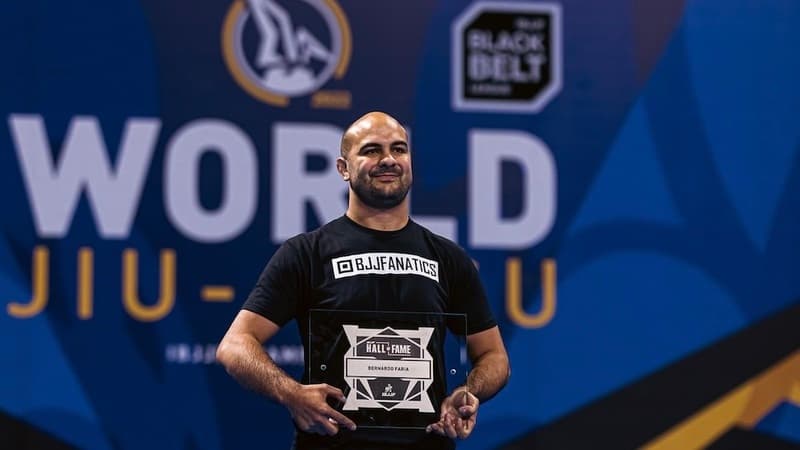
Main photo: IBJJF: Bernardo Faria with his Hall of Fame award.
The takeaway
Faria's career contains a world-class competitor and a substantial second act in teaching. His 2015 Worlds performance is a clear place to begin understanding the first. BJJ Fanatics and his later comments about fitting training around other responsibilities help explain the second.
For the student, the useful connection is between focused practice and continued curiosity. Choose something specific to work on, but remain willing to hear another explanation when the first one does not solve your problem. There is plenty to study before adding another course to the queue.
Put the lesson into a regular class
Use the gym directory to find instruction and training partners who can help you turn a useful idea into practice.
FAQ
Who gave Bernardo Faria his black belt? Ricardo Marques is identified as Faria's black-belt instructor. Faria later trained extensively with Fabio Gurgel at Alliance in São Paulo.
What did Bernardo Faria win at the 2015 Worlds? He won super-heavyweight and absolute gold. His weight-class final was an 8–2 points victory over João Gabriel Rocha; the absolute final was a walkover after Alexander Trans withdrew through injury.
Is Bernardo Faria connected to BJJ Fanatics? Yes. He is a co-founder, and the company's published origin story also names Michael Zenga and Michael Reardon. His work there extends beyond teaching only his own competition game.
Does learning from Faria mean copying his entire style? No. You can study a particular connection, such as the transition from a sweep to a passing position, and decide with your coach how it fits your existing training.
Related Posts

Training with women in BJJ: listen before you roll
Be a better BJJ training partner with women: agree on intensity, provide honest resistance, ask before coaching or filming, and respect a declined round.
Bia Mesquita: the grappling record behind the MMA newcomer
Follow Bia Mesquita's path from 2014 Worlds double gold and a 2017 ADCC title to her 2025–2026 UFC results, with dated sources and match context.
Ffion Davies: winning across gi and no-gi
Explore Ffion Davies's 2022–2023 championship results, from gi Worlds and ADCC gold to a World No-Gi double, with context for the matches behind the medals.
Comments (0)
Loading comments...