
Xande Ribeiro: from absolute titles to the masters mat
Quick answer: Alexandre “Xande” Ribeiro is a seven-time IBJJF world champion and a two-time ADCC champion. His career includes absolute titles against Roger Gracie, years of teaching, and the founding of Six Blades. His 2022 farewell to the Worlds was followed by a 2025 European title in the master 3 heavyweight division, a useful reminder that an athlete can change competitive settings without leaving the sport.
At the 2022 Worlds, Xande Ribeiro left his black belt on the mat after losing to Harryson Pereira. The IBJJF's report described the gesture as his retirement from that championship. It was a visible ending to one part of a career, with a room full of people able to recognize what the belt meant.
Three years later, his name appeared at the top of a different results list. The 2025 Europeans recorded him as the master 3 black-belt heavyweight champion. Put those two events beside each other and the biography becomes more interesting than a simple sequence of wins followed by retirement.
Manaus and Rio supplied the first training rooms
BJJ Heroes' biography places Ribeiro's childhood in Manaus, Brazil, where he began training with the Monteiro brothers at ten. He moved to Rio de Janeiro at eighteen to study law and continued training at Royler Gracie's academy. His brother Saulo led his black-belt promotion in March 2001.
The family connection is well known, but it should not flatten the two brothers into a single athlete. Saulo and Xande have separate competition histories and teaching work. Following Xande's career means looking at his own decisions and brackets, even when the people around him are part of the same family story.
The move to Rio also gives a young athlete's biography a concrete setting. There was a course of study alongside the training room. A later professional career can make everything before it look inevitable; at the time, the person still had choices to make.
Two absolute finals put him across from Roger Gracie
Ribeiro won the Worlds absolute division in 2006 and again in 2008, defeating Roger Gracie in both finals. The BJJ Heroes match record lists the first result on advantages after a 4–4 points score, and the second as a 4–2 points win.
Those are matches worth returning to in full. The absolute bracket puts athletes from different weight divisions into the same competition, and these two finals connect Ribeiro's record with another major figure of the era. A result line is enough to identify the meetings; watching them is a separate task.
When you do watch, keep the score and remaining time in view. Ask what each athlete needs at that point in the match. A grip exchange near the end can have a different purpose from one near the beginning, even when the body positions look familiar.
It is tempting to turn a pair of finals into a permanent ranking of two people. That is less useful than studying the actual contests. Ribeiro won those meetings under their rules on those days. The opponents' other achievements remain part of why the matches deserve attention.
The ADCC titles belong to a separate part of the record
The official 2007 ADCC results list Ribeiro first at under 99kg, followed by Braulio Estima and Robert Drysdale. Two years later, the 2009 results again place him first in that division, with Gerard Rinaldi second and Vinny Magalhães third. He also took absolute silver in 2009.
That gives the no-gi career its own major achievements. Ribeiro's reputation cannot be explained only by what he accomplished while wearing a gi, or only by one memorable match against Roger.
For a newer viewer, compare the settings before comparing the movements. Clothing grips available in a gi match are absent at ADCC. The scoring framework also belongs to its own ruleset. Our gi and no-gi guide provides the basic distinction without asking you to choose one as the only legitimate form of training.
ADCC later included Ribeiro in its Hall of Fame. Its official channel announced him as part of the 2024 class. That recognition looks backward at a completed body of work; the older matches remain useful for seeing how the results were produced.
Watch the quiet parts of a match as well as the finish
A submission clip is a convenient introduction to an athlete. It is a poor substitute for the exchanges that made the submission possible. When studying Ribeiro, leave the video running through the attempts that do not immediately turn into an attack.
Look at what the person underneath preserves when the passer changes direction. Notice when an athlete can create enough room to move and when they have to settle for preventing the next advance. These are viewing questions, not a claim that every defensive exchange has one universal answer.
Then watch how the position changes after the immediate danger has passed. Can the defender begin building an attack, or are they still occupied with recovering a workable guard? The transition between those jobs is easy to miss if you skip directly to the finish.
Bring one observation to class rather than announcing that you have discovered a complete new system. Ask your coach to explain the position you saw and whether it fits your current experience. A champion's footage can raise a good question without supplying a technique you should attempt at full speed the same night.
Six Blades made the teaching work visible in another form
The Six Blades Association's mission page dates its founding under Ribeiro to 2020 and identifies Austin, Texas, as its headquarters. It names six values represented by the blades: family, respect, honor, loyalty, attitude and discipline.
A list of values is an academy's statement of intent. The interesting part for a prospective student is how those ideas appear in a normal class. Respect has a practical form when a training partner hears a request to reduce the pace. Discipline has one when an experienced student practices the assigned exercise instead of turning every repetition into a contest.
Those examples are ways to assess a room, rather than a claim that we have audited every Six Blades branch. An association can share a name and teaching influences while individual classes still depend on the instructors and students present.
If you are considering training at an affiliated academy, ask who teaches the class you can attend and how newcomers join it. The founder's record is part of the school's history. Your experience will also depend on the ordinary lesson, the available partners and whether the timetable works for you.
The 2022 farewell had a specific meaning
The IBJJF's 2022 Worlds recap says Ribeiro had announced that the event would be his final World Championship. It records his heavyweight match with Pereira and the belt left on the mat afterward. The same report describes him as a seven-time world champion and an IBJJF Hall of Fame member.
A final match does not have to resemble a career highlight to carry meaning. Losing that day did not remove the earlier titles. Nor did the earlier titles guarantee a different result in the final appearance. Both facts can remain in the story without forcing the ending into a victory montage.
The wording matters here because the farewell was to the Worlds. It should not be casually expanded into a claim that Ribeiro promised never to enter any grappling competition again. A specific decision can be meaningful without making it larger than the athlete announced.
The 2025 Europeans offered a different bracket
The official European results for 2025 list Alexandre Couceiro Ribeiro of Six Blades first in male master 3 black-belt heavyweight. Vinicius de Castro Nascimento is listed second, with Newton Dias Casemiro and Wojciech Mieczyslaw Bak in the bronze positions.
That result belongs to a masters division. It is not an additional adult world title, and describing it accurately does not make it uninteresting. It shows the athlete returning to a competitive setting suited to a different stage of the record.
For recreational competitors, there is a useful distinction between stopping one kind of competition and deciding that competition has no place in your future. You may change how often you enter, which events you choose, or how much of your weekly training revolves around them.
Ribeiro's decisions do not prescribe yours. They simply make the range of possibilities visible. A person can keep teaching, continue learning and enter a later bracket without pretending to be at the same point in life as they were during an earlier title campaign.
Choose a few reference points and watch carefully
You do not need to consume a whole career to begin understanding it. Pick material with a clear date and purpose. A manageable starting list is:
The 2006 and 2008 absolute finals against Roger Gracie, viewed with attention to the score and time.
The 2007 and 2009 ADCC campaigns, kept separate from the gi championship record.
The 2022 Worlds farewell and the 2025 European masters result, which show different later chapters.
The first two entries are for studying competition. The last is for understanding the shape of a long involvement in the sport. Neither requires a claim that one athlete solved every problem or should be copied by every student.
After watching, write down one question you can ask in training. Keep it attached to a position or decision you actually saw. A useful conversation with your coach can begin with a few seconds of footage, provided you have watched enough around those seconds to understand the situation.
Our instructional-study guide offers a way to keep one useful question from disappearing into a much larger video queue.
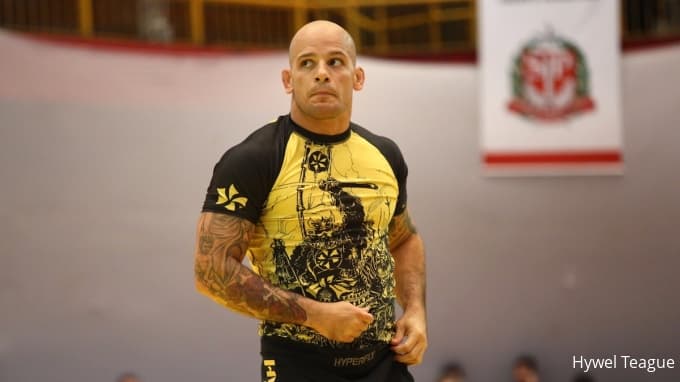
Main photo: Hywel Teague / FloGrappling.
The takeaway
Ribeiro's record has several distinct parts: major gi titles, consecutive ADCC championships, an academy association, and later competition in masters. Keeping those parts visible gives a fuller picture than treating the belt left on the mat in 2022 as the final sentence.
Start with the two Roger Gracie finals if you have only seen short clips. Leave enough time to watch them from beginning to end, then compare a gi performance with one of the ADCC appearances. There is a substantial archive beyond the familiar medal totals.
Find a place to ask better training questions
Explore the gym directory, then speak with the academy about its instructors and classes. A useful historical match becomes more valuable when you have someone to help explain it on the mat.
FAQ
How many IBJJF world titles did Xande Ribeiro win? The IBJJF describes him as a seven-time world champion. His absolute titles include the 2006 and 2008 wins over Roger Gracie; masters results should be identified separately.
Did Xande Ribeiro win ADCC? Yes. The official results list him as the under-99kg champion in 2007 and 2009. He also finished second in the 2009 absolute division.
What is Six Blades Jiu-Jitsu? It is the academy association founded under Ribeiro in 2020. Its official mission page identifies Austin as its headquarters and explains the values represented by the six blades.
Did he compete after the 2022 Worlds farewell? Yes. The 2025 European results list him as the master 3 black-belt heavyweight champion. The 2022 announcement concerned his retirement from the World Championship, not a verified promise to avoid every future event.
Related Posts

Training with women in BJJ: listen before you roll
Be a better BJJ training partner with women: agree on intensity, provide honest resistance, ask before coaching or filming, and respect a declined round.
Bia Mesquita: the grappling record behind the MMA newcomer
Follow Bia Mesquita's path from 2014 Worlds double gold and a 2017 ADCC title to her 2025–2026 UFC results, with dated sources and match context.
Ffion Davies: winning across gi and no-gi
Explore Ffion Davies's 2022–2023 championship results, from gi Worlds and ADCC gold to a World No-Gi double, with context for the matches behind the medals.
Comments (0)
Loading comments...