
Demian Maia made the route to the back worth watching
Quick answer: Demian Maia is a Brazilian jiu-jitsu black belt under Fabio Gurgel, the 2007 ADCC under-88kg champion, and a former UFC title challenger at middleweight and welterweight. His MMA career offers a long record of grappling tested against opponents who could strike, wrestle, and refuse the ground. The submissions matter, but so does the work required to reach them.
One minute and fifty-two seconds. That was all Demian Maia needed to submit Carlos Condit in Vancouver in August 2016. For a jiu-jitsu viewer, the finish was satisfying. The more interesting part was how quickly a standing fight became the sort of fight Maia wanted.
Maia is easy to reduce to a label: the BJJ specialist. It is accurate as far as it goes, but it leaves out the awkward part of specialization. Opponents know what you want. They can build an entire preparation around denying it. Maia spent years trying to make his preferred route available anyway.
The journalism student trained his way into a different profession
Maia came from São Paulo and earned his black belt under Fabio Gurgel. BJJ Heroes' biography describes his earlier training at Fabio Araujo's academy, then a move to Gurgel's Alliance school as his competitive ambitions grew. His martial-arts background also included judo, karate, and kung fu.
Alongside training, he studied journalism. His official biography names Faculdade Cásper Líbero and dates the beginning of his BJJ teaching to 2001. That combination is a useful corrective to the cartoon version of a fighter who has never done anything except fight.
It does not mean a journalism degree explains his guard passing. It means the person behind the competition record had another demanding subject to study. For recreational students trying to fit jiu-jitsu around college or work, that is a more interesting detail than pretending a champion's training schedule can simply be copied.
His rapid progression to black belt also needs its context. BJJ Heroes describes repeated daily training, not a couple of evening classes squeezed between other commitments. Admire the result without turning the calendar into a deadline for yourself.
ADCC gold came before the UFC submission streak
The official 2007 ADCC results put Maia first at under 88kg, ahead of Flavio Almeida and Tarsis Humphreys. The event was held in Trenton, New Jersey. Maia already had a serious grappling identity before many MMA viewers learned his name.
His route included points wins over Yushin Okami, Rafael Lovato, and Humphreys, followed by an armbar victory over Almeida, as recorded in the BJJ Heroes match database. That sequence is worth noticing. The man later associated with a UFC submission streak did not need to finish every ADCC opponent to win the championship.
There is a useful viewing contrast here. Watch one of those grappling matches, then an MMA bout. In the first, the contest can remain a grappling contest from beginning to end. In the second, reaching the same sort of position is part of the problem. A guard you can patiently adjust in one setting may have a very different cost in another.
Our gi and no-gi comparison covers another change of conditions. Maia's career adds a larger one: the effect of allowing strikes and putting the exchange inside a cage.
Five UFC appearances, five submission wins
Maia opened his UFC career by submitting Ryan Jensen, Ed Herman, Jason MacDonald, Nate Quarry, and Chael Sonnen. UFC's retrospective on that run records the five-for-five sequence. A newcomer could understand the sporting identity immediately, even without knowing his earlier medals.
The finishes included both rear-naked chokes and triangles. At UFC 95 in February 2009, Sonnen submitted to a triangle at 2:37 of the first round, according to Maia's UFC record. That ending makes a particularly useful companion to his later back-control finishes: the target was not always the same, even if the commitment to grappling was obvious.
A run like that can make the sport look simpler than it is. Find the grip, bring the opponent down, finish. The difficulty is in the resistance between those verbs. Each opponent has a different stance, different reactions, and a different willingness to remain in contact.
Watch the full rounds if you can. A compilation starts when the position is already favorable. A fight starts before Maia owns the position, which is where the uncertainty lives.
Condit showed how little wasted time a finish can contain
On August 27, 2016, Maia submitted Carlos Condit at Rogers Arena in Vancouver. The UFC's contemporary report records a takedown about thirty seconds into the fight and a rear-naked choke at 1:52 of round one. The win extended Maia's streak at the time to six.
The compact duration makes this a good fight to watch twice. First, follow the broad changes: standing, grounded, back control, finish. Then rewind and look for the moments when Condit tries to prevent the next change. The second viewing should take longer because you are asking a more specific question.
That is different from saying the fight was easy. Short duration measures elapsed time, not the difficulty of the preparation or the quality of the opponent. Condit's resistance belongs in the analysis even though the result belongs to Maia.
For a BJJ class, the sensible conversation is about maintaining connection between positions. The finish is recognizable. The challenge for a student is identifying where they would have lost that connection before getting there. Ask an instructor to help you isolate that earlier exchange rather than practicing only the final squeeze.
Two title challenges exposed the hardest part of the job
Maia challenged Anderson Silva for the middleweight title at UFC 112 in April 2010, losing a unanimous decision. Seven years later, he challenged Tyron Woodley for the welterweight title at UFC 214 and again lost a unanimous decision. The official UFC 112 and UFC 214 records preserve those outcomes without requiring a verdict on his entire career.
The Woodley bout is particularly useful beside the Condit fight. UFC's contemporary account describes Woodley shutting down Maia's ground attack. Put the two bouts next to each other and the limit of a favorite plan becomes visible: having a dangerous destination does not guarantee access to it.
That is not a reason to mock a specialist. It is a reason to give the opponent credit. A champion who denies the exchange is performing a skill too, even if it produces less attractive footage for a grappling highlight channel.
For students, the practical question is narrow. What is your next action when the entry you prefer is unavailable? You do not need to imitate an MMA title strategy in ordinary class. You can ask the same question about a grip, a takedown setup, or the first connection in your passing sequence.
Askren made the grappling exchanges the attraction
On October 26, 2019, Maia submitted Ben Askren in Singapore with a rear-naked choke at 3:54 of the third round. The official event result gives the ending; the UFC's fight report describes the changing positions that made the bout interesting before it ended.
In the second round, that report records Maia using an omoplata sweep to reach the top after an Askren takedown. In the third, Maia again reversed position, reached mount, and took the back when Askren turned. The route was longer and less orderly than the final result line.
For a grappling viewer, this is a good antidote to treating takedowns as the end of an exchange. Getting somebody down and keeping the position are separate jobs. So are reaching mount and securing the back when the opponent moves. Each transition can reopen the contest.
Avoid turning the fight into a verdict that one entire martial art defeated another. You are watching two particular athletes in a particular ruleset. The actual exchanges are rich enough without asking them to settle every wrestling-versus-jiu-jitsu argument on the internet.
The teaching career belongs in the picture too
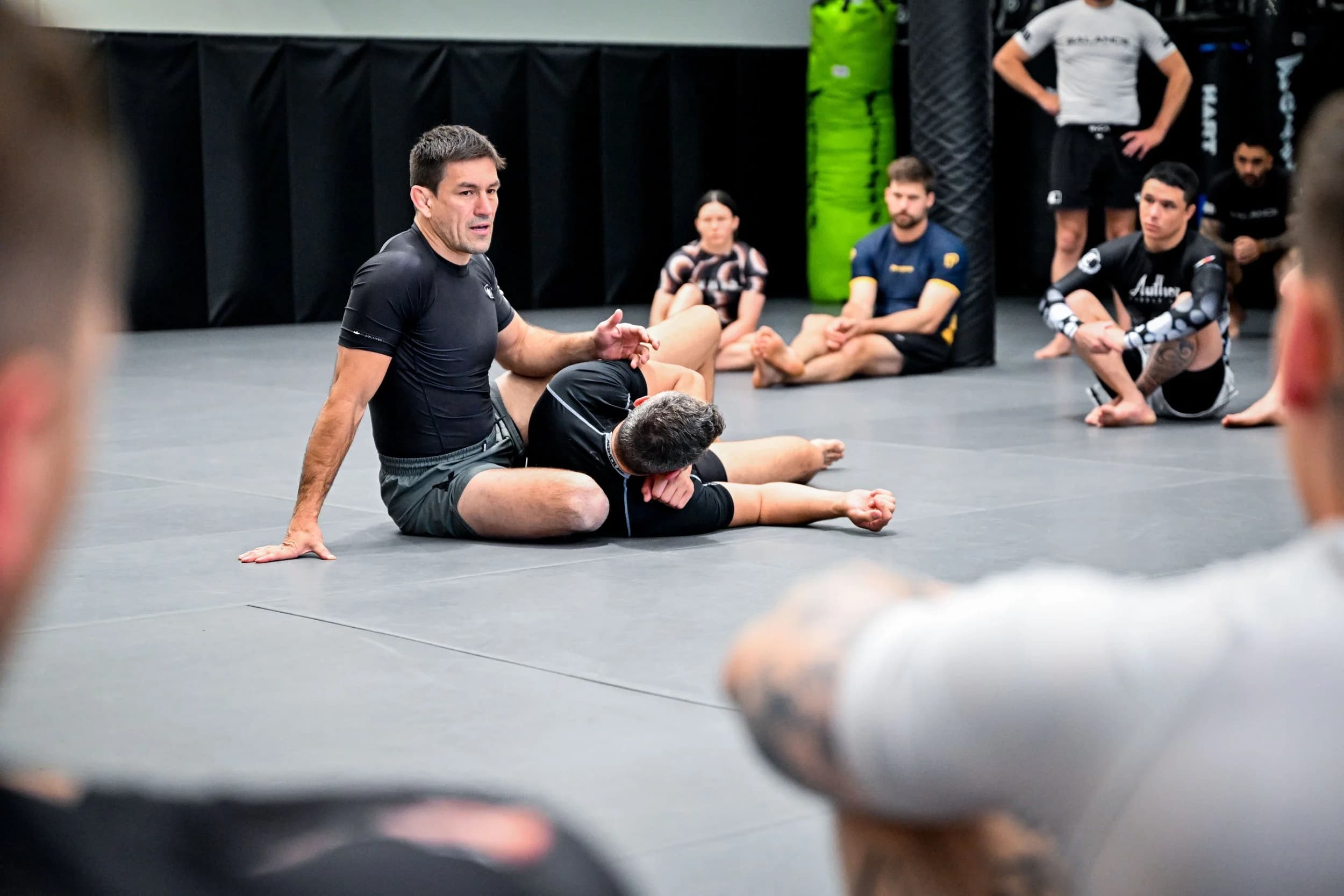
Maia's official site describes his teaching through Demian Maia Jiu-Jitsu Brasileiro, along with seminars and training programs in São Paulo. The competitive record gives those lessons a clear context, but a student's useful question is still what can be practiced in their own room.
If you attend a seminar or work through his material, arrive with a problem that is small enough to explain. Perhaps your partner frees their hips whenever you try to settle on top. Perhaps you reach the back but lose the position during the hand fight. Either is a better starting point than asking for his entire approach to MMA.
Keep a short set of questions ready:
Which connection must remain while I change position?
What reaction tells me to switch to the next option?
Where should we restart if the defender escapes?
How can we practice this under our class rules?
These are proposed study questions, not quotations from Maia or claims about a particular seminar. They turn admiration into a task you and a partner can actually repeat. Leave time to write down the answer in your own words before adding another technique.
The guide to studying BJJ instructionals can help organize that learning without treating another video purchase as the practice itself.
Main photo: Demian Maia official website; photographer not identified on source page.
The takeaway
Maia's record includes ADCC gold, an opening run of five UFC submission wins, and title challenges in two weight classes. The Condit and Askren fights offer different views of the same broad problem: how to reach a favorable grappling position against someone working hard to prevent it.
Watch the title losses alongside the finishes. They make the career more instructive because they show the destination and the difficulty of getting there. A highlight collection can tell you that Maia had dangerous submissions. A full fight lets you examine the price of each entry.
Find a room where you can work on the details
Use the gym directory to find local training, then ask how the academy teaches positional rounds and helps students connect techniques under resistance.
FAQ
Did Demian Maia win ADCC? Yes. He won the men's under-88kg division in 2007, with Flavio Almeida second and Tarsis Humphreys third. It is a submission-grappling championship, separate from his later UFC title challenges.
Was Demian Maia a UFC champion? He challenged for the middleweight title against Anderson Silva in 2010 and the welterweight title against Tyron Woodley in 2017. He lost both bouts by unanimous decision.
Who gave Demian Maia his black belt? Fabio Gurgel. His training history included an earlier period with Fabio Araujo before he moved to Gurgel's Alliance academy in São Paulo.
Which Maia fights should a BJJ student watch first? The 2016 Carlos Condit fight and 2019 Ben Askren fight offer contrasting routes to a rear-naked choke. Add the Woodley title bout to examine what happens when the preferred route to the ground is denied.
Related Posts

Training with women in BJJ: listen before you roll
Be a better BJJ training partner with women: agree on intensity, provide honest resistance, ask before coaching or filming, and respect a declined round.
Bia Mesquita: the grappling record behind the MMA newcomer
Follow Bia Mesquita's path from 2014 Worlds double gold and a 2017 ADCC title to her 2025–2026 UFC results, with dated sources and match context.
Ffion Davies: winning across gi and no-gi
Explore Ffion Davies's 2022–2023 championship results, from gi Worlds and ADCC gold to a World No-Gi double, with context for the matches behind the medals.
Comments (0)
Loading comments...