
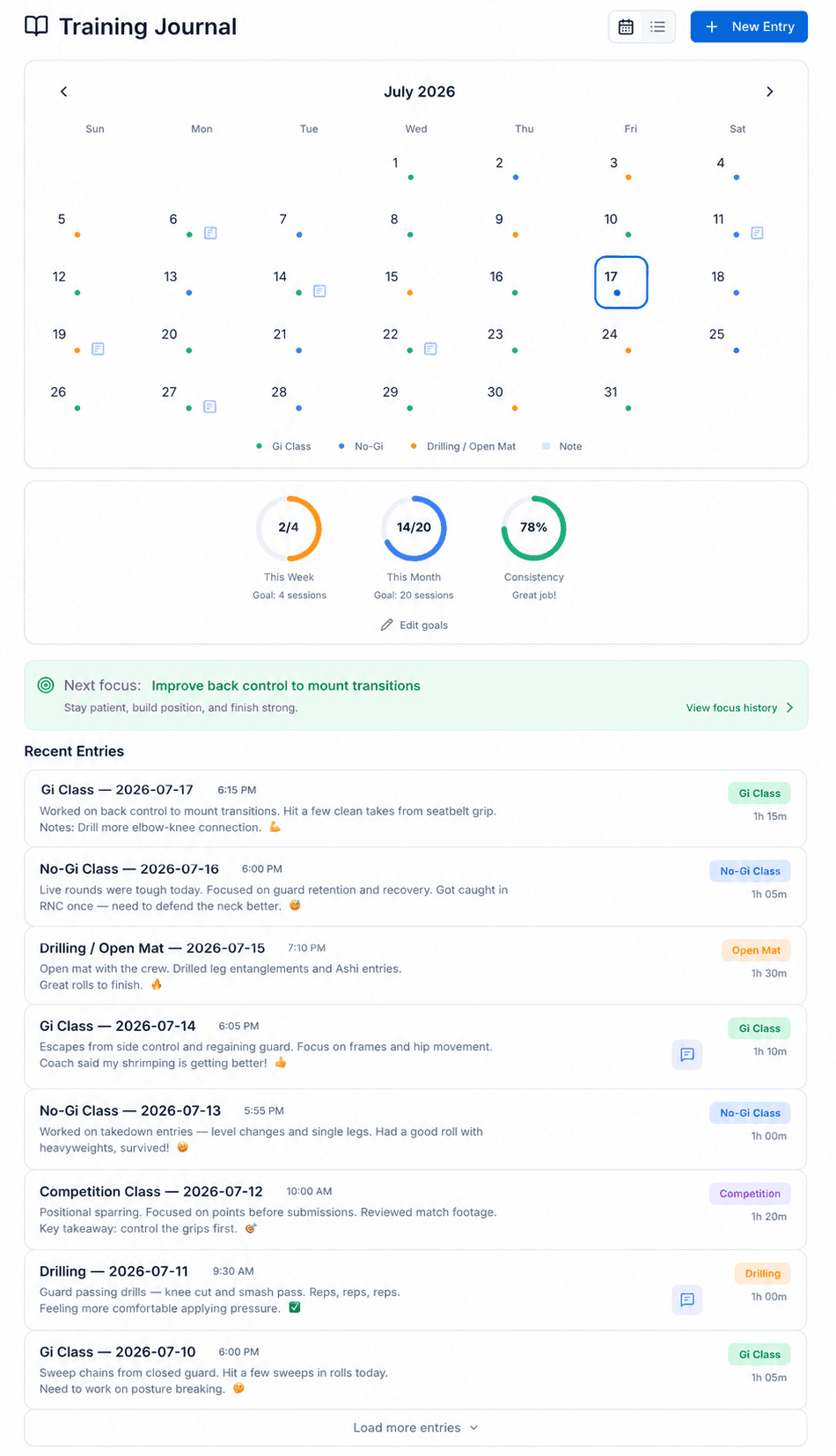
A BJJ training journal you will actually use
Quick answer: A BJJ training journal can help you keep track of questions, corrections, and recurring problems. Start with a short note about one exchange and what you want to ask next class. Use paper or a notes app, and judge the system by whether you return to the notes, not how much you write.
A notebook cannot recover your guard. It can, however, keep you from arriving at the next class with the same vague complaint and none of the details your coach needs to help.
That is a reasonable job for it. The trouble starts when a training journal becomes a second curriculum: pages of move names, scores from every round, and an elaborate color code that requires its own evening off. Try a smaller arrangement. Keep enough of the session to give the next one a starting point.
Give the notebook one useful job
Decide what you want the journal to help you do before choosing a format. Perhaps you keep forgetting which grip your coach corrected. Perhaps the same guard pass catches you, but you cannot explain where the exchange started. Those are workable reasons to take notes. Recording everything because serious grapplers supposedly record everything is a less useful reason.
Start with a question you could ask a person. For example: when your partner passes your half guard, which frame disappears first? You may not know the answer yet. Write what you remember, then mark the gap. A notebook full of honest gaps is easier to work with than a confident explanation assembled from guesses.
Set the scope low enough that you can finish after an ordinary class. A few sentences are a reasonable starting experiment, not a scientifically established dose. If the note takes longer than you want to spend, shorten it before abandoning the whole idea.
Describe an exchange instead of grading the evening
Bad class is a verdict. It does not tell tomorrow’s version of you where to begin. A description can do more: you started in bottom half guard, reached for an underhook, and ended flat while your partner freed the trapped leg. That sequence gives you something to reconstruct with your coach.
Keep the description separate from your explanation. You might suspect that reaching created the problem. Write that as a question until someone can check it. Otherwise an early guess can become the official account simply because it has been sitting in your notebook for a month.
A small entry might contain:
Position: bottom half guard, with the passer already controlling the upper body.
What happened: the attempt to reach underneath ended with both shoulders on the mat.
Question: what should change before making that reach?
This is a hypothetical example, not a technical diagnosis. Its value is that a coach can ask for the missing details. There is a difference between bringing a problem into focus and deciding you have solved it on paper.
Write the correction in words you can understand later
After getting help, record the correction using language you can reconstruct. Keep the elbow in is too loose if there are two people and four elbows involved. Identify whose elbow, where it should be, and what the coach asked you to notice. If you cannot describe that, ask for clarification while the explanation is still available.
Do not turn the entry into an instructional for someone else. It only needs to help you remember the supervised work. A small sketch may be more useful than a paragraph, provided you can tell which stick figure is you. Artistic ambition is optional.
There is some relevant research on recalling material, but its limits matter. In a 2006 study of students learning prose passages, Henry Roediger and Jeffrey Karpicke found an advantage for prior recall testing over repeated study on delayed tests. The study did not test BJJ journals or the ability to perform a technique against resistance. It supports being interested in recall; it does not prove that writing about a sweep will make the sweep work.
Choose a format that survives your actual routine
Paper and a phone solve different practical problems. A small notebook leaves the rest of your phone out of the process. A note on the device already in your pocket is easier to search and harder to forget at home. Neither choice deserves a personality test.
Try the simplest version of whichever you already use. Give entries a date and a plain position label, such as half guard or passing. Consistent labels make it easier to find related notes. You do not need a separate category for every variation you have ever watched in an instructional.
If a paper notebook fills up, keep a short index of the questions still open. If you use an app, make sure you understand its privacy settings and how to save a copy of your notes. The practical requirement is access: can you find the correction before class without disappearing into twenty unrelated tabs?
A voice memo is another option if writing is inconvenient. Keep it brief enough to replay. Ten minutes of tired commentary can be harder to search than two untidy sentences.
Read the last relevant note before collecting another one
The entry needs a return trip. Before your next class, open the most recent note that relates to something you can work on. You might ask your coach to check the position or ask a willing partner about a suitable drill. Fit that request around the class being taught, rather than arriving with an agenda everyone else must follow.
Choose one question. Trying to carry six corrections into a round can leave you monitoring the list more closely than the person in front of you. One question also makes the follow-up easier to write: you tried to recognize the situation, and this is what happened.
If the position never comes up, say so. That is different from trying the correction and finding that it did not help. You do not need to engineer every roll into a test. A positional exercise may be an option if your coach agrees and your partner understands the purpose.
This approach fits alongside a workable weekly training routine. The note should help you use the classes you attend. It should not become another reason to feel behind when the week gets crowded.
Look for a pattern without inventing a diagnosis
After several entries, read the notes together. Look for a repeated situation you can describe, such as losing the same grip or becoming flat from the same starting position. Then check how much the examples actually share. Different partners, starting conditions, and levels of resistance can produce similar-looking outcomes for different reasons.
A repeated note is a lead. It is not proof that you have found the single defect responsible for your jiu-jitsu. Take a small selection to your coach and ask whether you are grouping the exchanges sensibly. They may spot a common problem, or explain why two entries belong in different piles.
Also record when an old question becomes easier to answer. Perhaps you can now identify the position that used to feel like a blur, even though you still get passed. That is a specific change you can describe. It does not need to be inflated into a breakthrough.
Keep competition results and ordinary training observations distinct. A tap during a cooperative round tells you something different from a result under tournament rules. The journal becomes less useful when it treats every session as a private league table.
Leave room for ordinary life and other people
Missed entries do not create homework debt. If you cannot remember last Thursday, leave it blank and write about the next session. Reconstructing a detailed account because the calendar looks untidy defeats the point of keeping an accurate record.
Be equally careful about what you record about partners. You can describe a position without publishing somebody else’s name, health information, or a tally of who tapped whom. If you want to include footage, ask permission from the gym and the people involved before filming or sharing it. A private training note does not automatically make every attachment private.
Keep health questions separate from technical guesses. A journal can record when discomfort occurred so you can describe it to an appropriate clinician. It cannot diagnose an injury or decide whether continuing to train is safe.
Finally, let the system change. If you keep skipping the same field, consider whether you need it. The notebook is allowed to be less impressive than the template you downloaded. Its job is to remain useful when you are tired and the gi needs washing.
The takeaway
A useful training journal carries a question from one class to the next. Keep the exchange recognizable, mark what you do not know, and return to the entry when there is an opportunity to get help or practice. More writing is not automatically more learning.
For the next session, try one short note and one follow-up. If the note helps you ask a clearer question, keep that part of the process. If it disappears into a folder you never open, change the arrangement before adding more fields.
Keep the record somewhere you can find it
Use the Let’s Roll training passport as a place to begin keeping track of your training. Keep the accompanying notes small enough to review before class; the record should serve the next session.
FAQ
What should I write in a BJJ training journal? Start with the position, a short description of one exchange, and the question you want to ask. Add a correction after your coach checks it. You do not need to document every technique or score every round for the entry to have a purpose.
Is a paper notebook better than a phone app? Choose the format you can find and use consistently. Paper avoids phone distractions; digital notes can be searched and backed up. There is no BJJ-specific evidence presented here that establishes one format as the better route to technical improvement.
How soon after class should I write the entry? Choose a convenient time when you can still describe the exchange. If details are unclear, mark them as uncertain instead of filling them in. There is no required number of minutes, and you should never write or record notes while driving.
Can a journal fix a BJJ plateau? It can help identify a recurring question to bring to your coach. It cannot determine the cause by itself or replace practice. Compare the actual situations behind repeated notes before concluding that they all represent the same technical problem.

Owen Bellamy
Owen Bellamy writes for the person training twice a week around a job. Nothing he suggests requires quitting the job.
Related Posts

Mikey Musumeci gives up the belt to make room for MMA
Musumeci is vacating his UFC BJJ title to focus on MMA training. What he is leaving, what continues, and why the transition matters.
IBJJF membership: finish the paperwork before the deadline
IBJJF membership and tournament entry are separate steps. Plan documents, professor approval, renewals, and junior accounts before registration closes.
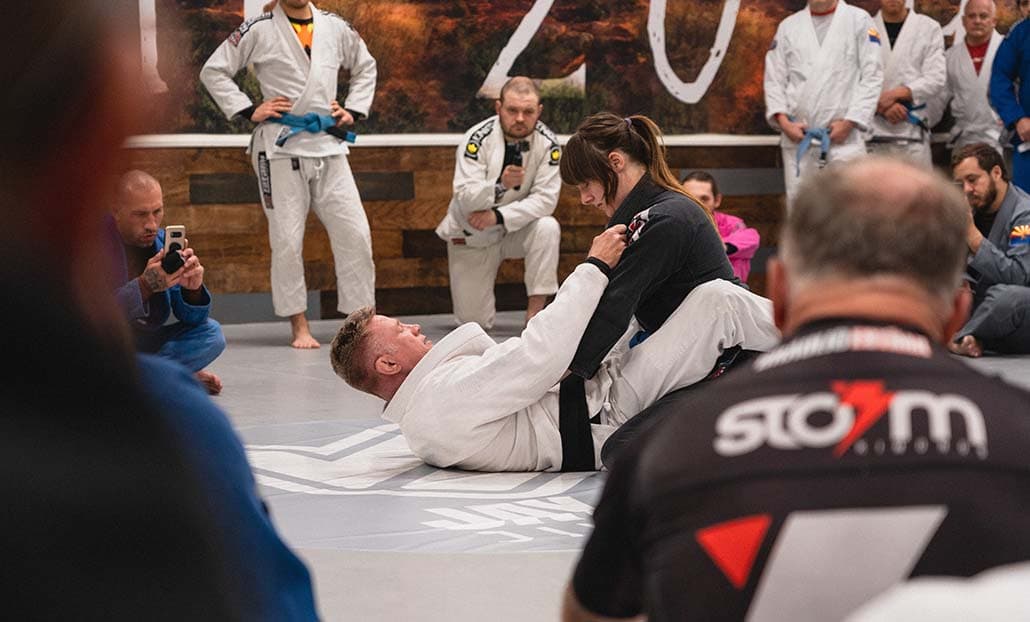
Choosing a BJJ seminar worth your time and travel
Choose a BJJ seminar by the subject, teaching format, access, and total cost. Know what to ask the host before buying a ticket.
Comments (0)
Loading comments...