
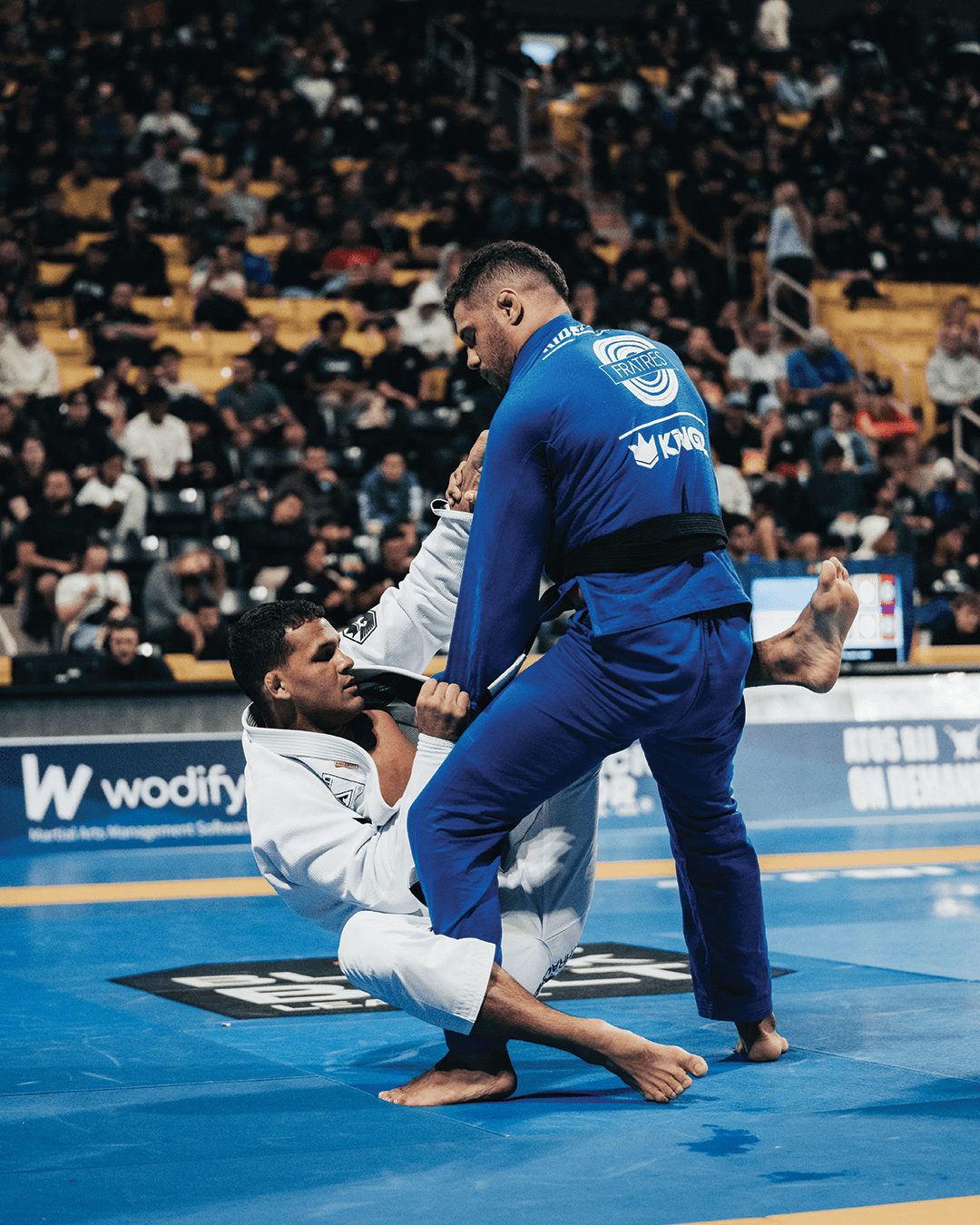
The IBJJF double guard pull puts both players on a clock
Quick answer: Under the IBJJF rulebook, a simultaneous guard pull starts a 20-second countdown, and the first athlete to achieve top position receives an advantage. If neither reaches top, has a submission in hold, or is imminently completing a scoring move when the count ends, both can be penalized and restarted standing. Read the applicable event rules before building a strategy around the exchange.
Twenty seconds can disappear inside a busy exchange. Both athletes are seated, grips are changing, and somebody is moving their hips. A spectator can see activity without seeing the particular progress the rule requires.
The double guard pull is worth learning as its own competitive situation. It combines a choice about position with a scoring consequence and a time limit. Treating it as ordinary guard play with two people on the floor leaves out the part that can change the next decision.
Identify the situation before applying the countdown
The relevant IBJJF provision concerns both athletes pulling guard at the same time. It does not describe every exchange in which both athletes eventually end up seated. That starting distinction matters before anyone begins explaining what a referee should have done.
The official rulebook page links the English document reviewed for this article. The PDF's footer identifies version 6.1, dated 2024, although the landing page calls the rulebook v6.0. The relevant provisions are article 3.5 and article 6.2.1(C). Those references make the explanation checkable without relying on the page label alone.
For a replay, include the entry. A clip that begins after both players sit down may omit the fact needed to classify the situation. Slow motion can help identify a sequence, but it cannot restore footage that was never included.
For training, make the starting instruction equally clear. Tell both partners whether the exercise begins standing with a simultaneous pull, or already seated in a chosen position. Those can be useful exercises, but they test different parts of the problem.
Coming on top has a specific scoring consequence
Article 3.5 awards an advantage to the athlete who achieves top position first after the simultaneous pull. It also says that going directly to side mount does not earn points or an advantage for a guard pass. Keep that separate from a conventional sweep or pass sequence.
For a competitor, the practical question is whether the route to top leaves a usable position afterward. An attempt to come up can be a good choice without being a good choice at every instant. The opponent's grips and leg position still matter.
A suggested review is to divide the action into two decisions. First, identify the opening to take top. Then identify the first task once there. If practice stops at the moment you rise, it may never test whether you can begin passing or keep your balance under the response.
This is why the advantage should not become the only goal in a training round. You want to understand the scoring incentive and the position it produces. A partner who immediately resumes playing guard supplies useful information that a cooperative finish does not.
Movement is not the same as satisfying the rule
Article 6.2.1(C) expressly includes movement in its wording. At the end of the count, the alternatives to reaching top include having a submission in hold or imminently completing a scoring move. If those conditions are not met, the provision calls for penalties to both and a standing restart.
That makes vague activity a poor planning target. Rotating, changing grips, and reaching toward a foot may be parts of a productive sequence, but the mere presence of motion does not establish the required outcome. A training partner and coach can help identify what the action is actually approaching.
Do not build a strategy around your own private definition of an imminent score. Review examples with a qualified rules instructor and ask about the specific transition. The referee applies the rule in the match; the competitor cannot make an action count by believing strongly in its future.
The same care applies to submissions. A recognizable attack and a loose connection are not interchangeable descriptions. Keep the training controlled, release promptly on a tap, and let the coach assess the position rather than asking a partner to endure a prolonged hold for the experiment.
Rehearse the entry and the first decision together
An athlete can understand a rule while having no practiced response to its trigger. Put the simultaneous entry into a coached session so the countdown is attached to a position you recognize.
One possible exercise is:
Begin from the coach's agreed grip and standing position.
Establish the simultaneous seated entry in a controlled way.
Let one athlete pursue a coached route to top.
Continue long enough to test the first response, then reset.
These are suggested practice steps, not an IBJJF training protocol. The coach should choose legal, appropriate techniques for the students involved. Do not add unfamiliar leg attacks simply because the example begins with both athletes seated.
Swap roles and repeat. The defender's response should become part of the exercise rather than an inconvenience to be removed. If the route works only when the other person leaves a grip open, identify that condition explicitly.
Once the movement is understood, introduce a time limit consistent with the rules being practiced. Keeping the early repetitions cooperative lets you separate a technical misunderstanding from a rushed decision. The clock becomes useful after both people know the task.
Read the whole scoreboard before choosing the next exchange
A score has value in the context of the match. The practical significance of pursuing an advantage can change with the time remaining and the rest of the board. Avoid planning the opening as if every match begins and ends with the same scoring situation.
For video review, note the score before the simultaneous pull and after the exchange. Then watch what the athletes attempt next. You are looking for how the position develops within that match, without claiming access to either competitor's private plan.
For your own preparation, explain a hypothetical score and remaining time to your coach. Ask how the same technical opening might be used under those conditions. A scenario makes the discussion more useful than asking whether coming on top is always the correct answer.
The close-match scoreboard guide considers that broader decision. Here, keep the focus on the transition: what do you gain by pursuing top now, what position are you likely to enter, and what response have you practiced? The rule supplies an incentive. It does not perform the movement.
Another promoter can reward the same entry differently
The Jiu Jitsu World League rulebook provides a clear comparison. Its double-guard-pull section awards two points to the first competitor who reaches top and establishes three seconds of control. The document also sets out its own countdown and restart provisions.
That is a material difference from the IBJJF advantage described above. An athlete arriving from another event should not carry the familiar scoring consequence over without checking it. The visible position can look similar while the rule attached to it changes.
Keep a short event-specific note before competition. Record the organizer, the current linked rules document, and the provisions that affect your intended opening. If an event publishes special rules or a separate briefing, include those too. A remembered explanation from a previous tournament is a starting question, not the final authority.
The guide to choosing a tournament looks at the broader event choice. Once you have chosen, narrow the research to what that organizer actually uses. Knowing several rulesets is useful only if you can identify which one is in force today.
Give the corner a plan that can be said briefly
A corner instruction needs to fit the moment. Discuss the possible simultaneous pull before the match, including the athlete's preferred response and the cues that make it appropriate. The coach should not have to explain the entire rulebook while the position is changing.
Agree on concise language for the task you have practiced. A short instruction about coming up or protecting a particular connection is more usable when both people already know what it means. Do not turn the countdown into a shouted substitute for technical preparation.
After the match, review the full exchange before assigning a cause to the result. A missed grip, delayed recognition, or misunderstanding of the score calls for a different next session. The existence of a penalty does not identify every technical error that preceded it.
Keep the review proportional. One difficult double-pull exchange can justify focused practice. It does not require abandoning the rest of your guard game. Establish what happened, check the applicable provision, and give the next practice a question precise enough to answer.
The takeaway
The IBJJF double guard pull has its own incentive and countdown. Learn the trigger, distinguish an advantage from other scores, and understand that movement alone is not the test described in the rulebook. Check the current document and any event-specific provisions before competing.
Then practice the position that the rule creates. A coached route to top, a clear response to the opponent's movement, and a plan for the next position make the rule useful. Memorizing a number without training the exchange leaves most of the work undone.
Choose the rules you will prepare for
Browse upcoming tournaments, then read the chosen organizer's current rules and entry information before registering.
FAQ
How long is the IBJJF double guard pull countdown? The reviewed rulebook specifies 20 seconds. Check the current official document and any special provisions for your event.
Does the first athlete on top receive two points in IBJJF? Article 3.5 specifies an advantage for the first athlete to achieve top position after a simultaneous guard pull. Other sequences and other promoters have different scoring provisions.
Does moving continuously prevent the double penalty? Not by itself. The rule identifies specific conditions involving top position, a submission in hold, or an imminently completed scoring move.
Should I use the same plan at every tournament? Check the organizer's rules first. The JJWL example awards two points after the specified top control, illustrating why the same-looking exchange can have a different scoring consequence.

Tess Hanley
Tess Hanley reads the rulebooks, the entry fees and the fine print. When a federation or a gym changes something, her first question is who ends up paying for it.
Related Posts
Lucas “Hulk” Barbosa’s best work is in the details
Lucas Barbosa’s nickname explains the first impression. His gi world title, no-gi record, and 2022 ADCC final give viewers more to study.
João Miyao’s record deserves its own first name
João Miyao’s adult world title and 2026 Master1 results tell a distinct story, even when his brother appears beside him on the podium.

Jena Bishop made time for a second sporting life
Jena Bishop’s 2026 PFL title followed a deliberate move from championship jiu-jitsu into learning a different sport.
Comments (0)
Loading comments...