

Training both sides in BJJ without doubling every lesson
Quick answer: You need workable answers on both sides of a BJJ position, but every answer does not have to be a mirror image of the same move. Build one reliable response to each direction, then spend extra practice time where a missing response is actually costing you position.
Your excellent right side can take the whole evening off if your partner keeps passing left. That is the awkward part of having a favorite: the other person is under no obligation to cooperate with it.
Still, the solution does not have to be learning every technique twice. A weekly training schedule has limits. If each new move arrives with a second assignment of equal size, a perfectly reasonable hobby starts looking like an administrative error. The better question is which parts of your game need another direction, and which need a different answer altogether.
Separate a preferred move from a missing response
There is a difference between choosing to pass toward one side and being unable to deal with the other. A preference leaves you options. A gap means that when the position changes, your useful jiu-jitsu stops.
Start with one recent round. Suppose you escaped side control on your right, but when pinned on your left you could not identify where to put the first frame. That is a specific gap worth taking to class. It is more actionable than announcing a plan to become equally good at everything.
Now consider a different case. You have a dependable pass to the left and a different dependable pass to the right. Neither needs to look like its counterpart for you to have options. Your partner presents different grips and leg positions; the same solution might not be available anyway.
Write the problem in ordinary language: unable to recover guard on the left, unable to change direction while passing, or unable to keep the back after falling one way. That description tells a coach much more than a general complaint about your bad side.
Equal coverage does not require identical techniques
Budo Jake's discussion of practicing both sides makes a useful distinction: having attacks in both directions need not mean using the same technique in each. It is a practitioner's argument about allocating training time, rather than a scientific finding that one practice split suits everyone.
Take that distinction into a lesson. If your coach teaches a particular pass on both sides, follow the lesson. There is information in the unfamiliar repetition, even if it never becomes your competition favorite. Outside that assignment, ask what the other direction needs to accomplish.
Perhaps one grip makes the mirror version clumsy, while another pass already fits the position. Perhaps the movement is unfamiliar enough that you need to learn it slowly before making any decision. Those are different situations, and they deserve different uses of the next ten minutes.
You can have a broad game with some very strong preferences. The test is whether those preferences allow a reasonable response when the round changes. A neat diagram with identical arrows is optional.
Defenses deserve their own inspection
An attack can often be declined. You can abandon a sweep that is going nowhere and choose something else. Being pinned on the less familiar side is less accommodating: the other person has already selected the problem.
For that reason, a sensible starting priority is basic defensive coverage. Ask your coach to look at your first response to side control, mount, and back control in each orientation. This is a suggested audit, not a requirement to fix all three in one session.
Do it cooperatively at first. If you cannot find the starting position for your arms without resistance, the first useful repetition may involve no escape at all. Set the frame correctly, reset, and repeat. Add movement when you can identify what you are trying to preserve.
Avoid deciding that the unfamiliar side is simply weaker. A partner may be using a different pin, or your own leg may be trapped in a way it was not on the other side. Compare the actual positions before blaming the direction. Sometimes the problem has been assigned to the wrong department.
Give the unfamiliar side a small, visible job
A free roll is a noisy place to introduce a movement you barely understand. By the time you recognize the opportunity, your partner may have moved on. Use a small agreed starting position to make the task appear more often.
Try this with a willing partner and your coach's guidance:
Choose one position and name the unfamiliar direction.
Agree on a modest endpoint, such as recovering a knee inside.
Start with enough cooperation to learn the movement.
Add one defensive response before adding the whole round.
The endpoint should fit the lesson. Recovering a useful frame can be a reasonable success even if the full escape is still a long way off. Counting only complete victories makes it harder to see whether the new movement is becoming usable.
Give your partner a real role. They should know whether to hold a position, offer a particular response, or attempt a limited escape. Otherwise, you may think you are working on your left-side defense while they think the assignment is to win a small world championship.
Test directions without borrowing a percentage
In a Grapplearts article on passing in the other direction, Stephan Kesting suggests testing the side a defender is less accustomed to protecting. The useful coaching idea is to investigate the alternative. The headline is not a promise that your personal passing rate will double.
For your own practice, compare similar starts. If one attempt begins against an established guard and the other begins after you have already cleared a foot, you have changed more than direction. The result cannot tell you much about the variable you meant to test.
Ask your partner to maintain the same agreed response for a few repetitions. Then change sides. Notice which connection becomes difficult to obtain and where you hesitate. That gives the next lesson something concrete to address.
Do not turn this into a running evaluation of the partner's supposed weak side. You are both doing the exercise. Swap jobs and let the other person examine your responses, too. The useful outcome is a clearer training problem for each of you.
Keep the working side in the week
There is no prize for making your dependable movement rusty while repairing the unfamiliar one. Keep some repetitions of what already works. It provides a reference and keeps the session from becoming an extended argument with your own coordination.
A practical split can change from week to week. Spend a little extra time on the missing response, keep using your established game in ordinary rounds, and review whether the extra work is showing up. There is no universal ratio hidden behind this advice.
Avoid attaching the plan to a heroic daily quota. Ten careful repetitions you actually understand may give your next coached session more to work with than a large number performed while guessing. If a repetition repeatedly produces discomfort, stop and ask for help rather than treating discomfort as evidence of productive practice.
The guide to useful drilling offers a broader way to think about this: a repetition should help you recognize or solve a problem. Merely accumulating an equal number on each side can leave the important question unanswered.
Change the test when your partner changes the problem
Eventually the unfamiliar side needs to appear outside a cooperative drill. Make that transition with someone who knows what you are working on. A short positional round is one option; an ordinary round with permission to pause and identify a recurring mistake is another.
Expect the movement to look less tidy under resistance. That is information. If the grip vanishes before the turn, return to establishing the grip. If you can make the turn but lose the next position, practice that connection. Do not restart the entire learning project every time one part breaks.
A different partner may expose a different issue. That does not make the previous practice worthless. It tells you the response was working under particular conditions, and the conditions have changed. Explain those conditions when asking the coach for help.
This is also where training both sides can become interesting rather than dutiful. You begin recognizing choices in places that previously felt blank. The measure is a growing set of usable decisions, including a decision to return to your stronger position when the opening is there.
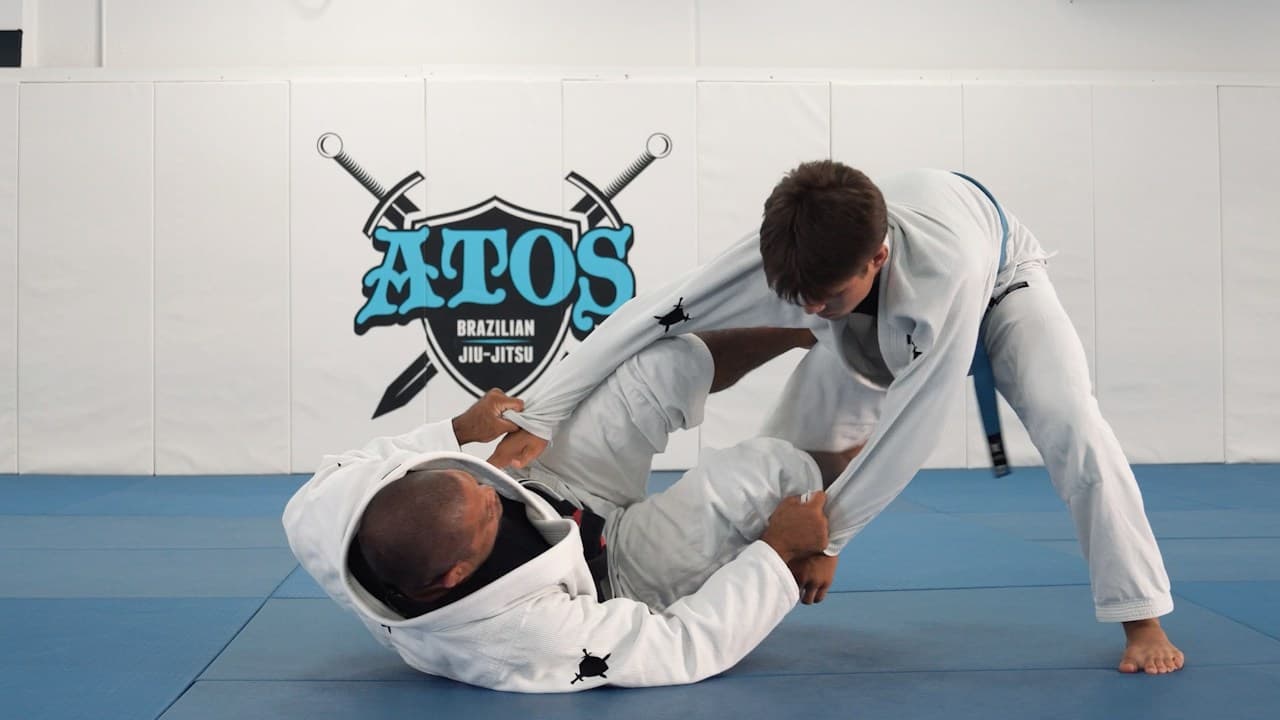
Main photo: Grapplearts; illustrative guard-passing instructional still.
The takeaway
You do not need to submit an application for perfect symmetry. You do need to notice when a direction leaves you without a practical response. Choose one of those gaps, make its first job small enough to learn, and test it with a partner who understands the assignment.
Keep the distinction between coverage and duplication. A dependable alternative can solve a problem that a mirrored technique does not. Let the position and your coach's feedback decide where the next repetitions go, while leaving room in the week for the jiu-jitsu you already enjoy.
Find space for a focused session
Check nearby open mats and confirm whether the host welcomes cooperative drilling as well as regular rounds.
FAQ
Should I practice every BJJ technique on both sides? Follow the class assignment, but you do not have to make every technique equally strong in both directions. Look first for positions where one direction leaves you without an answer.
Is it wrong to have a favorite passing side? No. A preference can be useful, provided you can recognize when the position calls for another route and have a workable option available.
How many extra repetitions should the unfamiliar side get? There is no fixed number that fits every student. Choose a small assignment with your coach and judge whether the movement is becoming understandable and usable.
Should I force the unfamiliar side during every roll? Agree on focused practice with suitable partners first. Ordinary rounds can test the response later; they need not all become the same experiment.

Owen Bellamy
Owen Bellamy writes for the person training twice a week around a job. Nothing he suggests requires quitting the job.
Related Posts

Mixed-level BJJ classes: share the lesson, change the task
A shared BJJ lesson can give a beginner and an experienced student different useful tasks. Make the starting point and partner role clear.
Sharing a BJJ private lesson: two people need one clear plan
Sharing the booking works best when the training problem connects both students. Agree on roles, price, and the next practice before the lesson.

An open mat can be useful without a single full roll
Bring one familiar position, ask the host, and agree with a partner. Open mat can support useful drilling without turning every block into a full round.
Comments (0)
Loading comments...