

Forgot the move already? Make the next rep smaller
Quick answer: If you forget a BJJ technique between the demonstration and your first rep, return to the starting position and identify the first action you can explain. Ask your coach to correct the point where the sequence disappears, then practice that short section before adding the finish. You don't need to reconstruct an entire class from memory to get useful work done.
The demonstration ends. Everyone finds a partner. You kneel down and discover that the move has apparently left the building.
That moment can feel particularly awkward when the person beside you is already offering an arm and waiting. The temptation is to start moving, partly to look busy and partly in the hope that the next step will return. Sometimes it does. Sometimes you build an entirely different technique with impressive confidence.
Give yourself a smaller task. The immediate problem is finding the missing step, and there are better ways to do that than running the whole demonstration again in your head.
Recover the starting position first
Before asking which hand goes where, check that you and your partner have recreated the position the instructor showed. A sequence from seated guard won't feel the same if you've already fallen onto your back. A pass against an opponent with their knees apart may become a different problem once those knees close.
Say what you can see in ordinary language. The top person is kneeling. The bottom person has one foot on the hip. The sleeve grip is on the opposite side. Those descriptions give your partner something concrete to confirm. You don't need the official name for every configuration before you can notice a mismatch.
If neither of you remembers the setup, stop there and ask. Otherwise, the rest of the rep may become an attempt to solve a problem the class hasn't been given. Your coach can often help faster when the question concerns one missing grip rather than a broad declaration that everything has gone blank.
A correct starting position doesn't guarantee a correct finish. It does remove one source of confusion before you spend five minutes arguing about the last movement.
Tell the coach where the memory stops
There is a difference between remembering nothing and remembering everything up to a specific transition. Make that distinction out loud. Perhaps you know the initial grip and the first step, but not how your hips turn afterward. Demonstrate the part you remember slowly, then pause.
A useful request might be: could you check the movement after this grip? That's an example of a question, not a script you need to deliver perfectly. The aim is to put the instructor's attention where it can help. Asking for a specific correction is often more manageable than requesting another complete performance.
Don't conceal uncertainty about the finishing position. If a joint lock or choke is involved, ask before applying it. Guessing is a poor substitute for instruction, and a willing partner doesn't turn an unclear finish into a sensible experiment.
After the correction, repeat back the change in your own words. Your coach can then hear whether you understood it. Nodding is easy; explaining which knee now moves tells both of you more.
Practice a piece that has an ending
A smaller rep still needs a defined endpoint. Simply deciding to do less can leave you wandering around the same opening grips. Choose a short section with your coach: establish the grip, move to the demonstrated angle, then reset. You should both be able to recognize when that task is complete.
Try this progression during the assigned drilling time, provided your instructor agrees:
Recreate the starting position without beginning the move.
Perform the first action and stop at the agreed checkpoint.
Add the next action once the checkpoint is recognizable.
Put the sections together at the pace your coach requests.
These are suggested practice steps, not a scientifically prescribed number of repetitions. Some lessons may suit them; others are organized around a different method. Stay with the class task and use the instructor's guidance.
The checkpoint should mean something mechanically. Getting your knee between the bodies is easier to assess than deciding the movement feels smoother. If you know what has changed, you have a useful place to pause, ask, or restart.
Let your partner provide the assigned response
Forgetting can become a two-person problem when your partner tries to help by changing the exercise. They may relax every grip, roll themselves into the finishing position, or add a counter the coach hasn't introduced. Each choice changes what you are trying to remember.
Ask for the response demonstrated in class. If the exercise calls for a cooperative partner, you don't need a surprise resistance test. If it includes a specific defensive movement, removing that movement can make the next step seem pointless. Your part of the sequence may depend on theirs.
You can return the favor on their turn. Pay attention to the beginning and endpoint instead of spending the entire time rehearsing your own rep. When they ask where an arm goes, check what the instructor actually said. Being the person who gives the answer doesn't make a guess more accurate.
When two memories disagree, flag the disagreement for the coach. There is no need to settle it by seniority, volume, or whichever version produces a submission first. A quick clarification preserves more drilling time than a lengthy debate beside an increasingly puzzled partner.
Use fewer labels, with better meaning
A string of technique names can look organized in a notebook while remaining almost useless on the mat. If one name could refer to several entries, remembering the name won't tell you which entry the class practiced.
Attach a cue to an observable action. Instead of writing only the name of a pass, note the grip that holds the leg and the direction you moved. Avoid turning the note into an instruction manual you cannot verify. A cue is useful when it brings back a movement you have already been shown.
Keep the coach's terminology where it helps communication, but ask what a word refers to if you're unsure. Left and right can also become confusing when you're copying someone facing you. Naming your gripping hand or your inside knee may be clearer in that particular exchange.
Our guide to BJJ technique names looks at that vocabulary problem in more detail. You can understand the task before you can confidently pronounce every term associated with it. The useful test is whether your words help you and your partner recreate the same position.
Don't turn the first rep into an examination
You can want to learn well without treating every pause as evidence that you don't belong in class. The first attempt gives you information about what you retained and what you need shown again. It doesn't need to settle whether you are good at jiu-jitsu.
Try separating two questions: can you explain the order, and can you perform it? You may remember every step yet struggle to coordinate them. Or your body may follow a familiar movement while you can't explain why it works. Those are different requests for help.
If you keep stumbling at the same transition, tell the instructor what happens there. Perhaps your foot remains trapped, or you lose the grip before the next action. The answer may concern positioning rather than memory. Repeating the verbal order won't necessarily fix a body that cannot move from the place you put it.
Leave comparisons with the next pair alone for the moment. They may have practiced the material before. They may also be making a mistake you cannot see. Neither possibility changes the correction available to you now.
Keep one useful reminder after class
Before leaving, write a brief reminder of the sequence you actually practiced. Include the starting position, the troublesome transition, and the correction you received. If the correction remains unclear, mark it as a question rather than recording a guess as established fact.
A note such as keep the near knee inside before turning is only useful if you will know what near means tomorrow. Add enough context to make it readable later. That may mean a few extra words about where the partner was facing, rather than a page of unfamiliar abbreviations.
Filming can help if your coach and everyone shown agree, and if the gym permits it. Don't assume permission because other people record elsewhere. Nor do you need a video of every demonstration. A short written question can be enough to guide the next conversation.
At the following class, check the reminder before training. If you still cannot recreate the position, ask during an appropriate moment. The purpose of keeping a note is to reduce the amount you have to reconstruct, not to accumulate a private textbook nobody, including you, wants to read.
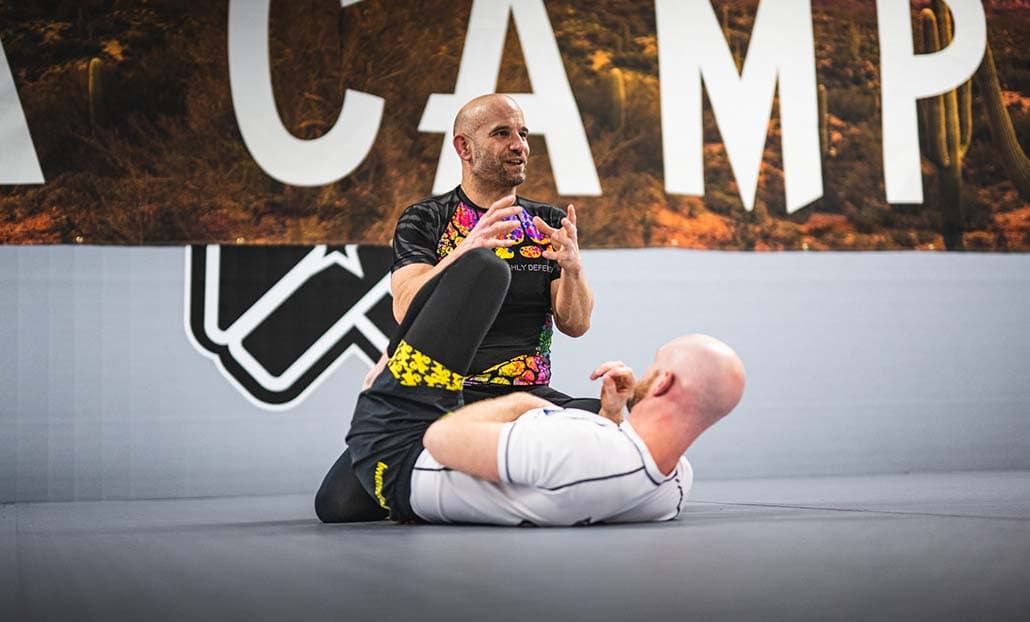
Main photo: BJJ Globetrotters, archive instructional still.
The takeaway
Start by recovering the setup, then locate the first missing action. Give your coach a specific place to correct, and practice a short section with a recognizable endpoint. Keep your partner's role consistent with the exercise instead of inviting new problems before the original one is clear.
For the next class, bring one readable reminder or one question. You can build the sequence from there. Forgetting the middle of a demonstration is a workable training problem; it doesn't require a verdict on your ability before you take another rep.
Find a class you can return to
Use the Let's Roll gym directory to explore nearby training options, then confirm the beginner schedule and class format directly with the gym.
FAQ
Should I ask the coach to demonstrate the whole move again? You can, especially if the setup is unclear. If you remember part of it, show that section and identify where you get lost. A focused question gives the coach a clearer starting point.
Is it okay to slow down while everyone else drills quickly? Follow the pace and purpose your coach assigns, and explain when you need a slower rep to understand a transition. Don't rush an unfamiliar submission just to match another pair's speed.
Should my partner correct every mistake? Agree on the task and use the instructor's directions. One relevant cue may help; several competing explanations can make the sequence harder to follow. Ask the coach when you disagree about the movement.
Do I need to remember the entire class afterward? A practical starting point is one position, one correction, and one unresolved question. That's a suggested way to organize your attention, not a requirement to summarize everything you were shown.

Owen Bellamy
Owen Bellamy writes for the person training twice a week around a job. Nothing he suggests requires quitting the job.
Related Posts
Online jiu-jitsu training: choose the format you need
Compare online BJJ libraries, structured courses, recorded classes, and feedback options before committing your time or paying for access.

A substitute BJJ coach can make familiar material feel new
Make a substitute BJJ class useful by comparing setups, asking specific questions, and testing unfamiliar details without turning coaches into opposing sides.
A home BJJ mat space built around the training you can do
Plan a home BJJ mat area around usable floor space, storage, setup, and specific practice, before buying mats or equipment.
Comments (0)
Loading comments...