
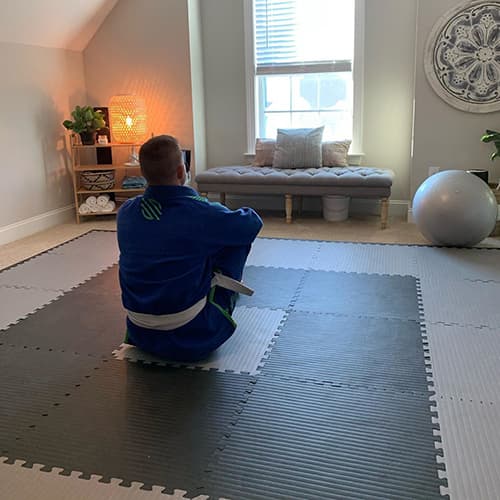
A home BJJ mat space built around the training you can do
Quick answer: Plan a home BJJ mat space around the activity, clear floor area, and storage you actually have. A product’s stated dimensions do not establish that your room is suitable for live grappling or takedowns. Ask your coach and the mat manufacturer about the intended setup, and start with a narrow practice plan.
A ten-foot room does not necessarily contain ten usable feet. The door opens inward. A radiator projects from the wall. A bookcase occupies the corner where a photograph makes the floor look empty.
Those details should shape a home training area before the mats arrive. The useful question is what you can practice there consistently, with suitable equipment and room to move. A small space with a clear purpose is easier to assess than a room expected to reproduce everything your academy offers.
Name the activity before choosing the mat
Write down what you intend to do. Reviewing a movement alone, practicing a slow sequence with a partner, and live sparring place different demands on the room. Do not buy equipment for the first activity and quietly begin using it for the third.
Ask your coach to help define a realistic home session. Give them measurements and photographs of the space, including the surrounding objects and floor. A close crop of the empty center hides the information most relevant to the decision.
For a beginner, a sensible starting brief might be a short session reviewing movements already taught in class. That is a proposed use, not a claim that any particular room makes those movements suitable. The coach can help identify what to leave for supervised training.
Keep a written limit on the setup. If the plan excludes standing exchanges, do not let a visitor’s enthusiasm expand it midway through practice. Equipment selection and session boundaries need to agree before anyone starts moving.
Measure the usable room, including the interruptions
Draw a simple floor plan. Record the walls, door swing, furniture, and anything fixed near the floor. Include access to exits and the path you need to walk through the room when it is not being used for training.
Measure the available rectangle after accounting for those features. Then ask how the planned movement fits within it. A mat reaching the wall does not create extra room beyond its edge, and soft flooring does not remove the hard object beside it.
Use these measurements when discussing the setup with a manufacturer. FUJI’s home roll-out listing distinguishes nominal dimensions from the actual approximate roll size. That detail is useful when a room appears to fit a product exactly on paper.
Leave room for uncertainty rather than designing around the tightest imaginable fit. If a product must be cut or installed in a particular way, get the manufacturer’s guidance first. The question is whether the complete installation suits the room and intended activity, not whether the shopping-cart dimensions can be made to look convincing.
Compare systems by setup and storage
Portable mats create a second space problem: where they go afterward. Measure that location before ordering. Consider the route from storage to the training area, including narrow doors, stairs, and whether you can move the pieces as instructed.
Manufacturers offer different systems. FUJI describes its home roll-outs as mats that roll for storage. Dollamur’s home BJJ range includes both taped and tapeless options. Those are features to investigate, not a reason to assume one system is right for every floor.
Ask how the pieces are joined, how the edges are managed, and what the manufacturer requires underneath. Explain whether the installation will remain in place or be assembled frequently. A system that suits a dedicated room may be awkward in a room that must become a dining area every evening.
Compare the full routine, including putting the space back. If a brief practice requires a long furniture move and difficult storage afterward, the plan may not suit your available time. That is worth discovering with a tape measure rather than a delivery truck.
Ask about the floor beneath the mats
Describe the existing floor accurately to the manufacturer. Include whether it is level, whether moisture is a concern, and whether the room has conditions that could affect the product. Do not assume a mat recommendation for one surface applies to another.
Avoid building a stack of unrelated materials because each item seems soft on its own. Ask for an installation method appropriate to the product and use. Extra layers are not automatically an improvement, particularly if they alter stability or the way sections meet.
This is also where a rented property or shared building enters the discussion. Confirm what installation changes are permitted and consider the effect on people nearby. An upstairs room has neighbors beneath it even when the floor looks like a convenient training area.
Keep any installation instructions accessible after setup. If the surface starts moving, edges lift, or the arrangement changes, stop and reassess. A room that worked for a carefully chosen drill yesterday still needs to be checked before today’s session.
Make cleaning and drying part of the layout
Plan how you will clean the mats using the manufacturer’s instructions and compatible products. Read the cleaning product’s label for dilution, contact time, and any other required steps. Do not improvise chemical mixtures or assume a stronger concentration is better.
Think about the underside and storage area too. If the mats need to be moved to inspect or clean beneath them, make that possible without dismantling the whole room. Follow the maker’s guidance on drying before storage.
Set a clear boundary between the training surface and outdoor shoes, pets, or ordinary room traffic. In a shared home, explain the routine to the people who use the space. A mat left across the route to the laundry will become part of that route unless you arrange otherwise.
Budget time for the end of practice. The session is not finished when the last repetition ends; the equipment still needs the appropriate care and the room needs to return to its agreed use. Keep supplies stored according to their labels and away from the training area while moving.
Build a session with a clear beginning and end
Choose one familiar task with your coach rather than assembling a playlist of unrelated drills. Write the starting position and the point where the repetition ends. That keeps the session focused and makes it easier to notice whether the setup is appropriate.
A simple planning note can contain:
The movement or sequence already taught in class.
The space and equipment needed for that specific practice.
The agreed pace and stopping conditions.
One question to bring back to the coach afterward.
If a partner is involved, agree on the task before beginning. Cooperative practice should not drift into an unplanned contest. Stop if the room, equipment, or either person is not suited to what you intended.
Keep the phone or tablet outside the movement area when referring to a lesson. Review the instruction, put the device somewhere stable, and then practice. Chasing a video while working around a charger cable creates a room-management problem that has nothing to do with improving the technique.
Decide whether the purchase solves a real constraint
A home mat can remove a particular obstacle, such as needing a suitable surface for a short review session. It does not provide a coach’s observation, a range of training partners, or automatic permission to practice every part of the sport at home.
Write a realistic weekly use case before buying. For example, a short session on two days between classes may justify a modest setup if the room and activity are suitable. Buying for an imaginary daily schedule can produce expensive equipment that is mostly moved out of the way.
Compare that plan with other options. An extra academy session or an agreed drilling period may solve the same problem more directly. Check nearby gyms if access to instruction is the main issue you are trying to address.
If you do buy, begin with the equipment needed for the agreed task. Additions should answer a problem you have actually encountered. A timer and an organized practice note may be more useful than another large object competing for the remaining floor space.
Main photo: FUJI Mats.
The takeaway
A workable home BJJ space starts with a specific activity and an honest floor plan. Match the mat system, installation, and session limits to those facts, using your coach and the manufacturer to resolve questions before purchase.
Include storage and cleaning in the design. The arrangement has to work before and after practice as well as during it. If the room cannot support the activity you had in mind, change the activity or use an appropriate training venue.
Keep coached training in the week
Explore Let’s Roll open mats for additional training opportunities, and confirm the host’s format, supervision, and visitor requirements before attending.
FAQ
Is a 10-by-10-foot mat enough for BJJ at home? The dimensions alone cannot answer that. The surrounding room, installation, people, and intended activity all matter. Ask a qualified coach and the manufacturer to assess the specific use rather than treating a product size as a safety guarantee.
Can I use my home mats for takedowns? Do not assume a home setup is suitable for standing exchanges or throws. That requires a separate assessment of the surface, installation, clearances, and supervision. Leave activities outside the agreed plan for an appropriate training environment.
Are roll-out mats better than puzzle mats? Compare the specific products, floor compatibility, joining method, storage, and intended use. A broad category name does not establish how well a particular installation will work in your room.
What should I buy first? Start with measurements and a coach-approved practice plan. Then identify the suitable surface and required setup materials. Buy additional equipment only when it serves a clear purpose within that plan.

Nina Okada
Nina Okada explains positions the way a good training partner does: one problem at a time, with the limits of the explanation said out loud. She is careful about the difference between what footage shows and what it only suggests.
Related Posts

Mikey Musumeci gives up the belt to make room for MMA
Musumeci is vacating his UFC BJJ title to focus on MMA training. What he is leaving, what continues, and why the transition matters.
IBJJF membership: finish the paperwork before the deadline
IBJJF membership and tournament entry are separate steps. Plan documents, professor approval, renewals, and junior accounts before registration closes.
Choosing a BJJ seminar worth your time and travel
Choose a BJJ seminar by the subject, teaching format, access, and total cost. Know what to ask the host before buying a ticket.
Comments (0)
Loading comments...