
How to ask a BJJ coach a question they can actually answer
Quick answer: A useful BJJ question identifies the position, the action you tried, and the response that stopped it. Ask at an appropriate pause, recreate the problem safely, and leave with one correction you can test rather than a longer list of techniques.
The coach asks whether there are questions. A student has several, but none fits into the few seconds before everyone pairs up. Something about the grip felt wrong. The movement looked different from the back of the room. During the first repetition, the partner somehow ended up on the other side.
That is enough information to begin. You do not need technical vocabulary or a theory of the entire position. You need to make the part you do not understand visible. A good question gives the instructor somewhere to look.
Start with the moment that disappeared
A broad question such as how to improve guard passing can produce a perfectly reasonable answer that does little for today's problem. The coach must choose which guard, which grips, which distance, and which level of detail to address. Most of the available time goes into locating the subject.
Begin closer to the failure. You stepped past the foot, but your partner recovered a knee between you. You tried to turn onto your side, but the shoulder stayed pinned. You secured the sleeve, then lost your balance when the partner stood. These are descriptions of observable exchanges, even without the correct technique names.
Identify the last moment you understood. That might be the starting grip rather than the instant the position collapsed. If everything after that point is a blur, say so. Reconstructing a clear beginning is more useful than confidently naming an error you could not actually see.
A coach may discover that the relevant mistake happened earlier than you thought. Allow that possibility. The question brings them to the exchange; it does not need to contain the diagnosis. Your job is to report what happened accurately enough for another person to investigate.
Distinguish an instruction question from a resistance question
Two students can ask why the same move is failing and need different answers. One has misunderstood where a hand belongs. The other understands the demonstration but cannot maintain the connection when a partner moves. Repeating the original instructions will not necessarily solve both problems.
Tell the coach which situation you are in. If you cannot reproduce the cooperative version, start there. Ask to see the missing movement or viewing angle again. There is no benefit in disguising a basic uncertainty as an advanced tactical question.
If the cooperative version works, describe what changes under resistance. Does the partner withdraw a leg, turn away, release a grip, or apply weight? That response gives the instructor a narrower problem. The answer might be a timing adjustment, a different setup, or permission to switch to another action.
This distinction also protects your partner from becoming the explanation for everything. A movement can fail because the starting position is inaccurate, because a reasonable defense is working, or because the task has changed. Asking which one applies is more productive than declaring that someone is drilling incorrectly before checking.
Make the demonstration easy to inspect
When invited to show the problem, begin slowly in the agreed position. Tell your partner which response you want to recreate. Avoid launching into a competitive round while the coach watches, hoping the same exchange will eventually occur. That makes the relevant detail harder to find.
Use the lightest contact needed to demonstrate it. If the question involves a submission or uncomfortable joint position, stop well before pressure becomes an issue. The instructor can explain the necessary arrangement without anyone proving how long they can tolerate it.
Let the partner describe their side, too. They may remember that your grip released before the turn, or that they were already moving when you began. Their account is useful evidence rather than a rebuttal. A shared reconstruction can explain why the same sequence felt different to each person.
After the coach changes something, try the original response again at an appropriate pace. You are checking whether the correction addresses the specific problem. A smooth demonstration by the instructor is informative, but your own supervised repetition shows which part of the explanation you have understood.
Pick a moment that allows an answer
Timing affects the usefulness of a question. During the main demonstration, a short clarification about what everyone should do next may help the room. A long account of a different position can interrupt the lesson before the class has tried the material in front of it.
During drilling, wait for the instructor to finish helping another pair and signal that you need assistance. Keep the problem ready to show. If the coach is managing several groups, a concise setup makes it easier to help you without losing track of the rest of the room.
Some questions deserve time after class or a separate lesson. Ask when the instructor would prefer to address them. Do not assume that the minutes after the final round are automatically available; coaches may have another class, administrative work, or somewhere else to be.
A short note can preserve the question if the timing is wrong. Write the position and the response that caused trouble. You are saving an observation for a later conversation, not building a case that the instructor failed to provide an immediate answer.
Use a small sequence of questions
A useful conversation often needs fewer questions than expected. The aim is to find the next decision you can make, then test it. Asking for every possible counter can turn a solvable problem into a demonstration neither student remembers afterward.
Try a sequence like this:
Where should the position be before the movement begins?
What is my partner doing that changes the original plan?
Which detail should I correct first?
What response should my partner give while I practice it?
When should I stop attempting this route and choose another?
These questions are prompts, not a script to recite during every lesson. A beginner might only need the first and third. An experienced student might already know the setup and need help recognizing the point at which a transition becomes appropriate.
Stop when you have a task you can explain back. If the coach has shown several options, ask which one to concentrate on today. A smaller assignment is easier to evaluate than an impressive collection of movements that all depend on details you have not yet learned to notice.
Treat a different answer as information
Another instructor may solve the same position differently. That does not automatically make the first explanation wrong. They may be addressing a different starting condition, preferring another risk, or teaching a version that suits the lesson and student in front of them.
Describe the earlier instruction without turning the conversation into a contest between coaches. Explain the setup you were taught and ask what changes in the new version. Often the useful distinction is specific: a grip has moved, the opponent's knee is elsewhere, or the intended finish is different.
There are times when advice truly conflicts. Ask for clarification instead of combining pieces at random. Two complete approaches can each make sense while a mixture of their grips and movements does not. Understanding the conditions for a choice matters more than deciding which instructor wins an argument.
The guide to learning from different BJJ coaches develops that comparison further. In the immediate conversation, stay with the position. A clear account of what you were attempting gives the coach something concrete to explain.
Bring back a result, not a verdict
After trying the correction, report what changed. Perhaps the first grip now holds, but you lose the position during the second movement. Perhaps the partner can still defend, but only by choosing a different response. Both observations are more useful than saying the technique still does not work.
Keep the practice conditions in the report. A correction that succeeds during slow repetitions has passed a different test from one used in an unrestricted round. Neither observation should be exaggerated. The instructor needs to know the level of resistance to suggest a sensible next step.
A brief BJJ training journal can keep the conversation from restarting every week. Record the original problem, the correction, and one result. There is no need to transcribe the lesson or assign yourself a grade after every attempt.
Eventually, asking becomes part of a cycle: notice, describe, test, return. The coach contributes expertise, the partner contributes a useful response, and you contribute attention to what actually happened. None of those roles requires you to perform certainty before you have understood the exchange.
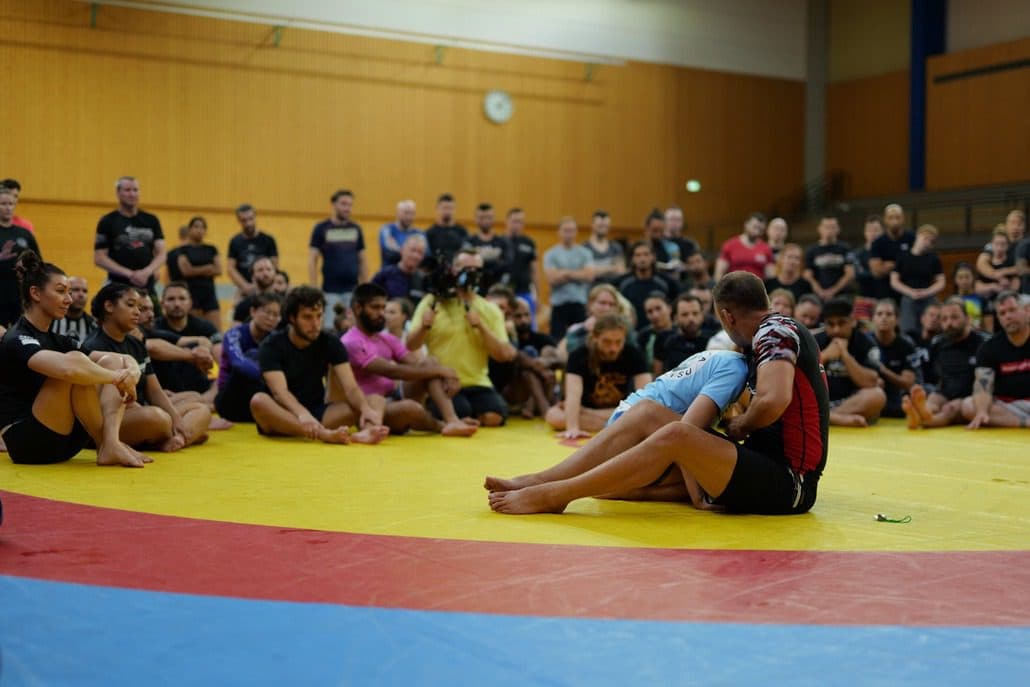
Main photo: BJJ Globetrotters; illustrative archive photograph.
The takeaway
You can ask a strong technical question while knowing very little terminology. Identify the position, show the response that stopped you, and distinguish a missing instruction from a problem that appears under resistance. Choose a moment when the coach can look properly.
Leave with a correction and an agreed way to practice it. The next conversation becomes much easier when you can describe what changed, including the parts that still need work.
Find a room where questions have a place
Explore BJJ gyms on Let's Roll, then ask how instructors support beginners and handle technical questions during ordinary classes.
FAQ
What if I do not know the name of the position? Describe where you and your partner were, then demonstrate safely if invited. Accurate physical details are more helpful than guessing a technical label.
Should I ask during the main demonstration? A brief clarification about the movement being taught may be appropriate. Save longer or unrelated questions for drilling time or another moment the instructor recommends.
What if the answer seems different from another coach's advice? Explain the earlier setup and ask which conditions change the choice. Avoid mixing the two approaches until you understand what each is trying to accomplish.
How many questions should I ask at once? Begin with the problem that blocks your next useful repetition. Once you have a clear correction and practice task, test them before requesting every possible variation.

Owen Bellamy
Owen Bellamy writes for the person training twice a week around a job. Nothing he suggests requires quitting the job.
Related Posts
Competing in gi and no-gi on the same day takes two plans
Prepare for gi and no-gi competition on the same day with separate rule checks, complete outfits, schedule coordination, and a realistic second-bracket plan.
Jiu-jitsu in Montreal: build the visit around a real class
Plan BJJ training in Montreal around confirmed classes, language arrangements, winter travel, visitor policies, and equipment that is ready to use.
BJJ gi pants that fit standing up can still fail on the mat
Check BJJ gi pants at the waist, rise, knees, and cuffs so a good-looking size label becomes a uniform you can actually move in.
Comments (0)
Loading comments...