
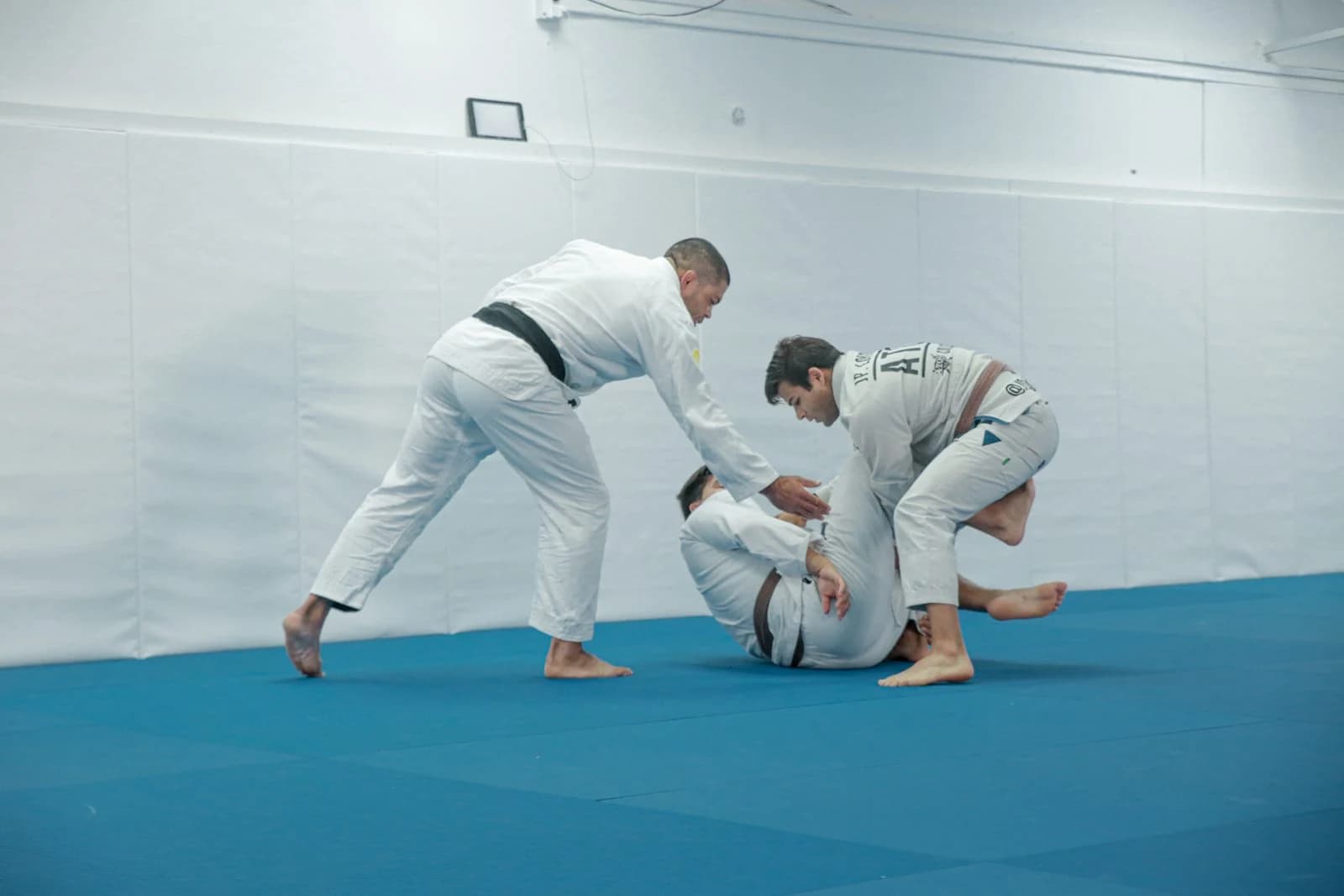
Drilling BJJ with three people: give the third person a job
Quick answer: If three people are sharing a BJJ drilling group, ask the coach how they want the group to work. For an approved cooperative drill, a short six-turn rotation can give everyone a turn performing the movement with each partner. Give the observer one visible detail to watch, keep the receiving partner's response consistent, and stop the rotation when the coach changes the task.
Three people can agree to take turns and still finish a drilling block with one person barely having moved.
The problem is usually hidden in the phrase take turns. Does the person who just received the technique now perform it? Does the person sitting out enter first? Does a correction earn somebody another five repetitions? Without an order, a polite group can spend much of the lesson negotiating its own rotation.
The format below is a proposed arrangement for a cooperative drill, subject to the instructor's approval. It is meant to solve that small organizational problem. Live positional rounds, takedown practice and other assignments may need a different arrangement chosen by the coach.
Establish which task the three of you are doing
Before inventing a rotation, establish what the instructor wants repeated. That includes the starting position, the partner's response and the point where the repetition ends. Otherwise the third person can enter a drill that has already changed into something else.
In a hypothetical guard-passing lesson, the assignment might stop after obtaining a particular entry. If one pair keeps going until a full pass and a submission, they have lengthened their turn and added material. The waiting partner now has less time for the actual entry the class was shown.
The Academy of Jiu-Jitsu's etiquette page tells students to stay with the technique the instructor demonstrates during drilling. That is a useful boundary here: the rotation should organize the existing lesson rather than replace it with a group project.
Ask the coach one concise question about working as three. They may already have a preferred system, another partner available or a reason to assign a different activity. Follow that answer. A rotation that conflicts with the class plan has failed before anyone takes the first turn.
Name the roles before counting repetitions
For this proposed format, the active practitioner performs the assigned movement. The receiving partner supplies the response the coach requested. The observer stays clear of the exchange and watches one agreed detail. Receiving is a task too; it does not mean becoming a loose collection of limbs.
Choose a short unit everyone understands. Three repetitions per turn is one possible example, not a claim that three is an ideal training dose. A coach may prefer a timed interval or another count. Pick the unit with their approval and keep it the same across the cycle.
State how sides are handled. If the lesson calls for both sides, agree whether one turn includes both or whether the coach wants a particular side first. Otherwise one person's three repetitions may take twice as long as another's.
The turn ends at the agreed count or signal. A missed detail can become a question for the coach; it does not automatically give the active practitioner an unlimited extension. That small rule keeps the person who is least comfortable asking for a turn from disappearing into the observer role.
Use a six-turn order that includes both partners
Call the three people A, B and C. These letters describe an example group, not ability, rank or seniority. In each turn, the first named person performs the drill and the second supplies the agreed response:
A works with B; C observes.
B works with C; A observes.
C works with A; B observes.
A works with C; B observes.
C works with B; A observes.
B works with A; C observes.
After the first three turns, everyone has performed, received and observed once. After all six, everyone has performed with both partners and received from both partners. Each person has also observed two turns.
If the approved unit were three repetitions, each practitioner would complete six active repetitions across the cycle, three with each partner.
Keep the order somewhere the group can remember without introducing a phone onto the mat. The observer can announce who comes next at the reset. If the coach changes the lesson after four turns, stop there and follow the new instruction rather than finishing the chart at the class's expense.
Give the observer a detail they can actually see
A useful observation is narrow enough to answer without diagnosing the whole technique. Did both partners reset to the demonstrated starting grips? Did the active practitioner pause at the position the coach asked to check? Did the receiving partner provide the same requested response on each repetition?
Choose one of those, or another visible detail supplied by the coach. Looking at everything invites a running commentary that can interrupt the pair and make the drill harder to follow. The observer's task can be as small as noticing that the second repetition began from a different position.
There is a boundary between describing that difference and teaching a replacement movement. Academy Jiu Jitsu's published code of conduct prohibits coaching or instructing other students without instructor permission. Ask how your own coach wants feedback handled rather than treating the observer role as permission to teach.
A description such as we started with different grips that time leaves the correction to the instructor. Our guide to giving a training partner useful feedback develops that distinction between an observation and an unsolicited lesson.
Keep the receiving partner's job consistent
Changing partners can change the drill even when the active practitioner's intention stays the same. One receiver may offer the demonstrated position; another may immediately escape it. The active practitioner is now solving two different tasks, and the group may misread the difference as a failure of the movement.
Use the response the coach requested. If that response is unclear, ask about it before adding resistance or counters. In the guard-passing example, a cooperative entry drill and a live attempt to prevent the entry require different behavior from the person on bottom.
On the second half of the cycle, the active practitioner works with the other partner. Treat that as a chance to repeat the assigned task with another person, without promising that the movement will feel identical. Body proportions, familiarity and the way someone sets the starting position can make a detail worth asking about.
If a combination is unsuitable, stop and involve the coach. The rotation is a scheduling aid. It is not a reason to force every pairing, intensity or movement. A group can alter its order or assignment when the instructor gives it a better arrangement.
Keep the third body outside the exchange
The observer needs a place to watch without becoming an obstacle. Ask where to sit or stand, especially when nearby pairs are moving. Avoid arranging three separate stations inside space that was allocated for one pair.
Do not reach into a moving repetition to put somebody's hand or foot in place. Stop the action, ask for clarification and let the coach demonstrate the correction. The active pair should know when a repetition is happening and when everyone has paused to discuss it.
Conversation also needs a limit. A short observation at the reset is easier to use than instructions spoken over the middle of a movement. When the instructor calls for attention, all three stop. The person receiving the technique should not have to choose between listening to the class and finishing a group discussion.
The broader BJJ gym etiquette guide covers these shared-space habits. In a trio, the practical test is immediate: can the active pair complete the assignment while the third person remains clear, attentive and ready for the next turn?
Review one cycle before changing the system
At the end of the cycle, identify the actual problem before changing the format. If the starting position drifted, fix that with the coach. If one person received fewer active turns, check the order. If everyone kept losing count, use a simpler approved turn unit.
Avoid changing the count, resistance and technique all at once. Then nobody knows which change made the next cycle feel different. One small adjustment is easier to explain when the coach returns to the group.
There is also a clear counterexample: a winner-stays-in positional game may deliberately give unequal time to different participants. That is another task. Do not impose this six-turn cooperative rotation on a live game the instructor has designed around staying in or rotating out after a result.
Before the next demonstration, leave the coach with one specific question if the group needs help. Everyone should be able to identify their next role and repeat the assigned starting position. If the movement keeps breaking down at the same point, bring that point to the instructor before beginning another cycle.
The takeaway
Three-person drilling needs an explicit order and a clear job for the person waiting. The six-turn example gives each practitioner an active turn with both partners, while leaving room for the coach to choose the count, response and appropriate pairings.
Try it only within the class assignment. Keep the observer's contribution narrow, stop when the instructor calls the room together, and use any remaining confusion to ask a better question about the drill.
Find a class where you can ask
Explore BJJ gyms on Let's Roll and ask the instructor how they organize cooperative drilling when the class has an odd number of students.
FAQ
Can three people drill one BJJ technique together? They can share a cooperative drill when the coach approves the arrangement. Only two people perform the exchange at a time in the proposed format; the third observes from a clear position.
What should the person sitting out watch? Choose one visible detail, such as the agreed starting grips or the requested partner response. Ask the coach how observations should be shared rather than appointing the observer as an instructor.
Does everyone get equal active turns in this rotation? Yes, if the six-turn cycle is completed as described. Each person performs twice, once with each partner.
Should we use the same order for live positional rounds? Only if the coach chooses it. A live game may have different goals and rotation rules, so this cooperative-drilling example should not replace the instructor's assignment.

Nina Okada
Nina Okada explains positions the way a good training partner does: one problem at a time, with the limits of the explanation said out loud. She is careful about the difference between what footage shows and what it only suggests.
Related Posts

Take BJJ seminar notes without missing the seminar
When filming is off limits, a few well-timed notes can preserve the starting position, the sticking point and the question you need to ask.
BJJ with low vision: make the class easier to follow
A useful first session starts with access arrangements, clear explanations, and asking the student what works for them.

Cycling to BJJ: plan the ride home before the first round
Make riding to jiu-jitsu workable with a route check, secure kit, a parking plan, and an honest decision about the journey home.
Comments (0)
Loading comments...