
Give your BJJ partner feedback they can actually use
Quick answer: Useful BJJ partner feedback describes a specific exchange and leaves room for the other person to disagree. Ask whether feedback is wanted, separate what you felt from what you think caused it, and test one small change together. Being a helpful partner does not require pretending to be the coach.
A partner can tell you something a video cannot: exactly when they felt able to move. That information is useful. It becomes less useful when it arrives buried inside a lecture about everything your jiu-jitsu lacks.
The difference is usually precision, not rank. A newer student may accurately report that a grip came loose. An experienced student may still make an incorrect guess about why. Good feedback leaves those two statements separate.
Ask before turning the round into a lesson
Start with consent to the conversation. Ask whether your partner wants an observation about the exchange. They may be working on something else, heading to the next round, or simply not ready to discuss the attempt yet.
A refusal need not make the next round awkward. You offered information, and they chose not to take it at that moment. Keep training considerately. Advice that must be accepted to preserve the relationship is no longer much of an offer.
During a taught drill, follow the instructor's format. If the coach has asked partners to give a particular kind of feedback, use that task. Do not replace the demonstration with your preferred variation while the other person is trying to learn what was assigned.
There is a separate category for an immediate training concern. You can say that something hurts, that you need to stop, or that the pace is not what you agreed. You do not need permission to communicate your own limit. Technical advice can wait; a request to stop should not.
Describe the moment you can actually identify
A broad assessment such as saying a guard is weak gives the partner little to work with. A specific observation can be examined. Their knee moved away, you found room to turn, or the grip released when you changed direction.
Stay with what you felt or saw. If you were the person underneath, describe when space appeared. If you were passing, describe the point where the connection stopped controlling you. You do not have to explain the entire technique to provide that information.
Use the immediate sequence rather than reconstructing a dramatic version of the round. Both people may remember it differently. That is a reason to reset the position slowly, not a reason to argue about who has the more authoritative memory.
For example, you might say that you could turn after the partner changed grips. That does not prove the grip change was wrong. It identifies a place to investigate. The coach may show that the grip was correct but another part of the position needed to change with it.
Separate the observation from the proposed fix
There are two steps in useful feedback: identifying what happened and suggesting what might change it. Keep them distinct. Your first step may be accurate even when the second is not.
A partner might correctly feel that your pressure disappeared when you moved a knee. Their suggestion to keep that knee fixed forever could still be wrong for the position. Treat the observation as evidence and the proposed correction as something to check.
This is particularly useful when students have learned from different instructors. A familiar detail can belong to a different variation. The guide to learning from different coaches explains why the starting conditions matter before apparently conflicting instructions are combined.
Use ordinary uncertainty where it belongs. Say that you think an adjustment may help, rather than presenting a guess as a rule. You can be direct without being absolute. A partner is more likely to learn something useful from a clearly identified possibility than from a confident correction that later has to be unlearned.
Change one part of the exchange
Once both people want to investigate, make the comparison small. Return to a familiar starting position and agree on what the defender will attempt. Try the proposed change at a manageable pace, then compare it with the original version.
Keep the test fair enough to learn from. If the defender suddenly uses much more effort on one attempt, the outcome no longer isolates the detail you meant to examine. You may still learn something, but be honest about what changed.
A simple feedback loop can look like this:
Name the specific point where the position changed.
Agree on one adjustment and one expected response.
Repeat slowly enough for both people to observe it.
Ask the coach if the result remains unclear.
Do not call a technique solved after one cooperative attempt. The exercise is a first comparison. More realistic resistance can follow when the coach considers it appropriate. The article on BJJ constraint games offers ways to define a limited training problem without turning every attempt into an unrestricted round.
Do not explain away every successful attack
A partner who catches you does not automatically need a tutorial from you afterward. Sometimes the appropriate response is to acknowledge the exchange and reset. Offering an immediate explanation of how they could have done it better can make a successful attempt feel like something they are not allowed to own.
If you genuinely noticed a useful detail, ask whether they want it. Keep the information separate from the fact that you were caught. There is no need to repair your standing in the room before the next round.
The same restraint applies when a newer partner succeeds. You may have been working at a lower intensity or exploring a position. Unless that context is relevant to an agreed drill, announcing it can serve your pride more than their learning.
Honest feedback includes credit. You can say that their grip prevented your usual escape or that their timing caught you before you could reset. That is specific information too. A training conversation does not become more serious merely because every sentence identifies something wrong.
Match the amount of feedback to the opening
The pause after a round is small. Choose one observation. A partner is unlikely to remember a long list delivered while they are tired and another person is already asking them to train.
If the topic needs more time, arrange it. You could revisit the position after class, ask the coach together, or dedicate part of an open mat to it. Do not assume the other person has silently agreed to remain until your explanation is complete.
For beginners, use the terms they know. Point to the relevant grip or position and let them ask for more detail. An explanation packed with unfamiliar names can sound impressive while leaving the actual question untouched.
For experienced partners, concision still helps. They may understand a short description and prefer to explore the adjustment themselves. Helpful feedback should fit the person receiving it, rather than becoming an opportunity to deliver every thought the exchange produced. Leave enough space for their account of what they were trying to do.
Receive feedback without surrendering judgment
You can listen carefully and still decide that a suggestion needs checking. Thank the partner for the observation, ask a clarifying question, and bring the issue to the coach if necessary. Accepting information does not require immediately replacing the technique you were taught.
When you disagree, keep the discussion close to the position. Explain what you were attempting and ask whether the partner is describing the same moment. Many disagreements become smaller once both people point to the same part of the exchange.
If someone repeatedly offers advice you do not want, set a clear boundary. Say that you would like to finish the assigned drill or save technical questions for the instructor. You do not need to debate their qualifications to make that request.
The relationship can remain friendly. Training partners have different strengths: some explain details well, some provide useful resistance, and some are simply reliable people to work beside. Nobody needs to perform every role. Good feedback is one possible contribution to the room, not a compulsory conversation after each round.
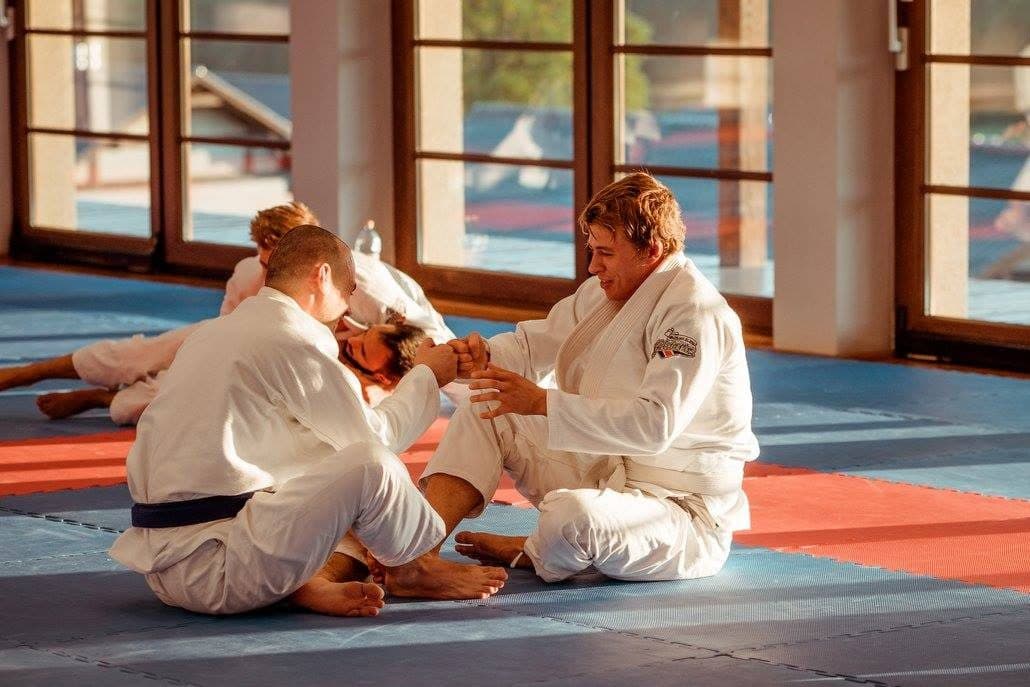
Main photo: BJJ Globetrotters; illustrative archive photograph.
The takeaway
The most useful partner feedback is usually small: a moment identified accurately, a possible explanation clearly labelled, and a change both people agree to examine. Keep observations separate from conclusions so the information survives even if the first proposed fix does not.
Ask before teaching, give credit when something works, and involve the coach when the technical question exceeds what either partner can resolve. A helpful exchange should leave both people with a clearer idea of the position, not a new argument about who gets to explain it.
Make room for a focused training question
Find open mats, confirm that technical practice fits the host's format, and arrange a small positional task with a willing partner.
FAQ
Can a white belt give useful BJJ feedback? Yes. A newer student can accurately describe what they felt or when they were able to move. They should separate that observation from a technical correction and ask the instructor when the explanation is uncertain.
Should I correct my partner during every drill? Follow the coach's instructions and ask whether your partner wants the observation. Keep corrections specific and relevant to the assigned task. Stop immediately for a safety concern or a request from either person to pause.
What if my partner's advice conflicts with the coach's? Identify whether both instructions concern the same starting position and goal. Treat the partner's suggestion as a question to check, not an automatic replacement. Ask the coach to explain the difference when needed.
How can I stop unwanted coaching without being rude? State the preference directly: you want to complete the assigned drill or save the question for the instructor. You can appreciate the intention without accepting a lesson you did not request.

Owen Bellamy
Owen Bellamy writes for the person training twice a week around a job. Nothing he suggests requires quitting the job.
Related Posts

Mikey Musumeci gives up the belt to make room for MMA
Musumeci is vacating his UFC BJJ title to focus on MMA training. What he is leaving, what continues, and why the transition matters.
IBJJF membership: finish the paperwork before the deadline
IBJJF membership and tournament entry are separate steps. Plan documents, professor approval, renewals, and junior accounts before registration closes.
Choosing a BJJ seminar worth your time and travel
Choose a BJJ seminar by the subject, teaching format, access, and total cost. Know what to ask the host before buying a ticket.
Comments (0)
Loading comments...