

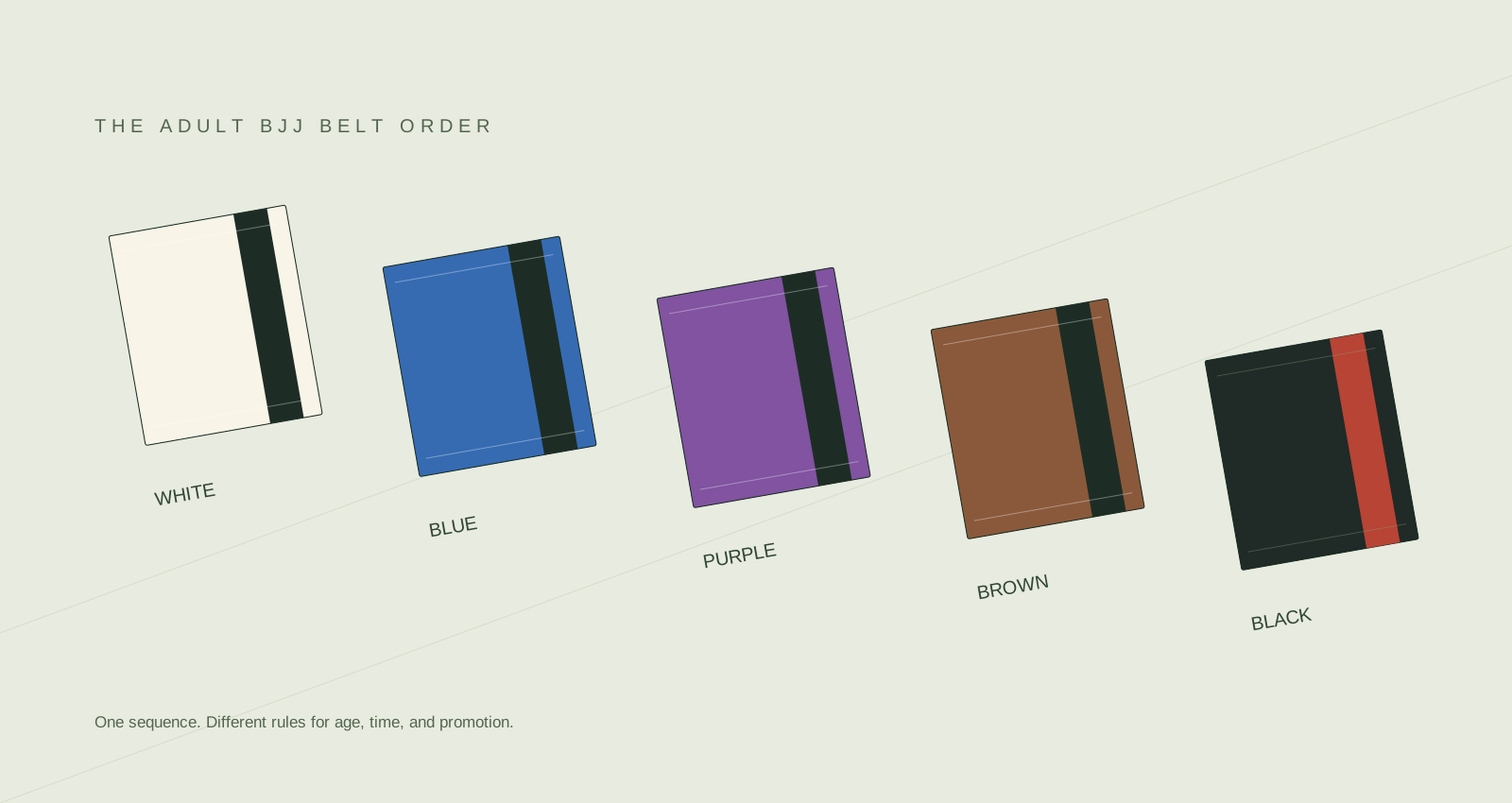
A blue belt can have no stripes. A teenager can hold a purple belt. A black belt can still be decades away from a red belt. All three fit the same jiu-jitsu ranking system once age, rank, and degrees are separated.
Those distinctions get lost in a tidy line of colored rectangles. Rank tells you where someone sits in a school’s progression. Age rules determine which ranks IBJJF recognizes. Minimum periods set the earliest possible recognition for certain promotions. They answer different questions.
This guide uses the IBJJF General Graduation System published in June 2026, version 3.3. The change matters: an Adult brown belt World champion can now be recognized at black belt at 18. That exception does not make 18 the general black belt minimum. Use the belt explorer for a quick reference, then read the sections that explain the conditions.
Belt reference
Find the rank. Read the conditions.
Choose a system and a belt to see the age rules and what the period actually measures. Compare the complete references below when you need more than one rank.
White
- Minimum IBJJF age
- Any age
- Period at this rank
- No IBJJF minimum time at white
Starting rank. No federation waiting period does not mean automatic promotion; the professor decides readiness.
Check the official graduation system (PDF)Age means current calendar year minus birth year in the IBJJF system. Default periods are measured at the displayed rank, from completed IBJJF registration. This reference shows rank rules, not a personal promotion date. Read Article 3 for youth-history and Adult World champion exceptions.
Checked against the June 2026 IBJJF General Graduation System, version 3.3. Black belt at 18 applies only to the Adult brown belt World champion exception.
Complete adult / ages 16+ reference
White
- IBJJF age:
- Any age
- Period at this rank
- No IBJJF minimum time at white
Starting rank. No federation waiting period does not mean automatic promotion; the professor decides readiness.
Read the IBJJF source (PDF)Blue
- IBJJF age:
- 16
- Period at this rank
- Default adult period at blue: 2 years
This is time at blue before purple, not time required to earn blue. Youth registration and Adult blue belt World champion exceptions apply. Ages 16–17 have no minimum at blue.
Read the IBJJF source (PDF)Purple
- IBJJF age:
- 16
- Period at this rank
- Default adult period at purple: 18 months
This is time at purple before brown. Prior youth or Juvenile registration and an Adult purple belt World title can alter the minimum. Brown is only available from the Adult division.
Read the IBJJF source (PDF)Brown
- IBJJF age:
- 18
- Period at this rank
- Default adult period at brown: 1 year
An Adult brown belt World champion has no minimum period at brown. Black belt at 18 is restricted to that championship exception; otherwise the ordinary minimum age is 19.
Read the IBJJF source (PDF)Black
- IBJJF age:
- 19 ordinarily; 18 with the Adult brown belt World title exception
- Period at this rank
- First degree: 3 years of proven qualifying activity
Black belt promotion, IBJJF rank registration, and black belt degree certification have different requirements. A degree is not awarded solely because a date passes.
Read the IBJJF source (PDF)Red-and-black
- IBJJF age:
- 49
- Period at this rank
- Seventh degree: 31 qualifying years from black belt
Represents seventh-degree black belt. IBJJF requires recognized activity and certification. The next senior rank follows seven more qualifying years.
Read the IBJJF source (PDF)Red-and-white
- IBJJF age:
- 56
- Period at this rank
- Eighth degree: 38 qualifying years from black belt
Represents eighth-degree black belt. The next senior rank follows ten more qualifying years.
Read the IBJJF source (PDF)Red
- IBJJF age:
- 66
- Period at this rank
- Ninth degree: 48 qualifying years from black belt
Represents ninth degree. The document reserves the historical tenth-degree distinction for the named pioneers, rather than presenting it as an ordinary next application.
Read the IBJJF source (PDF)
Complete kids / ages 4–15 reference
White
- IBJJF age:
- Any age
- Period at this rank
- No IBJJF minimum time
Starting rank. The youth chart covers ages 4–15. A white belt may remain white when moving into the 16-and-older system.
Read the IBJJF source (PDF)Gray group
- IBJJF age:
- 4–15
- Period at this rank
- No IBJJF minimum time in each belt
Gray-and-white → gray → gray-and-black. These long center-stripe variants are ranks; small end stripes are degrees. At calendar-year age 16, this group moves to blue under IBJJF rules.
Read the IBJJF source (PDF)Yellow group
- IBJJF age:
- 7–15
- Period at this rank
- No IBJJF minimum time in each belt
Yellow-and-white → yellow → yellow-and-black. Reaching age 7 does not require an immediate promotion. At calendar-year age 16, this group moves to blue.
Read the IBJJF source (PDF)Orange group
- IBJJF age:
- 10–15
- Period at this rank
- No IBJJF minimum time in each belt
Orange-and-white → orange → orange-and-black. The professor determines promotion within the age rules. At calendar-year age 16, this group moves to blue.
Read the IBJJF source (PDF)Green group
- IBJJF age:
- 13–15
- Period at this rank
- No IBJJF minimum time in each belt
Green-and-white → green → green-and-black. At calendar-year age 16, a green group athlete may move to blue or purple at the professor’s decision.
Read the IBJJF source (PDF)
Adult jiu-jitsu belts in order
For practitioners aged 16 and older, the familiar BJJ belt sequence is white, blue, purple, brown, and black. Red-and-black, red-and-white, and red belts come after black within the IBJJF degree system. The later colors reflect senior degrees; they are not extra competition divisions that a new student needs to work through.
“Adult belts” is convenient shorthand, but IBJJF’s sequence begins in the Juvenile division at 16. Blue and purple are available from that age. Brown begins at 18. Black generally begins at 19, with the specific 18-year-old World champion exception introduced in the current graduation document. The official graduation system separates these age requirements from time at each belt.
A belt also has a limited job. It communicates a recognized rank. It cannot tell a visiting partner someone’s weight, injury history, preferred pace, or experience in a particular position. Ask before a round rather than using color as a complete briefing.
If you are starting from scratch, your immediate task is smaller than the whole chart: learn the class routine and find out what your instructor expects from beginners. The jiu-jitsu beginner guide covers that first step.
- White → blue → purple → brown → black.
- Black belt seventh degree → red-and-black.
- Black belt eighth degree → red-and-white.
- Black belt ninth degree → red.
White and blue describe a progression, not a universal syllabus
White is the starting rank. IBJJF imposes no minimum time at white belt before blue, but the absence of a federation waiting period does not mean a student is ready for promotion immediately. The professor decides when to promote, subject to the requirements of the system in which that rank will be registered.
At a practical level, a beginner needs enough context to understand what is happening. Which person is on top? Is a partner trying to pass the legs, escape a pin, or establish a submission? Knowing the name of a position helps, but recognizing it during a round is a different task. A useful conversation with a coach can focus on that gap.
Blue is the next rank in this sequence and has an IBJJF minimum age of 16. There is no single list in the graduation document saying that every blue belt must perform an identical set of moves. A school may have a curriculum, an assessment, or other promotion criteria. Ask for that school’s expectations instead of treating an online checklist as its policy.
For example, “What do you want me to understand before blue belt?” can produce a useful answer. “How many submissions do I need to know?” may reduce a broad judgment to a number the instructor does not use. For a clearer conversation, see how to ask your BJJ coach a useful question.
Purple and brown do not come with one prescribed game
Purple follows blue; brown follows purple. Under IBJJF’s age rules, purple can be recognized from 16 and brown from 18. The default adult minimum periods are 18 months at purple before brown and one year at brown before black. Registration history and Adult World Championship titles can change those requirements, as explained below.
The color does not prescribe a favorite guard or require everyone to move the same way. Two people at the same rank may solve a position differently. One may prefer staying seated; another may build a game around getting on top. That difference alone does not tell you which person understands jiu-jitsu better.
A more useful technical question is whether the person can explain a decision and its limit. If a guard pass works because the defender cannot bring a knee inside, what happens when that knee returns? That is an example of a learning question, not an official purple belt examination. Your instructor’s actual criteria still govern your school’s promotion decision.
Brown is often discussed as though it were a waiting room for black. The minimum period can encourage that reading, but a year passing does not itself evaluate a student. A coach may identify a specific weakness, ask for broader understanding, or decide that more time is needed. The calendar provides one condition; it cannot supply the whole judgment.
Black belt is followed by degrees and senior colors
The black belt itself is a rank. Its degrees are additional distinctions. In IBJJF’s system, black belt has first through sixth degrees before the seventh degree is represented by a red-and-black belt, often called a coral belt. Eighth degree uses red-and-white, also commonly called coral. Ninth degree uses red.
The published progression requires proven activity, not simply the passage of calendar years since someone bought a black belt. The first three degree intervals are three years each. The next three are five years each, reaching sixth degree after 24 qualifying years. Seventh degree follows at 31, eighth at 38, and ninth at 48 qualifying years. Article 4 of the current graduation document explains the evidence and certification rules.
The minimum ages are 49 for red-and-black, 56 for red-and-white, and 66 for red. Age and recognized activity work together. Reaching one of those birthdays does not award the belt. The document also identifies tenth-degree red belt as a distinction given to the named pioneers of Brazilian jiu-jitsu; it is not the next ordinary application after ninth degree.
Promotion and IBJJF certification are separate processes. A professor can award a rank while federation registration and certification require their own review. Certification has documentation and course requirements. Read our black belt certification guide if that administrative distinction is the question you need to resolve.
What stripes mean, and why four is not a universal countdown
The small bands on a belt usually indicate degrees, commonly called stripes. IBJJF’s system divides white, blue, purple, and brown into four degrees, but it leaves adoption of that degree system through brown belt to the professor. A school can therefore recognize progress without following a four-stripe schedule.
That matters when comparing teammates or moving schools. A student with three stripes has not necessarily completed exactly three quarters of a standardized curriculum. Another student’s unstriped belt does not prove they have only just started at that rank. Before interpreting the tape, find out how the academy uses it.
Kids’ degrees have additional suggested formats. IBJJF publishes monthly, quarterly, and every-four-month approaches, with different numbers and arrangements of stripes. These are suggested systems that a professor may adopt. They are not a requirement that every child in every academy receive tape on the same date.
The distinction becomes stricter at black belt, where IBJJF recognizes degrees according to its own activity and certification rules. Do not transfer the flexible meaning of a white belt stripe to a black belt degree, or assume the paperwork for one works like the other. They occupy different parts of the graduation system.
Kids’ BJJ belts: gray, yellow, orange, and green groups
The IBJJF youth sequence covers ages 4 through 15. After white, there are four color groups: gray, yellow, orange, and green. Each group contains three belts: the color with a white center stripe, the solid color, and the color with a black center stripe. That makes 13 ranks including white.
These long stripes running along a belt identify the rank itself. They are different from the small degree stripes placed near the end. A gray-and-black belt is therefore a rank within the gray group, not an adult black belt or a gray belt with a particular number of degree stripes.
Age determines when a group becomes available. Gray starts at 4, yellow at 7, orange at 10, and green at 13. Each youth group ends at 15 within this system. The chart does not say that a child must receive the first belt in the next group as soon as that age arrives. IBJJF specifies no minimum time in each youth belt; the professor still makes the promotion decision.
A child starting at 12 does not have the same available calendar as someone starting at 4. Treating all 13 ranks as a mandatory race before age 16 produces the wrong question. Ask the program how it handles older beginners and transitions instead. The kids’ belt guide explores the parent-facing side of that conversation.
- Gray-and-white → gray → gray-and-black: ages 4–15.
- Yellow-and-white → yellow → yellow-and-black: ages 7–15.
- Orange-and-white → orange → orange-and-black: ages 10–15.
- Green-and-white → green → green-and-black: ages 13–15.
What happens to a kids’ belt at 16?
IBJJF uses calendar-year age: the current year minus the athlete’s birth year. Someone born in 2010 therefore has an IBJJF age of 16 throughout 2026, including before their birthday. This calculation matters for the move from youth colors to the sequence used from Juvenile 1 onward.
The graduation document gives specific conversion rules. A white belt may remain white. An athlete in the gray, yellow, or orange group must move to blue. A green belt may move to blue or purple at the professor’s decision. These are transitions between two ranking systems, not proof that a child skipped a fixed adult curriculum.
The same registration history can affect later minimum periods. That is why a parent or teenager should keep the actual rank history clear instead of relying on a photograph of an old belt. A prior registered youth rank and a rank remembered informally are not interchangeable when the federation is evaluating its requirements.
Ask about the class transition separately. A competition-age rule does not answer whether a particular teenager should join a certain adult session, what partner matching will look like, or which training restrictions the school applies. Those are questions for the program and instructor, alongside the paperwork for the new belt.
IBJJF minimum time is not an average promotion timeline
For an athlete aged 18 or older without an applicable exception, IBJJF lists no minimum period at white, two years at blue, one and a half years at purple, and one year at brown. These are periods at the current belt before the next promotion can be recognized. They are not promises about how quickly a school will promote. These are the defaults in Article 3 of the graduation system, with the exceptions listed immediately afterward.
The federation counts these periods from completion of registration at each rank. A person who trained for years but only recently registered needs to check their record with IBJJF; adding the time they remember training will not automatically reproduce the federation’s calculation.
The exceptions are specific. At blue, a previous registered gray, yellow, or orange belt reduces the period to one year. Prior green or Juvenile blue registration removes that minimum. At purple, prior Juvenile blue registration can reduce the period to one year. Certain combined youth and Juvenile histories remove it. Prior Juvenile purple registration also removes it. Adult World champions at blue, purple, or brown have no minimum period at the corresponding rank under Article 3.
For ages 16 and 17, white and blue have no minimum period, while brown is only available in the Adult division. An Adult brown belt World title also supports the special black belt eligibility at 18 introduced in June 2026. These rules are too conditional for a useful “your black belt date” calculator. The explorer gives the default and directs exceptional cases to the actual document.
A Master title does not become an Adult World title by dropping the word “Master.” The published exemptions name the Adult World Championship. Anyone relying on one should confirm that their precise title and registration history satisfy the rule.
How long does it take to get a BJJ black belt?
The honest answer for an individual student begins with their instructor and training history. The official graduation system does not publish an average white-to-black duration. Adding its default minimum periods gives 4.5 years after blue belt registration, but that arithmetic leaves white belt time out and does not predict a promotion.
A website can make a timeline look exact by assigning a neat number of months to every color. Unless the number comes from a defined sample, with a clear starting point and treatment of people who stopped training, it is not a dependable population average. The precision of the graphic does not repair the missing evidence.
For your own training, ask for the next observable improvement. You might ask a coach to watch whether you can maintain a position when the partner changes grips, or whether an escape still works when the first attempt fails. Those are proposed review tasks. They make a discussion concrete without claiming that one technical test earns a belt everywhere.
Attendance is worth discussing because it affects the training available to you. It still cannot turn two students with different backgrounds and responsibilities into a fair head-to-head promotion clock. A useful plan describes what to practice and when to review it. It need not end with a predicted color.
Ask the school about promotion and the organizer about eligibility
A promotion decision belongs to your school’s system. Competition eligibility belongs to the event’s rules and registration process. The two connect, but they should not be collapsed into a single check. A newly awarded belt may require a membership update before the next tournament.
Before entering, verify the event’s age division, recognized belt, and current registration record. Do not choose a lower rank to create a more convenient bracket. If a promotion occurs near a deadline, ask the organizer how the change must be recorded and keep the answer with your entry information.
If you are comparing academies, ask how progress is assessed, who awards promotions, and whether testing or promotion fees are separate from membership. The answers tell you more about the program you might join than a promised date for blue belt. You can find jiu-jitsu gyms and then check those policies directly with the schools that fit your schedule.
For a current student, one question is usually enough to open a productive conversation: “What should I work on before our next progress review?” Ask for an example you can recognize during training. That gives you something to bring back to class, even when the answer contains no date and no tape.
Common questions
What are the jiu-jitsu belts in order?
From age 16 onward, the main sequence is white, blue, purple, brown, and black. IBJJF then recognizes red-and-black at seventh degree, red-and-white at eighth degree, and red at ninth degree. Children aged 4–15 use white plus gray, yellow, orange, and green groups.
How many belts are there in BJJ?
There are five main ranks from white through black in the sequence used from age 16. Including the three senior colors gives eight. The IBJJF youth system contains 13 ranks: white plus three variants in each of four color groups. Count ranks and degree stripes separately.
How long does it take to get a blue belt?
IBJJF sets no minimum time at white belt. Your professor decides when to promote, and a school may have its own curriculum or assessment. That rule does not establish an average or guarantee a particular number of months. Blue belt has an IBJJF minimum age of 16.
Do you need four stripes before the next belt?
Not under a universal IBJJF requirement through brown belt. The federation describes a four-degree system for white, blue, purple, and brown, but adopting it is at the professor’s discretion. Ask how your academy uses stripes rather than assuming a fixed countdown.
Can someone get a BJJ black belt at 18?
Yes, under the June 2026 IBJJF update, an athlete who has won the Adult World Championship at brown belt can be recognized at black belt at 18. Without that exception, the ordinary minimum remains 19. Professor approval and the other applicable requirements still matter.
What belt does a child get when they turn 16?
In IBJJF’s calendar-year system, a white belt may remain white. Gray, yellow, and orange group athletes move to blue. Green group athletes may move to blue or purple at the professor’s decision. The conversion does not itself decide the appropriate class or training partners.
Are no-gi belts different from gi belts?
The IBJJF graduation document sets ranks rather than a separate no-gi color ladder. No-gi competitors do not wear the belt around their waist during a match, but rank still affects their division and permitted techniques. Another organization may use experience classes instead, so check that event’s rules.
Sources & accuracy notes
Sources checked . The belt reference uses the official June 2026 IBJJF General Graduation System, version 3.3. Minimum eligibility is separate from a professor’s promotion decision. Check the current official document before making a registration decision.
- IBJJF General Graduation System, June 2026, version 3.3Adult and youth belt sequences; age calculation and minimum ages; Article 3 minimum periods and registration-history exceptions; degree progression; certification requirements; June 2026 black belt exception for Adult brown belt World champions.
- IBJJF graduation-system pageOfficial current publication location and statement that the three kids’ degree approaches are suggested methods chosen by the academy.
- IBJJF 2026 graduation-system posterVisual verification of rank order, age bands, belt colors, degree configurations, and default minimum periods, including the 18-year-old World champion footnote.
- IBJJF suggested monthly kids’ graduation systemOne example of an optional youth stripe system; supports why kids’ degree stripes must not be treated as one universal four-stripe countdown.
- IBJJF books and videosCurrent rulebook source for competition rules; rank recognition does not replace the event-specific eligibility and technical-rules check.
Found a factual error or a rule that has changed? Send a correction to support@letsroll.co.