

Yuri Simões: how he won ADCC in three different divisions
Quick answer: Between 2015 and 2022, Yuri Simões won ADCC titles in under-88kg, under-99kg, and the absolute division. That sequence crossed weight categories and survived an unsuccessful divisional campaign at the 2022 event. This retrospective looks at those three championships and the other competitive work around them.
Yuri Simões wasn't on the under-99kg podium at ADCC 2022. His name appears at the top of the absolute results instead. Reading only one bracket would leave you with an incomplete account of his weekend.
By then, he had already won ADCC in two weight classes. The open-weight title added a different category to that earlier success, while keeping a difficult first part of the event in the story. The interest lies in those separate competitive tasks, rather than a claim that one victory explains everything that preceded it.
To understand the 2022 result, go back to the earlier titles and the no-gi record between them. The route includes another sport as well, where a grappling reputation could open a door but couldn't determine the outcome.
The first title came at under-88kg
ADCC's 2015 event review identifies Simões as the under-88kg champion and records wins over defending champion Rômulo Barral and finalist Keenan Cornelius. That places the first title against specific opposition rather than leaving it as an isolated line in a biography.
The names matter because a division is a field of different problems. A successful approach against one opponent doesn't remove the work required against the next. The result confirms that Simões completed that task at the event; it doesn't require a claim that his game had become immune to everyone in the category.
There is a useful discipline in watching an athlete before later achievements enter the picture. Try treating the 2015 material as its own competitive setting. What position is being contested? Which attempts continue, and which get abandoned? Later medals can't answer those questions for the footage.
That approach also gives the opponents proper weight. They were participants in the match, making decisions and creating resistance. They shouldn't disappear into a retrospective where the eventual champion's success is written as though it had already been guaranteed.
A second championship changed the division
In 2017, Simões won under-99kg. The official ADCC results place Felipe Pena second, Jackson Sousa third, and Rafael Lovato Jr. fourth. It was another ADCC title, earned in a different weight category from his 2015 championship.
That difference is easy to lose in shorthand. Two-time champion tells you the count but not the shape of the achievement. Attaching the divisions gives the record more detail without adding any mythology about an athlete's intentions or physical transformation.
Nor does the change justify casual advice about moving up a division. A professional athlete's result isn't a recommendation for a recreational competitor's weight management. The relevant point here is historical: the championships belonged to distinct brackets.
A viewer comparing the two events should keep that distinction visible. Look at what the opponents offer and deny, rather than trying to prove that a single quality explains both wins. Similar results can be reached through different match situations. A careful comparison leaves room for differences that a short career summary tends to flatten.
The IBJJF record adds another measure
Between those ADCC titles, Simões won twice at the 2016 IBJJF No-Gi Worlds. The federation's official results list him first in adult black belt ultra-heavyweight and first in the open class. Gustavo Elias was second in the former; Murilo Santana was second in the latter.
Those results give the timeline more substance than a leap from one ADCC edition to the next. They establish success in another event structure and provide additional matches worth seeking out. A no-gi career can contain several distinct competitive settings even before anyone puts a gi back on.
Treat those settings separately when studying tactics. The value of a position depends partly on the rules and match situation. Don't assume that a sequence rewarded in one event produces the same score or strategic problem in another.
For a spectator, the advantage of broadening the viewing list is practical. You get more examples of the athlete facing resistance, rather than watching the same famous finish repeatedly. Include exchanges that don't end in submissions. They may show how the next position becomes available, or why a promising attempt has to be abandoned.
The team connection belongs in the account
In a 2020 profile published before his MMA debut, ONE Championship reported that Simões began judo at four, started BJJ at nine, received his black belt from Ricardo Vieira in 2011, and joined the Caio Terra Association in 2013. Those are attributed biographical details, not observations from a Let's Roll interview.
The team connection helps explain where to look for further accounts of his preparation. It doesn't allow a writer to divide credit for a title into neat percentages. The athlete competes, coaches contribute, and training partners supply work that a podium photograph cannot document in full.
For readers interested in how BJJ affiliations work, this is a useful distinction. An affiliation can identify a public relationship and a source of instruction. It is not a complete description of every person involved in an athlete's development.
Keep the documented relationship in the profile and leave unsupported explanations out. A story can acknowledge a coach's importance without inventing a private conversation, a particular training-room scene, or the precise moment somebody supposedly became ready to win.
MMA presented a different problem
Simões' MMA debut against Fan Rong supplied a clear reminder that achievements do not transfer as results. ONE's November 2020 event report records Fan winning by unanimous decision after three rounds. The report describes Fan defending takedown attempts and using his striking in the contest.
That outcome shouldn't be turned into an argument that the earlier grappling titles were less meaningful. It was another sport, with additional ways to create danger and different conditions for reaching the ground. Equally, the titles could not substitute for winning the fight that actually took place.
The interesting question is narrower than whether BJJ works. How does an athlete create access to the positions where their established skills are useful? In MMA, a failed entry can lead into exchanges that don't exist in a submission-grappling match. That changes the cost of getting to the preferred position.
ONE also published the full fight, which gives viewers a better basis for examining those attempts than a career-label argument. Watch the entries and the responses. Keep the analysis attached to this contest instead of treating it as a referendum on an entire martial art.
The 2022 absolute followed a difficult first day
The Caio Terra Association's account of ADCC 2022 states that Simões was eliminated before the divisional semifinals, then entered the invitation-only absolute. It credits the subsequent preparation and game plan to work with Terra. That is the team's account, and should be identified as such.
The independent check on the final placing is the organizer's official 2022 result sheet: Simões first in the absolute, Nicholas Meregali second, Tye Ruotolo third, and Roberto Abreu fourth. The open-weight win completed the three-category sequence discussed here.
There is no need to invent a psychological turning point between the brackets. Another competitive opportunity existed, and Simões won it. The team has described its role; the official record establishes the outcome. Those pieces are enough to make the weekend worth revisiting.
For an ordinary competitor, the relevant caution is that another division may offer another opportunity only when the event's eligibility rules permit it. A famous absolute run doesn't guarantee entry elsewhere. Check the actual format rather than building a tournament plan around somebody else's exceptional weekend.
Watch the work between the medal photographs
The most useful comparison across these years isn't a ranking of how celebratory each podium looks. It is a set of questions about the exchanges before the result becomes certain.
Watch how Simões first establishes contact, and how the opponent responds.
Follow one unsuccessful attempt instead of skipping straight to the next attack.
Keep the event rules and score alongside any tactical conclusion.
Separate what the footage shows from a theory about the athlete's intentions.
A sequence can be worth studying without containing a finish. A defended takedown, a reset, or a change of direction may explain why a later position becomes available. The match-review guide offers a way to record those observations without turning a viewing session into a catalogue of every movement.
Choose one question you can bring to a coach. You don't need to reproduce a champion's entire style. Understanding one transition, including the conditions under which it fails, is a more realistic outcome from an evening spent watching the archive.
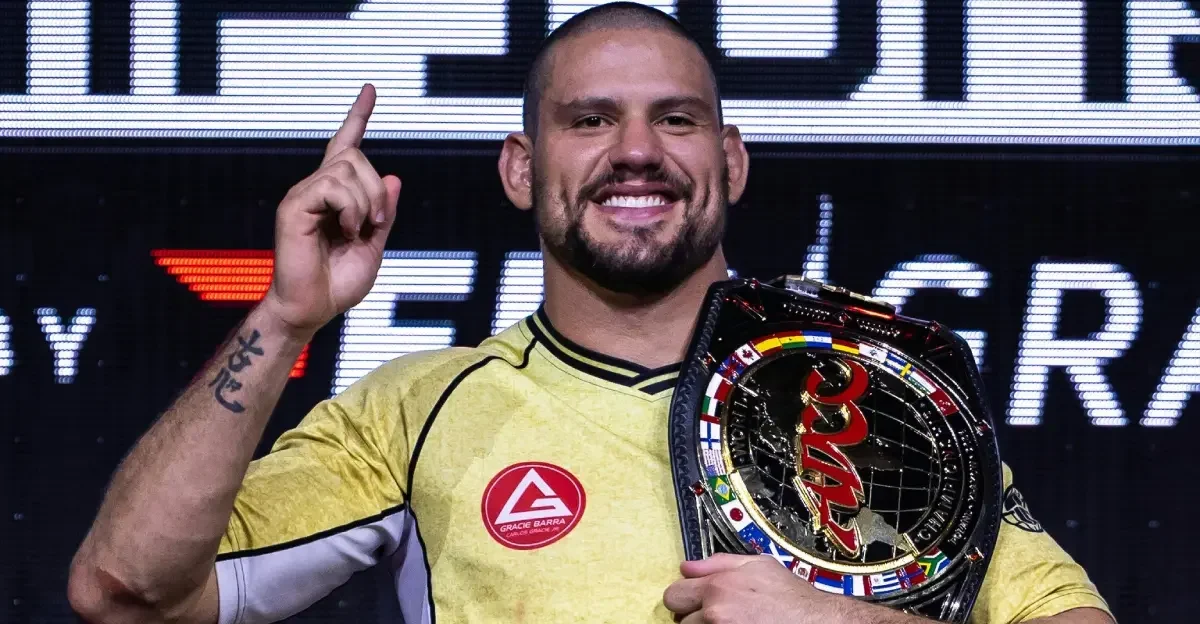
Main photo: Caio Terra Association; photographer not identified on the source page.
The takeaway
Under-88kg in 2015, under-99kg in 2017, and absolute in 2022 describe three distinct ADCC achievements. The IBJJF no-gi results and the MMA appearance around that period add context without making every contest part of the same uninterrupted winning story.
The 2022 weekend is especially instructive as a record: a divisional result and an absolute result can coexist. Keep both, then look at the matches. The athlete becomes more interesting when the account preserves the different tasks he faced.
Follow the next event
Use the Let's Roll tournament directory to find events to watch or enter, and confirm their current divisions and eligibility rules with the organizer.
FAQ
Which three ADCC divisions did Yuri Simões win in this period? He won under-88kg in 2015, under-99kg in 2017, and the absolute in 2022. This article examines that historical sequence rather than presenting a complete current career tally.
Did Simões win his weight class at ADCC 2022? No. The championship discussed here was the absolute title. His team's event account records an earlier elimination from the weight division.
Did Yuri Simões also win IBJJF no-gi titles? Yes. The 2016 official results list adult black belt gold in ultra-heavyweight and the open class. Those are separate achievements from the ADCC titles examined here.
Did his grappling success guarantee an MMA win? No. Fan Rong won their 2020 MMA contest by unanimous decision. The result belongs to that fight and its rules; it does not change the earlier grappling records.

Miles Serrano
Miles Serrano writes about competitors and the decisions that shaped their careers. He is more interested in the adjustment someone made in the third minute than in the medal count afterward.
Related Posts

Remembering names at BJJ is a training habit, too
Learn your BJJ teammates’ names without awkward introductions, forced small talk, or turning friendliness into a demand for private information.
Felipe Pena: the career beyond one rivalry
ADCC absolute gold, gi world titles in two divisions, and a career that deserves more than a summary of one rivalry.

Sharing a room at BJJ camp: agree on these things first
A better BJJ camp room share starts before booking: sleep, payment, laundry, room access, and enough space for separate plans.
Comments (0)
Loading comments...