
Felipe Pena: the career beyond one rivalry
Quick answer: Felipe Pena's career deserves more than a summary of his matches with Gordon Ryan. His 2017 ADCC absolute title sits alongside IBJJF world gold in two different gi weight classes in 2018 and 2019. Looking across those results gives a fuller picture of the athlete known as Preguiça.
Felipe Pena left ADCC 2017 with two different answers. Yuri Simões beat him in the under-99kg final. Pena then finished the absolute division above Gordon Ryan. The same event produced a silver medal and a championship, with neither result cancelling the other.
That is a useful place to begin a profile because it resists the easiest version of the story. Pena cannot be understood only as somebody's rival, and a tournament cannot always be reduced to its most replayed match. His record asks the viewer to follow him between divisions, opponents, and formats.
This retrospective focuses on the 2017–19 stretch that makes that point particularly clearly, with a later ADCC result for perspective. It is a route through the career, rather than an attempt to turn every appearance into one uninterrupted story of ascent.
Two finals made the 2017 picture complicated
ADCC's contemporaneous finals report records Simões beating Pena 2–0 in the under-99kg division and Pena beating Ryan 6–0 in the absolute. Those scorelines establish the outcomes. They do not, by themselves, describe every exchange or tell us what any athlete felt between matches.
The distinction matters because a later celebration can make the earlier result disappear from a retelling. Keeping both in view gives each opponent their due. A title in one bracket isn't a revision of the result in another. Equally, losing a divisional final didn't prevent Pena from winning the open-weight event.
For someone learning to watch grappling, this is more useful than sorting athletes into permanent categories of winner and loser. A particular matchup happens under particular conditions. Another opponent creates another set of problems. The official 2017 results preserve the separate podiums, which is how they should remain in the account.
Begin there before adding a theory about momentum. The medal table is already interesting without inventing the conversation that supposedly changed everything.
The rivalry is a chapter, not a job description
A recurring opponent gives spectators an easy point of entry. Two names fit neatly into a headline, and a rematch offers an immediate question about whether the result will change. There is nothing wrong with following a career through that doorway.
The limitation arrives when every other achievement becomes supporting material for the rivalry. Pena's matches with Ryan can be studied on their own terms without making Ryan the explanation for Pena's entire competitive identity. Readers who came to the sport through Gordon Ryan's career should still look at what Pena did against different opponents and in different uniforms.
It also helps to keep the event attached to the result. A points win in an ADCC bracket answers the question that match set. It shouldn't be silently converted into a claim about every ruleset, every duration, or every future meeting. Rivalries become less informative when their details are treated as interchangeable.
A better comparison asks what each contest required and what changed between appearances. That approach leaves room to appreciate a decisive result without asking it to carry more historical weight than it can support.
In 2018, the gi supplied another answer
The IBJJF's 2018 World Championship results list Pena first in the adult black belt heavyweight division, above Patrick Gaudio, with Fellipe Andrew and Keenan Cornelius sharing the bronze positions. This was a different competition from the no-gi event that had put him on the absolute podium the previous year.
That change of setting is central to the profile. Gi grips alter the available connections. The sleeve and lapel can become parts of an attack or obstacles a defender must remove. An athlete moving between formats has to solve the position actually in front of them, rather than rely on a medal from somewhere else.
The result sheet doesn't tell us precisely which technical habits transferred. For that, a viewer needs the matches. But it does establish why a study of Pena restricted to ADCC would leave out a substantial part of his work.
Watch a gi appearance with that question in mind: what role is the clothing playing in the exchange? Avoid treating it as decorative packaging around a no-gi game. The equipment changes the choices, even when the underlying objective is familiar.
The next world title came in another weight class
A year later, Pena appears at the top of the adult black belt medium-heavyweight results. The 2019 IBJJF record places Gustavo Batista second, followed by Matheus Diniz and Renato Cardoso. Together with the previous year's heavyweight gold, it gives a precise account of two titles across two divisions.
Keep the division names attached when discussing them. Calling both simply world titles is accurate at one level, but less informative. The distinction shows that the fields were not identical. It also prevents a reader from assuming that defending success always means returning to the same bracket.
What those records don't establish is Pena's reason for changing divisions, how he managed his preparation, or what the change cost him. Those questions would require a sourced account from the athlete or his team. A result cannot supply a private motive.
For the spectator, the practical consequence is a broader viewing list. Compare the opponents and the positions that appear, rather than expecting the two championships to be copies of each other. Repetition of a title can still involve a different competitive problem.
A later ADCC title extends the timeline
The career didn't end with that three-year window. VF Comunica's athlete profile records Pena winning the over-99kg title at ADCC 2024, finishing Luke Griffith with a rear-naked choke in the final. The same profile records a loss to Ryan in a separate superfight at that event.
Again, one weekend contains more than one result. A reader who keeps only the superfight would miss the divisional championship; a reader who keeps only the title would miss the other match. Neither requires pretending the two performances say exactly the same thing.
The seven years between the 2017 absolute title and the 2024 divisional title also make a narrow highlight selection less satisfactory as a career summary. They establish separate points on a long competitive timeline. They don't prove that every season between them unfolded smoothly, or that the athlete remained technically unchanged.
That is the reason to revisit older matches alongside newer ones. Look for what the footage actually lets you compare. An old result is a reference point, not an obligation for the next version of an athlete to behave identically.
The academy is another part of the record
Pena's official academy site identifies Gracie Barra Felipe Preguiça and presents programs for different experience levels, alongside information for prospective students. It is a concrete part of his public work beyond the competition bracket.
A famous athlete's academy still deserves to be evaluated as a place where ordinary people train. A prospective student needs the appropriate class, a workable journey from home, and clear answers about joining. A championship record does not tell you which instructor will teach a specific Tuesday session or whether that session accepts visitors.
Confirm those details directly rather than assuming a name on the building promises daily access to the athlete. That is fair to the school as well as the visitor. Programs can be valuable because of the team delivering them, even when the person whose name you recognize isn't leading every class.
For this profile, the academy adds an institutional dimension. Competition produces records of individual matches. A school presents a different set of questions about instruction and participation. Both belong in the public picture, and neither needs to be inflated into an unsupported claim about the other.
Build a viewing list that gets past the headline
A useful Pena study session can begin with three distinct settings. You don't need to watch an entire career in one evening; choose material that gives you a fair comparison.
Start with the 2017 under-99kg and absolute finals as separate contests.
Add a gi match from the 2018 or 2019 Worlds, keeping its division visible.
Compare a later no-gi appearance without assuming every change was caused by one rival.
For each match, pick one question about position. How does the athlete establish a connection? What happens when the opponent denies it? Where does a failed attempt leave the exchange? Those questions are more productive than trying to extract a personality from a facial expression.
The guide to reviewing match footage offers a way to keep observations organized. Record what happened before deciding why. If the footage doesn't show the relevant grip or the full setup, leave that uncertainty intact. A careful viewing note can be incomplete and still be useful.
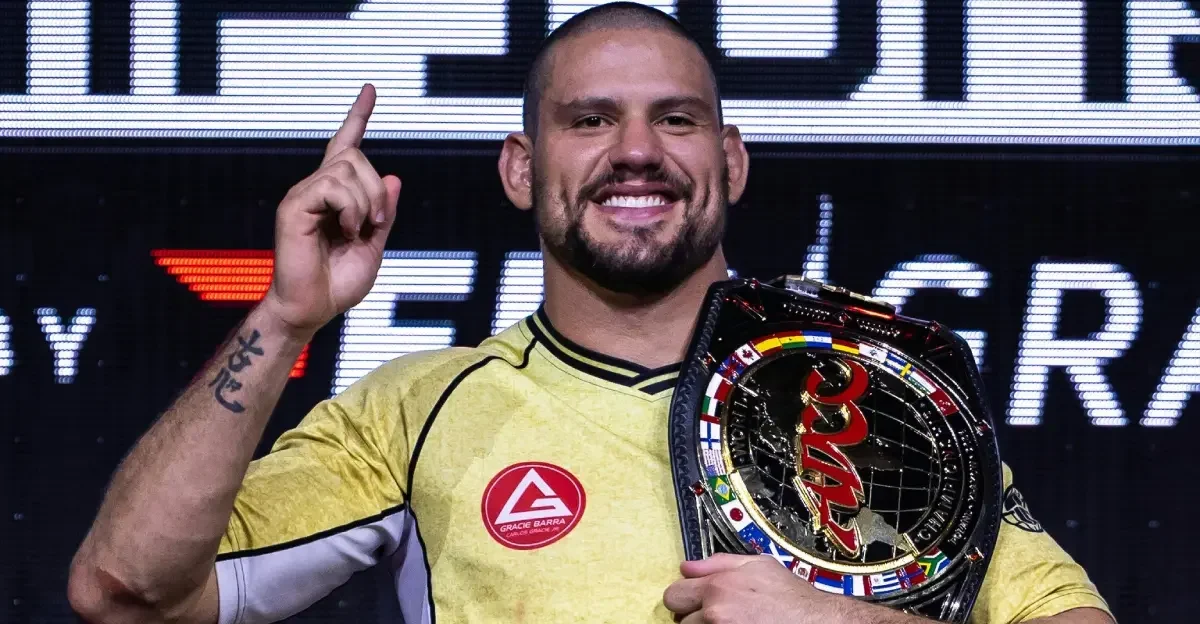
Main photo: Gracie Barra Felipe Preguiça; photographer not identified on the source page.
The takeaway
Pena's 2017–19 results connect ADCC absolute success with gi world titles in heavyweight and medium-heavyweight. The later over-99kg ADCC title adds another distinct achievement. Together, they support a broader account than a rivalry alone can provide.
Keep the losses, divisions, and formats attached to the wins. Then watch the positions inside those matches. The career becomes easier to understand when each result is allowed to be specific, rather than recruited into a single argument about who an athlete is supposed to represent.
Watch a bracket unfold
Explore upcoming events in the Let's Roll tournament directory, then check the organizer's current schedule and spectator information before attending.
FAQ
What is Felipe Pena's nickname? He is widely known as Preguiça, the name used by his official academy. Using either name in a match search can help locate relevant footage and results.
Did Felipe Pena win both divisions at ADCC 2017? No. He won the absolute division and finished second to Yuri Simões in under-99kg. Keeping those outcomes separate gives an accurate picture of the event.
Which gi world titles are discussed here? This article examines Pena's adult black belt heavyweight gold at the 2018 IBJJF Worlds and medium-heavyweight gold in 2019. The federation's result pages identify the divisions and podiums.
Is this a complete Felipe Pena career record? No. It is a focused retrospective on selected results, with a later ADCC title for context. A full record would need to account separately for each event, format, and appearance.

Miles Serrano
Miles Serrano writes about competitors and the decisions that shaped their careers. He is more interested in the adjustment someone made in the third minute than in the medal count afterward.
Related Posts
Choosing a BJJ seminar worth your time and travel
Choose a BJJ seminar by the subject, teaching format, access, and total cost. Know what to ask the host before buying a ticket.

Claudio Calasans and the second bracket of ADCC 2015
Claudio Calasans won gi Worlds and ADCC absolute gold in 2015. The separate brackets tell a better story than a simple comeback slogan.

A university BJJ club needs a plan for after graduation
Keep a university BJJ club running after graduation with clear coaching arrangements, newcomer information, and a practical committee handover.
Comments (0)
Loading comments...