
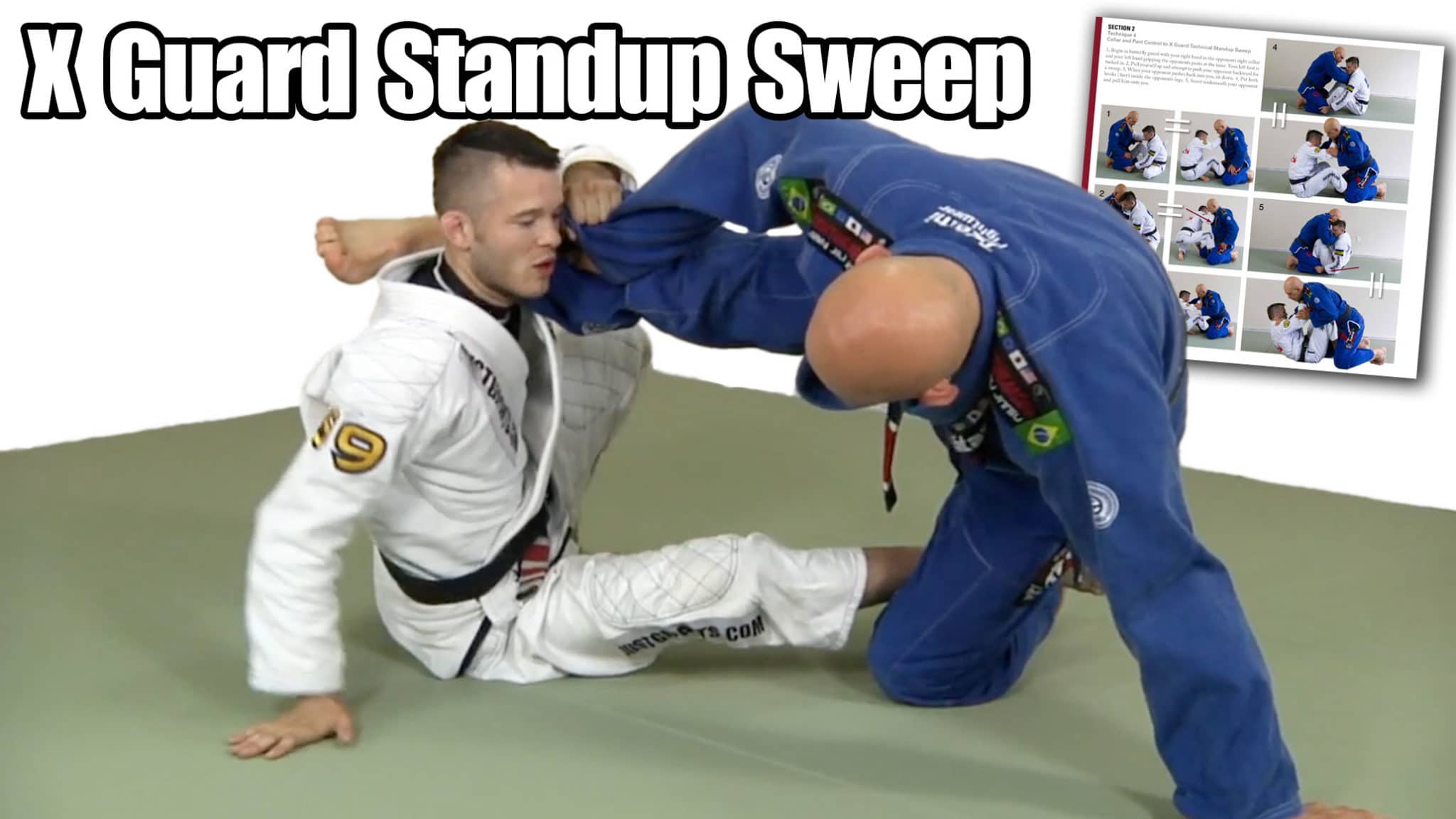
X-guard: make the hands touch the mat, then get up
Quick answer: Give X-guard a clear first attack by learning the standup sweep with your coach. Disturb the opponent's balance before trying to rise, and preserve the leg control that makes the standup useful. Practice the setup and the arrival separately if the full sequence becomes a scramble.
A standing opponent can make you feel very busy without ever feeling particularly threatened. You adjust an X-guard hook. They adjust a foot. You adjust another hook. They look down, apparently willing to spend the rest of the round watching you organize yourself.
The standup sweep gives that exchange a direction. Instead of waiting for the passer to fall into an unspecified attack, you make a balance problem and begin getting off the floor. The useful work is in connecting those events closely enough that the opponent has to deal with both.
Give the leg on your shoulder some attention
X-guard has variations, so begin by agreeing which one you are learning. The Grapplearts guard glossary illustrates several leg arrangements. In its standard version, one opponent leg rests on the bottom player's shoulder while the feet control the other leg at different levels.
That shoulder connection is easy to neglect if you focus entirely on crossing your feet into an X. Ask the instructor to check it before you begin sweeping. Where does your hand control the leg? What happens when the opponent tries to turn and face you? You want answers tied to this configuration.
Have your partner make a small, controlled adjustment while you maintain the taught position. If the leg slips away immediately, stop and investigate rather than speeding into the sweep. A successful-looking finish performed after the partner quietly restores the missing connection teaches a different sequence from the one you will face while rolling.
Our open-guard overview explains where X-guard fits among other guards. Here the concern is the exact configuration you intend to use for getting up.
The entry should leave you close enough to act
A butterfly-to-X entry can be studied as a sequence with its own purpose, not merely a way to reach the interesting part. In Grapplearts' September 2020 demonstration, the bottom player draws the opponent into an elevated exchange before arranging the X-guard and standup.
For the first session, it is reasonable to begin already in X-guard. That removes one problem while you learn another. Just remember what you removed. Once the sweep is recognizable, put the entry back and check whether it leaves the same usable position.
If the entry deposits you underneath with the opponent facing a different direction, do not force the rest of the remembered sequence onto it. Stop at the arrival and have the coach compare the two starts. The hand position or the distance may need attention before the sweep is available.
Keep a distinction in your notes between obtaining the named guard and obtaining the version your chosen attack needs. Both can look like X-guard at a glance. Only one may match the lesson you were trying to reproduce.
Make the hand post happen for a reason
In Lachlan Giles's July 2019 butterfly-to-X lesson, the guard player uses the leg arrangement to disturb the opponent's base and send weight toward the hands. The standup follows that balance change rather than waiting for the opponent to recover comfortably.
This gives you something concrete to practice before the finish. Ask the top player to maintain balance honestly, at a controlled pace. Bottom tries to produce the agreed hand-posting reaction. Reset there for the first part of the exercise.
A hand touching the mat because the partner expects the demonstration is not the same as a hand going down because they need it for balance. Ask them which happened. They do not need to make the drill adversarial to answer accurately.
When the reaction starts appearing, connect the next movement. If you pause long enough for the opponent to rebuild their stance, you may be attempting the standup against a different situation from the one you just created. Watch that gap in the sequence before deciding you need a stronger leg action.
Rehearse the standup with the leg still attached
The movement is related to the technical standup taught in many BJJ classes, but carrying the opponent's leg changes the assignment. In Kesting's 2018 discussion of getting back to your feet, the X-guard example rises while retaining the leg on the shoulder.
Work on that stage under supervision. Start near the moment of posting and ask the partner to remain cooperative while you learn where your own limbs travel. Then let them offer the limited balance response the coach wants you to handle. You should be able to tell what changed between those two repetitions.
The September 2020 photo sequence is useful for following the progression from a mat post to an upright finish. Use it to review an in-person lesson, not to guess at a movement that feels awkward or puts you under uncomfortable load.
If you keep losing the leg halfway up, practice that interval separately. Start immediately before it and finish immediately after it. Repeating the entire entry every time can hide a small hand adjustment beneath a much longer sequence of movements you already understand.
Begin with one attack that asks a clear question
Kesting's July 2014 X-guard lesson recommends the standup sweep as his opening attack. His explanation is that a defense to it can create the conditions for another attack. You can use that idea without copying his entire game.
Choose the standup as your first question and one coach-selected continuation as the response to a particular defense. Practice against a partner who sometimes permits the original sweep and sometimes supplies that defense. Avoid a rigid sequence in which the second technique happens on every repetition regardless of what the opponent does.
The distinction matters because a combination is supposed to respond to resistance. If the opponent is already falling from the first attack, inserting a second one may only delay the finish. If they have removed the connection both attacks require, forcing either may be the wrong task.
Keep the branch small enough to remember while moving. You can expand later. At the beginning, being able to explain why you changed attacks is more informative than being able to list every sweep associated with X-guard.
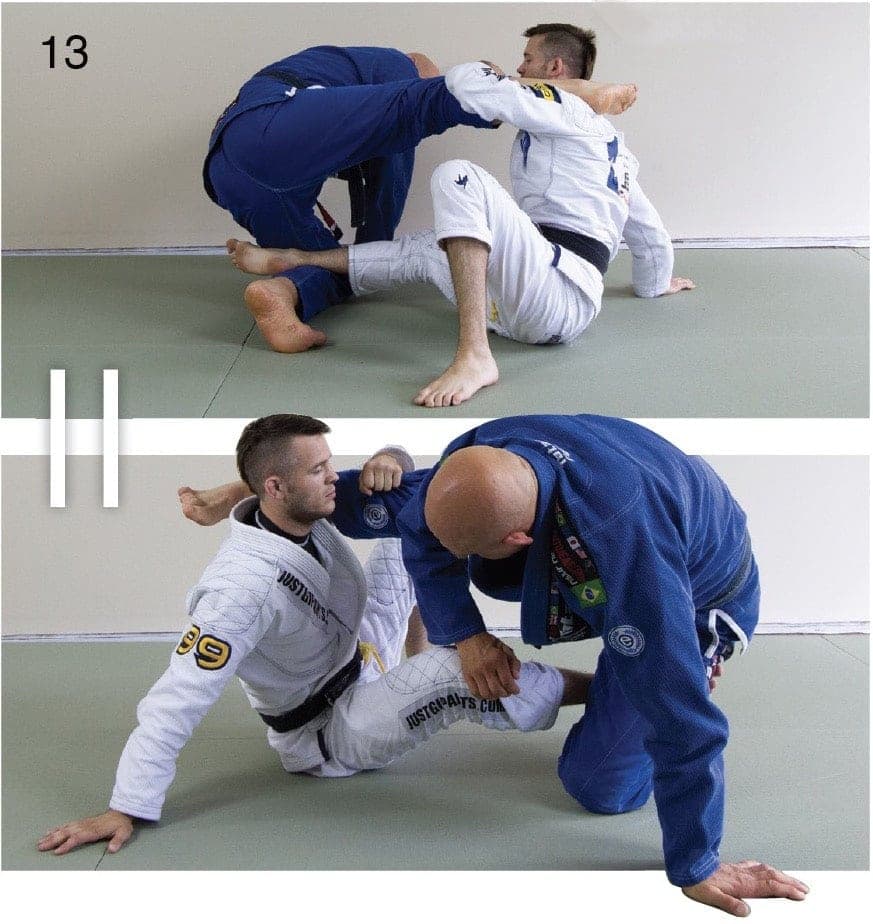
Photo: Grapplearts / Nonstop Jiu-Jitsu standup sequence.
Continue through the opponent's landing
A reversal is not the last movement of the practice rep unless that is explicitly the lesson. If the purpose is to come on top, inspect the position in which you arrive.
In the September 2020 sequence, standing completes the sweep and leads toward passing. That is a useful place to extend your practice. Ask what connection remains after the opponent lands and which passing position your instructor wants next. Do not invent a passing grip because your hands happen to be free.
Keep the landing controlled. Give the partner room, and avoid turning the last step into an abrupt finish they cannot follow. If the mat is crowded, shorten the exercise or use a different start with the instructor's help.
For a later round, let the bottom player attempt to recover guard after the sweep. Now the former guard player has to solve the arrival under modest resistance. This is a different test from tipping somebody over, and it may reveal a gap even when the sweep itself has become familiar. Record that gap as a top-position problem rather than deleting the successful sweep from your account of the round.
Use a partner who will show you the missing interval
Full sparring gives you many ways to fail at once. A short X-guard practice block can be more selective. Agree on the start and use the same sweep so that you can compare one attempt with the next.
First check the shoulder and hook connections against a small change in the passer's stance.
Next work only on producing the balance reaction that precedes the standup.
Add the rise, allowing the partner one familiar defensive response.
Finish by including the controlled landing and the agreed top position.
There is no required number of repetitions here. Keep a stage until you can describe the failure accurately, then decide with the coach whether to correct it or move on. Do not make the partner repeat a painful or uncontrolled movement to meet an arbitrary target.
One useful note might be that the hand post happened, but the leg escaped during the rise. Another might be that the opponent never needed to post at all. Those notes point to different parts of the lesson. The vague verdict that your timing is bad points almost nowhere.
Use our BJJ drilling guide to organize the repetitions around the response you are trying to recognize.
Main photo: Grapplearts / Butterfly to X-guard standup lesson.
The takeaway
X-guard becomes easier to organize when it has an opening attack with a recognizable trigger. For the standup sweep, study the balance change and the movement off the floor as connected parts. Keep the leg control intact long enough to make the rise useful.
When the full sequence breaks, locate the interval that failed. It may be the entry, the hand-posting reaction, or the arrival on top. Work on that interval rather than treating every unsuccessful repetition as a reason to replace the sweep with a more elaborate one.
Work through the sweep with an instructor
Find BJJ training near you and bring the specific X-guard exchange you want checked. An observed repetition can show whether the problem begins before the opponent loses balance or while you are getting up.
FAQ
Is X-guard the same as single-leg X? They are related positions with different leg configurations. Begin by identifying the exact version your instructor is demonstrating. Shared terminology does not mean a sweep from one can be inserted unchanged into the other.
Why do I struggle to get up from X-guard? The obstacle may be the setup, the retained leg connection, or the standup movement itself. Have your coach watch the stage where you stop progressing. A general instruction to get up faster can miss the actual problem.
Should I always wait for the opponent's hands to touch the mat? This article focuses on a lesson that uses that reaction to time the standup. It is a specific practice target, not a rule for every X-guard attack. Learn the conditions of the technique you are studying.
What should I do after the sweep? For a session focused on coming on top, continue to a stable position and the passing setup your coach selects. Do not stop automatically when the opponent lands. The next connection is part of learning to use the sweep during a round.
Related Posts
Lasso guard: know when to keep the sleeve and when to leave
A lasso hook can buy time or trap you in a grip battle. Give the free leg a purpose, keep useful sleeve control, and recognize when to change guards.
Spider guard: give each foot a job
Make spider guard easier to read. Learn how sleeve tension, different foot positions, and the passer's posture shape your next sweep or transition.
The seated arm drag starts before you pull the arm
The seated arm drag needs more than a wrist grip. Study the arm connection, hip movement, and reactions that open a back take or a route to top position.
Comments (0)
Loading comments...