
UFC BJJ rules: rounds, submissions, and the title-bout tiebreak
Quick answer: Professional UFC BJJ uses three five-minute rounds, submission victories, and three judges applying a 10-point must system. Submission threats lead the judging criteria, followed by offensive progression and control. A championship bout tied after regulation can receive a special three-minute fourth round.
A UFC BJJ championship match can need four rounds. That does not mean four rounds are scheduled from the start, or that its format follows a five-round UFC mixed martial arts title fight. The extra period has a specific trigger and its own decision rule.
The differences matter throughout the match. A guard pass has no fixed three-point value here, a submission attempt needs to require meaningful defense, and a quiet guard pull is treated differently from an immediate attack. Reading those provisions together is more useful than calling the format submission-only.
Three rounds create three separate decisions
The professional UFC BJJ rules, published by UFC on June 23, 2025, establish three five-minute rounds with a one-minute rest between them. Each round is scored separately if a submission does not end the contest.
That arrangement breaks a possible fifteen minutes of action into distinct scoring periods. An athlete who wins the first round has not automatically banked an equivalent number of seconds in the second. The next five minutes create a fresh comparison between the athletes’ work, subject to the same judging priorities.
For a spectator, the interval is a useful place to write a provisional score and the reason for it. Keeping those notes separate discourages the common habit of allowing one memorable late exchange to rewrite the whole match. This is a viewing method, rather than an instruction to ignore earlier action while learning how the athletes respond to one another.
The one-minute pause also changes what uninterrupted momentum can mean. A sequence that has not finished by the horn cannot simply continue through the rest period. Follow the referee and the restart instead of expecting the match to behave like a single continuous tournament round.
A submission can settle the contest early
The result can be decided before the judges’ totals matter. A submission ends the contest, which is why the threat of a finish remains relevant even for someone who appears to be behind on the rounds.
That does not make every hand movement around a foot a credible finishing attempt. The written scoring criteria specify effective submission attempts requiring meaningful defense. The distinction is between an attack the opponent must solve and an appearance of activity that does not create the same problem.
A helpful spectator question is what the defender had to change. Did the athlete abandon an offensive position, address the trapped limb, or devote both hands to preventing a choke? Those observations can help locate the threat. They cannot tell a remote viewer precisely how close a joint was to injury or whether a competitor should have delayed a tap.
Training decisions belong in a different setting. A professional rules allowance is not permission to introduce an unfamiliar submission without agreement or coaching. The competitive result records who won; it does not provide a safe teaching progression by itself.
Judges use a hierarchy, rather than a position tariff
The scoring order is explicit. Effective submission attempts are the highest priority. Effective offensive action, including takedowns, passes, and sweeps that progress toward bout-ending techniques, comes next. Effective control of position and pace follows those categories.
A pass can therefore matter a great deal without receiving a predetermined number of points. Its importance depends on the offense it produces and its place in the round. Conversely, spending longer on top does not automatically defeat a meaningful submission threat from underneath.
The three judges use the 10-point must system. The published descriptions identify 10–9 for a close margin, 10–8 for overwhelming dominance, and 10–7 for complete dominance including near-bout-ending techniques. Those categories require judgment; the rules do not supply a formula assigning a half-point to each attempt.
A hypothetical 10–9 round means one athlete edged that period. It does not mean the athlete completed ten scoring movements while the opponent completed nine. That distinction separates UFC BJJ scorecards from the positional totals familiar to many tournament competitors. The UFC BJJ overview provides the broader setting for that choice.
The championship tiebreak has a narrow trigger
Title bouts begin with the same three regulation rounds. If the championship contest is a draw after those rounds, the rules provide a fourth period of three minutes. The rest between the third and fourth rounds is two minutes.
A submission in that extra period ends the match. If no submission occurs, all three judges select a winner based solely on performance and action during that fourth round. Regulation creates the condition for the tiebreak; it is not carried forward as a second set of scoring evidence for deciding the extra period.
Consider a hypothetical title match that ends regulation tied. The next three minutes become the decisive contest. One athlete cannot win that extra period merely by pointing to a strong first round from earlier in the evening. The special rule asks the judges to compare what happens after the additional rest.
This provision should not be applied to every close match. A split decision is a decision, rather than a draw. A unanimous decision also does not require overtime. The condition is an actual championship draw after regulation, not disagreement among fans or a feeling that the match was too competitive to finish.
Guard pulling depends on immediate action
The illegal-actions list prohibits a guard pull that does not result in immediate initiation of action with the opponent. That wording leaves out two popular oversimplifications: that all guard pulling is prohibited, and that any seated athlete is free to wait indefinitely.
The next interaction matters. A competitor moving into a direct attack is presenting a different sequence from someone sitting down without beginning action against the other athlete. The referee applies the rule to the exchange; a single still image cannot establish everything about the timing or contact.
For viewing, keep the entry and its continuation together. If a replay begins only after the athlete reaches the floor, the material needed to understand a warning may have been omitted. The visible position can be legal while the preceding way of reaching it raised a separate issue.
For competition planning, an athlete should work from the actual event instructions and officiating clarification. The professional provision does not establish the guard-pulling rules at a local tournament or a UFC BJJ Open. A shared brand name is insufficient evidence that those formats use the same enforcement.
Illegal actions remain illegal without strikes
Professional UFC BJJ is grappling, with striking prohibited. The published list also covers eye gouging, interference with bodily openings, hair pulling, grabbing ears, biting, groin attacks, and intentional scratching or pinching. Holding or twisting fewer than four fingers or toes is prohibited, as is grabbing one’s own or an opponent’s clothing.
The clothing provision is especially useful for viewers accustomed to gi grips. A competitor wearing a rash guard has a garment, but that does not make the garment an available handle. Watch the body connection rather than assuming every visible grip is interchangeable with a collar or sleeve grip.
Slamming is prohibited except when used to escape a fully applied submission, according to the professional rule text. That is a narrow, context-dependent exception. It should not be shortened to a claim that UFC BJJ generally permits slams, or turned into a suggestion for ordinary training rounds.
The referee is the sole arbiter of the bout and can issue cautions, warnings, negative points, positional resets, and disqualifications. There is an officiating structure around the action, rather than a promise that anything goes until someone taps.
Read the surface and the referee together
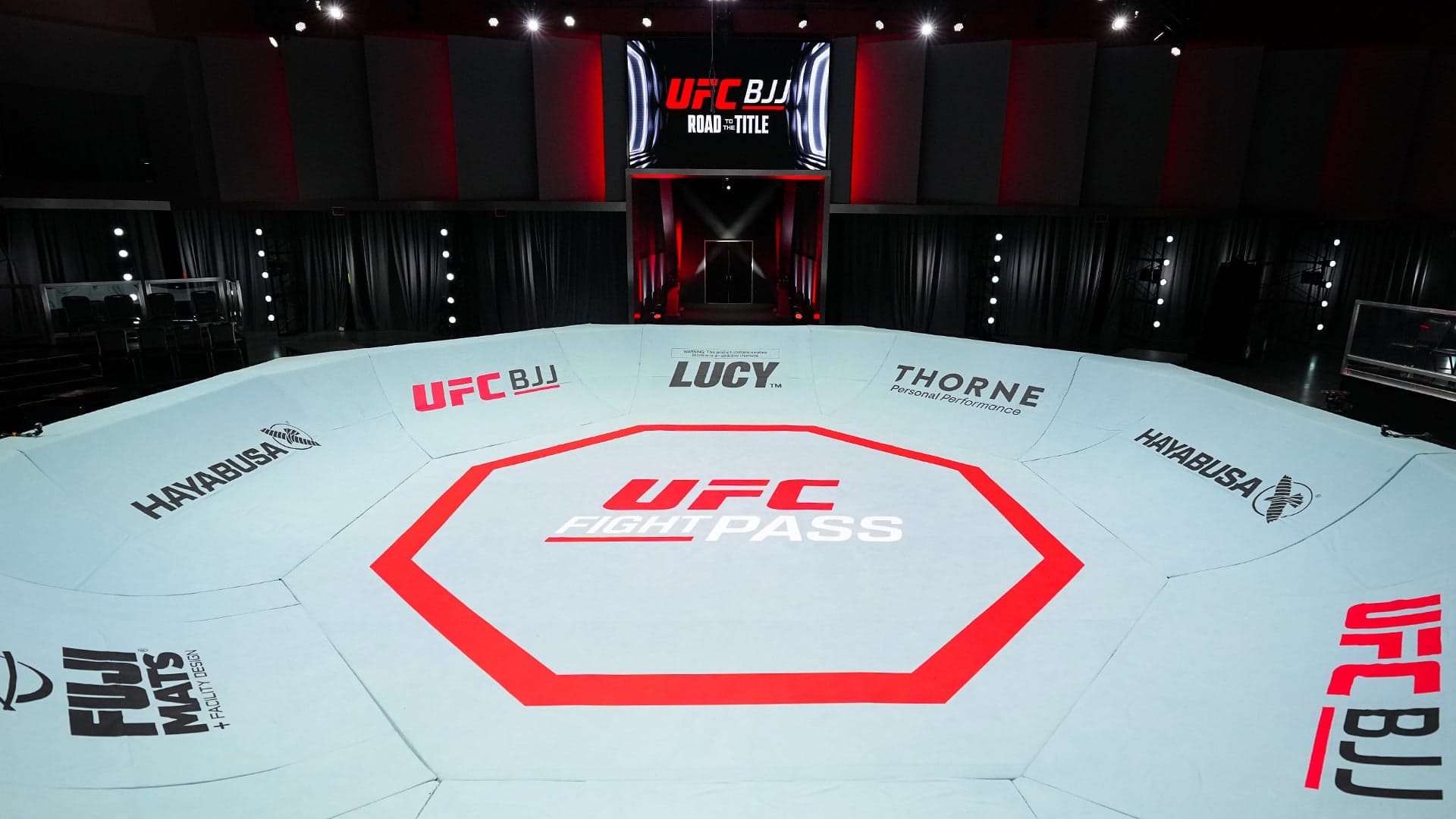
The Bowl’s slope can keep an exchange moving where a flat competition area would present a different boundary problem. It does not remove the referee’s power to stop action or order a positional reset. The written authority is still there.
That distinction matters when a sequence climbs the slope. A spectator should follow the referee’s instruction, the athletes’ relative positions, and the restart if there is one. Assuming that the walls make every exchange continuous can produce the wrong explanation for an official intervention.
A short rules checklist helps before a replay:
Confirm that the match is professional UFC BJJ and whether a championship is involved.
Follow each five-minute round and the highest-priority effective offense within it.
Separate a judges’ decision from a regulation draw that could trigger the title tiebreak.
Treat warnings and referee instructions as part of the match record.
For comparison with a familiar tournament system, the IBJJF rules guide explains why positional points and round scores should not be treated as interchangeable numbers.
Main photo: UFC; official UFC BJJ Bowl promotional photograph.
The takeaway
UFC BJJ gives submissions the clearest route to ending a match, but the rest of its rules are necessary for understanding what happens when the finish does not arrive. The judging hierarchy, individual rounds, and referee’s authority all affect what an athlete must accomplish.
The title-bout tiebreak is the detail to keep close. It follows a championship draw after regulation, lasts three minutes, and is judged on that period alone if there is no submission. Knowing its trigger prevents an ordinary close decision from being mistaken for an incomplete match.
Find a competition to follow
Browse the tournament directory and check the organizer’s own rules before comparing an event with UFC BJJ. The scoring system belongs to the competition, even when the athletes and techniques look familiar.
FAQ
How long is a UFC BJJ match? Regulation consists of three five-minute rounds with one-minute rests. A submission can end the match earlier. A championship draw after regulation can lead to an additional three-minute period, following a two-minute rest.
Does UFC BJJ have points? Judges score individual rounds using the 10-point must system, and the referee can issue negative points. The format does not use a fixed positional point schedule in which a particular pass or mount automatically adds a set number.
Can athletes pull guard in UFC BJJ? The professional rules prohibit a guard pull that does not result in immediate initiation of action with the opponent. They do not prohibit every guard pull. Timing and the ensuing engagement are relevant to enforcement.
Are UFC BJJ Opens governed by these exact rules? Do not assume that they are. UFC’s Opens announcement describes an adjusted amateur ruleset and point system. Entrants should obtain the rules for their specific event, age, and skill division before registering or preparing a match strategy.

Tess Hanley
Tess Hanley reads the rulebooks, the entry fees and the fine print. When a federation or a gym changes something, her first question is who ends up paying for it.
Related Posts
Lucas “Hulk” Barbosa’s best work is in the details
Lucas Barbosa’s nickname explains the first impression. His gi world title, no-gi record, and 2022 ADCC final give viewers more to study.

João Miyao’s record deserves its own first name
João Miyao’s adult world title and 2026 Master1 results tell a distinct story, even when his brother appears beside him on the podium.

Jena Bishop made time for a second sporting life
Jena Bishop’s 2026 PFL title followed a deliberate move from championship jiu-jitsu into learning a different sport.
Comments (0)
Loading comments...