
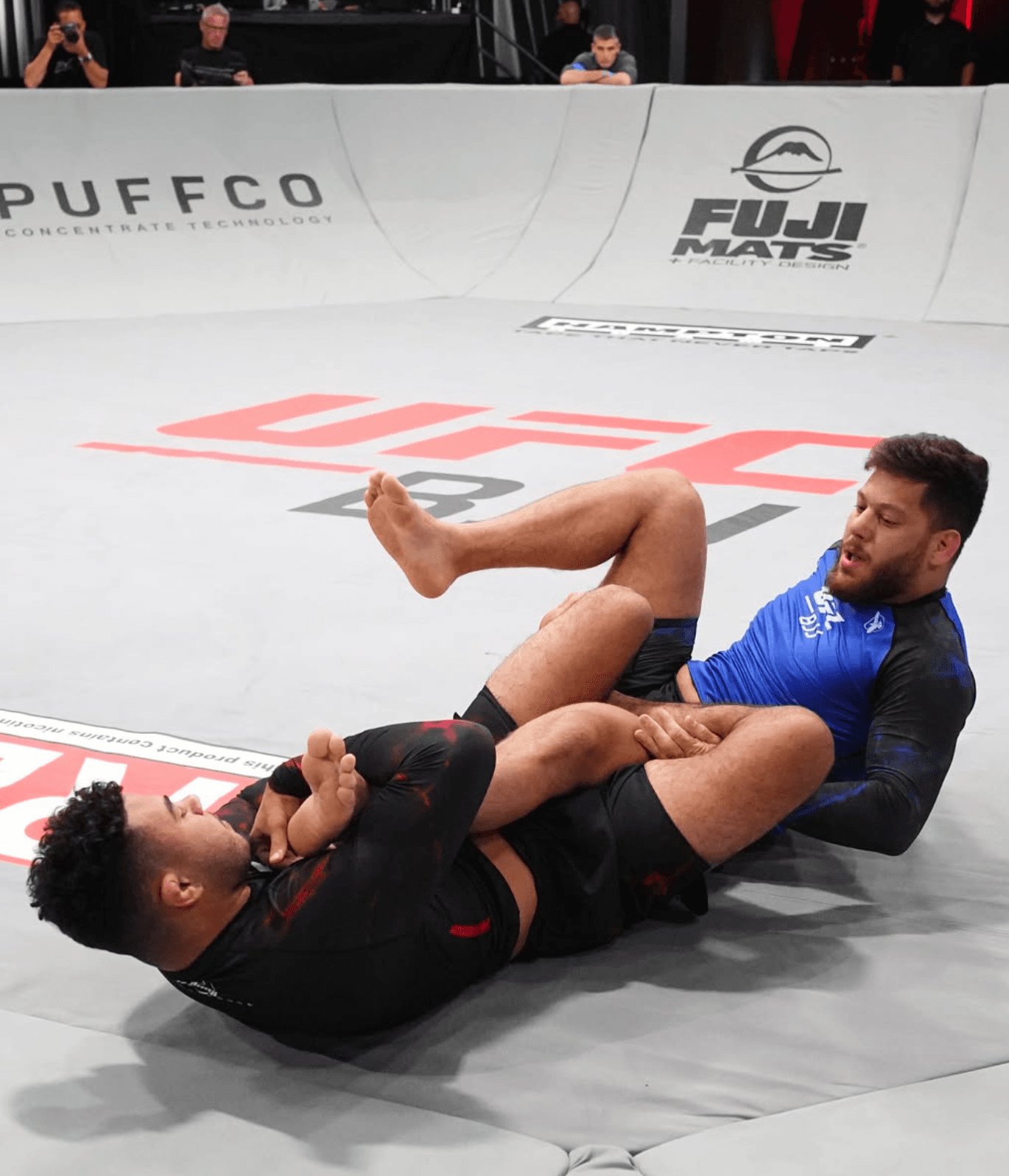
UFC BJJ explained: the Bowl, the rules, and the money
Quick answer: UFC BJJ is the UFC's own submission grappling promotion, launched in June 2025 under TKO Group. Matches run three five-minute rounds inside "the Bowl," a curved-walled mat, with no positional points — if no submission comes, three judges score it on the 10-point-must system, prioritising submission attempts over control time. Nine events have run so far, all at the UFC Apex in Las Vegas, and they stream free on YouTube and UFC Fight Pass.
If you started training in the last year, UFC BJJ probably arrived in your feed before anyone explained it. A slick fight-week graphic. Mikey Musumeci in a UFC-branded rashguard. A mat with walls that curve up at the edges, which looks like a mistake until you watch someone try to back away in it.
It is real, it is fourteen months old, and it has already changed which grapplers you get to see fight. Here is what it is.
What UFC BJJ is and where it came from
UFC Brazilian Jiu-Jitsu is a submission grappling promotion owned by the UFC, itself a subsidiary of TKO Group Holdings. It launched in June 2025 with Dana White fronting it.
The on-ramp was a reality series, UFC BJJ: Road to the Title, eight episodes free on Fight Pass and YouTube. Two teams of lightweight and welterweight grapplers, coached by Musumeci and Rerisson Gabriel, competed to produce finalists in each division, who then fought for the inaugural belts at the first live card. If you have ever watched The Ultimate Fighter, you know the shape exactly.
UFC BJJ 1 ran on June 25, 2025 at the UFC Apex in Las Vegas with three title matches. Musumeci beat Gabriel for the bantamweight belt, Carlos Henrique beat Danilo Moreira for lightweight, and Andrew Tackett beat Andy Varela for welterweight. Bella Mir, daughter of former UFC heavyweight champion Frank Mir, made her debut on the same card.
The ruleset: rounds, no points, and a ranked scoring order
This is where UFC BJJ differs most sharply from the rest of the sport, and it is worth knowing before you watch.
Every bout is three rounds of five minutes. There are no points for takedowns, sweeps, passes, mount, or back control. Nothing accumulates. The referee has broad authority (cautions, warnings, negative points, positional resets, stoppages) and uses it to keep things moving.
If no submission lands by the end of round three, judges decide it on the 10-point-must system, the same structure boxing and MMA use. What makes it different is that UFC BJJ publishes its criteria in priority order:
First: initiation of bout-ending techniques. Who went hunting for the finish.
Second: initiation of action. Who made things happen.
Third: duration of control. Riding position is the least valuable thing you can do.
That ordering is a policy statement. IBJJF rules pay you for holding a dominant position, and ADCC pays you for it too, eventually. UFC BJJ puts it last, which means a competitor who spends nine minutes in controlled top position and never threatens anything can lose to someone who chased three submissions and missed. Whether that is correct depends on whether you think grappling should be scored as a fight or as a chess problem.
The Bowl
Bouts take place inside a bowl-shaped area with graduated, curved walls. The stated logic is the same as the Octagon's: remove the corners, remove the escape, and you remove the option of shying away from contact.
In practice it does two things. It kills the out-of-bounds reset, the single most action-deadening moment in grappling. And it gives the broadcast a look you recognise in a three-second scroll, which matters more than purists like to admit.
Nine events in fourteen months
The cadence has been roughly one card every six to eight weeks, every one of them at the UFC Apex:
UFC BJJ 1, June 25, 2025 (Musumeci vs. Gabriel)
UFC BJJ 2, July 31, 2025 (Tackett vs. Canuto)
UFC BJJ 3, October 2, 2025 (Musumeci vs. Carrasco)
UFC BJJ 4, December 11, 2025 (Tackett vs. Dorsey)
UFC BJJ 5, February 12, 2026 (Musumeci vs. Montague)
UFC BJJ 6, March 12, 2026 (Fowler vs. Machado)
UFC BJJ 7, April 2, 2026 (Tackett vs. Rocha)
UFC BJJ 8, May 21, 2026 (Musumeci vs. Dantzler)
UFC BJJ 9, June 4, 2026 (Fowler vs. Johnson)
UFC BJJ 10 is booked for later this month, headlined by Andrew Tackett defending the welterweight title against Jonnatas Gracie. The promotion has said it plans around ten events a year plus another season of the reality show, with talk of taking a card to Brazil.
Who holds the belts
Seven titles exist, five men's and two women's. Going into August 2026:
Light heavyweight (186-205 lb): Mason Fowler, champion since July 2025, two defences.
Middleweight (171-185 lb): Ronaldo Júnior, champion since December 2025.
Welterweight (156-170 lb): Andrew Tackett, champion since the inaugural card, three defences.
Lightweight (146-155 lb): Lucas Valente, champion since April 2026.
Bantamweight (126-135 lb): Mikey Musumeci, champion since the inaugural card, three defences.
Women's featherweight (136-145 lb): Rebeca Lima, champion since April 2026.
Women's bantamweight (126-135 lb): Cassia Moura, champion since March 2026.
Musumeci and Tackett are the constants. Both won belts on night one and have defended three times each, which in a promotion this young is close to a dynasty.
Where to watch it
Free. That is the short version, and it is not a small thing.
Events stream live on the UFC BJJ YouTube channel and on UFC Fight Pass, with some cards also on Facebook. No pay-per-view, no separate subscription. Compare that to the rest of pro grappling, where almost everything of consequence sits behind a FloGrappling paywall, and the strategy is obvious. The UFC is buying attention, not revenue, at least for now.
The money is the story
The pay structure is unusual and it tells you what the promotion wants.
Athletes get show money and submission money. Not show and win — show and submit. Win by decision and you leave roughly half your potential purse on the table. Craig Jones claimed when the Tackett brothers signed in 2025 that the figure on offer was $15,000 to show and $15,000 to win, and nothing since has publicly contradicted it.
In an appearance on the Mundo de Luta podcast, reported by BJJDOC in March 2026, UFC BJJ executive Claudia Gadelha put annual earnings for exclusive athletes competing four times a year at 500,000 to 800,000 Brazilian reais, roughly $97,000 to $155,000. Gadelha told the Mundo de Luta podcast in March 2026 that athletes were now earning sums at that level for a single jiu-jitsu contest, and she framed it as the sport finally arriving.
For jiu-jitsu, it genuinely is. It is also a top-end figure that assumes four bouts, all won by submission. Win four without finishing and the same math lands somewhere near $65,000. Gadelha's numbers appeared to describe the promotion's roughly ten exclusive athletes; what everyone else on the card earns has not been made public.
The exclusivity clause, and what it took away
Here is the part that has the rest of the sport uneasy.
UFC BJJ contracts are exclusive, and Gadelha has said the promotion will enforce them, including barring signed athletes from ADCC after 2026. You can see the effect already. Look at the invite list for the ADCC World Championship in Kraków next month: no UFC BJJ champions on it. Musumeci was never going to compete there anyway, but the absence of the rest is not an accident.
This is the standard trade. Athletes get reliable pay, a stipend, a production budget, a schedule. The sport loses the ability to answer its most interesting questions, because the best bantamweight in one promotion can no longer meet the best bantamweight in another. MMA fans have watched this movie. It usually ends with the athletes taking the deal, because rent is monthly and legacy is not.
EBI and Metamoris also had mainstream exposure
Two positions, and I hold both at once.
The optimistic one: grappling has needed a well-funded promoter with real distribution for twenty years. Consistent purses, professional production, and a free YouTube stream that puts jiu-jitsu in front of MMA fans who have never seen a heel hook entry is a straightforward good. If UFC BJJ raises the floor for what a full-time competitor can earn, that matters more than any belt.
The skeptical one: mainstream exposure has been promised before. EBI had it. Metamoris had it. Both mattered, both faded. A promotion that locks up ten athletes while paying the rest an undisclosed amount is not obviously a rising tide. It might just be another promotion with a better camera, competing for the same small audience while making the cross-promotional matchups fans want harder to book.
Ask again in three years, when the first wave of contracts comes up for renewal. That is when we will learn what this really was.
The takeaway
UFC BJJ is a legitimate, well-produced submission grappling promotion with a coherent ruleset that rewards finishing and punishes riding. Nine cards, seven champions, free on YouTube. If you want an easy entry point into watching pro grappling, it is the easiest one that exists.
What it is not, yet, is the top of the sport. The most prestigious title in no-gi is still ADCC, and this year's edition in Poland will run without a single UFC BJJ champion in the brackets. That fact is the whole story in one sentence: the biggest brand in combat sports now promotes jiu-jitsu, and the immediate result was fewer of the best grapplers meeting each other, not more.
Watch it anyway. It is good, it is free, and the Bowl works.
Watching is one thing. Competing is another.
If the finishes have you thinking about entering something, the local version is closer than you think. Find a tournament near you on Let's Roll →. Most run no-gi divisions at every belt, and your first one teaches you more than a season of watching.
FAQ
What is UFC BJJ? A submission grappling promotion owned by the UFC and TKO Group, launched in June 2025. It runs three-round matches with no positional points, judged on a 10-point-must system if neither competitor submits, inside a curved-walled mat called the Bowl. Nine events have taken place, all at the UFC Apex in Las Vegas.
How do you win a UFC BJJ match? By submission at any point in three five-minute rounds. If nobody taps, judges score it, weighing initiation of bout-ending techniques first, initiation of action second, and duration of control last. Riding a dominant position without threatening a finish is the weakest way to win a round.
Where can I watch UFC BJJ? Free, live on the UFC BJJ YouTube channel and on UFC Fight Pass, with some cards also on Facebook. There is no pay-per-view, which makes it the most accessible professional grappling on the calendar.
Who are the UFC BJJ champions? As of August 2026: Mason Fowler at light heavyweight, Ronaldo Júnior at middleweight, Andrew Tackett at welterweight, Lucas Valente at lightweight, Mikey Musumeci at bantamweight, Rebeca Lima at women's featherweight, and Cassia Moura at women's bantamweight. Musumeci and Tackett have both held their belts since the first event.
Related Posts
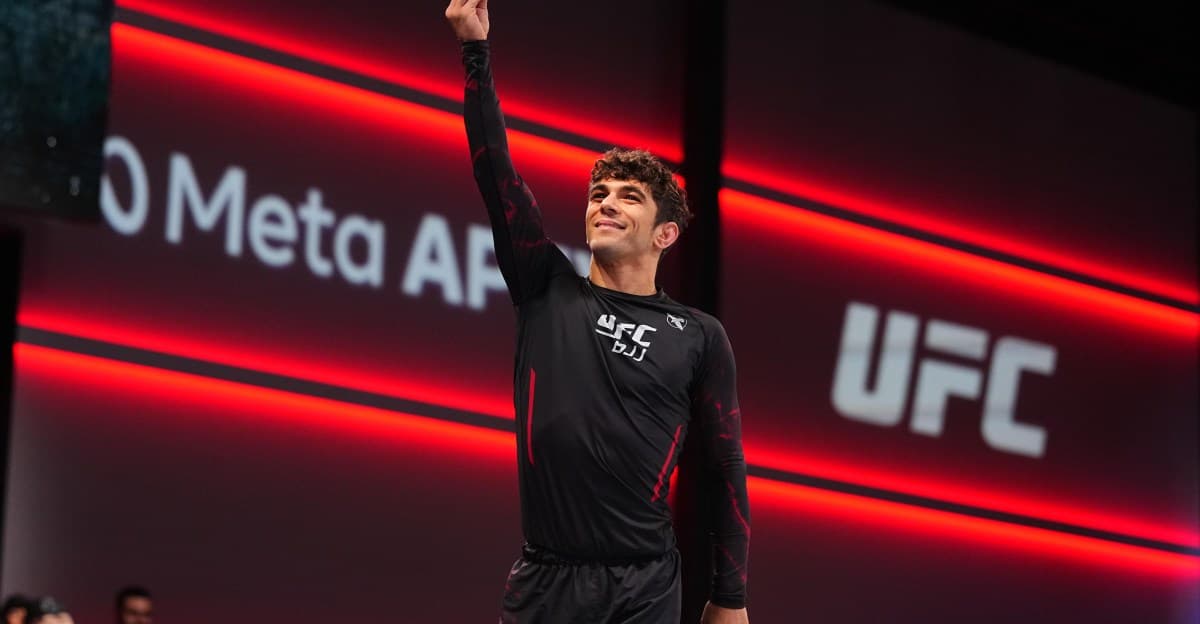
Mikey Musumeci gives up the belt to make room for MMA
Musumeci is vacating his UFC BJJ title to focus on MMA training. What he is leaving, what continues, and why the transition matters.
IBJJF membership: finish the paperwork before the deadline
IBJJF membership and tournament entry are separate steps. Plan documents, professor approval, renewals, and junior accounts before registration closes.
Choosing a BJJ seminar worth your time and travel
Choose a BJJ seminar by the subject, teaching format, access, and total cost. Know what to ask the host before buying a ticket.
Comments (0)
Loading comments...