
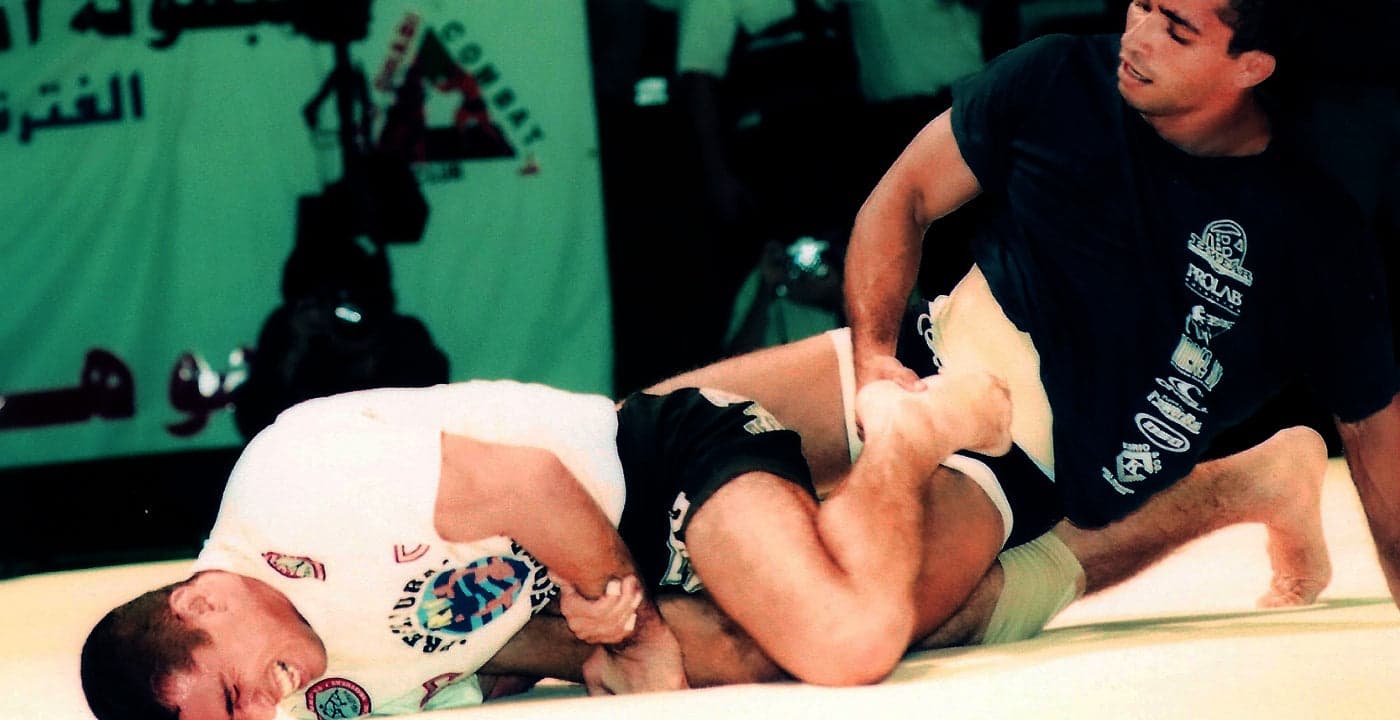
Royler Gracie: four Worlds, three ADCCs, and a teaching legacy
Quick answer: Royler Gracie won the featherweight division at the Worlds in 1996, 1997, 1998, and 1999, then collected ADCC under-66kg gold in 1999, 2000, and 2001. He also helped lead Gracie Humaita and taught competitors who carried its jiu-jitsu into other rooms. His famous matches are worth watching alongside that longer record of competition and instruction.
Royler Gracie was already 30 when he won the 1996 World title. Born on December 6, 1965, he had spent years on the mat before the first entry in that four-title sequence appeared. A championship record can start much later than the person behind it.
The next several seasons made the record unmistakable. Four consecutive featherweight Worlds. Three consecutive ADCC titles. Yet a younger fan may first encounter Royler through a single upset, a seminar photograph, or the name on an academy wall. Each is a real part of the story. None is large enough to contain it.
His childhood classroom was a family training room
The Gracie Humaita association biography describes Royler beginning jiu-jitsu as a small child under his father, Helio, alongside brothers and cousins. It also records his years managing the Rio academy under Helio's guidance.
BJJ Heroes' profile adds the influence of his cousin Rolls and, later, his brother Rickson. That places his development inside a group of teachers and training partners rather than a single straight line from father to son.
There is something useful about keeping that group visible. A famous competitor's biography can make training sound solitary: one gifted person, one great teacher, one inevitable result. In a grappling room, other people have to be there. Someone provides the resistance, asks the difficult question, or exposes the opening the athlete did not know was available.
You do not need to invent private conversations to appreciate that setting. The documented relationships already explain why the room mattered. They also leave space for the work Royler later did as the person responsible for other students' development.
Four straight featherweight Worlds established the sporting record
The official 1996 results list Royler first in adult black belt featherweight, with Paulo Brandao second. The following year, the 1997 results place him ahead of Vitor Ribeiro. Titles in 1998 and 1999 completed his four-year run.
That sequence is enough to explain why his name became attached to the division. It is also more precise than saying he won everything. Nobody needs an impossible claim of universal victory to understand four consecutive championships.
For a viewer looking backward, the opponents help put texture into the sequence. Do not skip directly from the year to the medal count. Read the other name in the final and follow that athlete's career too. A division becomes more interesting once it contains people rather than only the eventual champion.
The achievement also resists the convenient split between a traditional family representative and a tournament competitor. Royler's actual record sits squarely in competition. Whatever broader arguments people want to have about schools or styles, those four results remain concrete.
A featherweight also entered the open class
At the 1997 Worlds, Royler finished third in the adult black belt open category. The official podium lists Amaury Bitetti first, Fabio Gurgel second, and Royler sharing bronze with Mario Sperry.
That result gives the profile another scale. Winning within a weight division and entering an open category present different competitive situations. A featherweight's open-class medal should be recorded as such, without pretending it was another featherweight championship or turning it into proof that size never matters.
This is especially relevant to recreational students who enjoy stories about smaller athletes. A historical medal does not obligate you to accept every size mismatch offered during open mat. A professional competitor's choice under tournament conditions and your choice after a working day are separate decisions.
Admire the result. Then choose your own training partner according to experience, control, and the purpose of the round. Our training-partner guide is a more useful reference for that decision than an argument about what a champion did in 1997.
ADCC required another set of answers
The ADCC championship statistics record Royler's under-66kg victories in 1999, 2000, and 2001. In this case, three consecutive titles really did arrive in three consecutive calendar years.
The gi titles and the ADCC titles should be allowed to remain different accomplishments. The absence of cloth grips changes the practical problems in front of a grappler. A familiar opponent may still require a different approach when a collar or sleeve is no longer available.
For somebody who trains mostly in one format, those years provide a useful invitation to watch the other. Look first at how the athletes establish contact. Then follow how that contact changes as they move between standing and the ground. You do not need to know every rule to notice that an attachment has been gained or lost.
Our gi and no-gi comparison can supply background, but the historical matches deserve their own attention. Avoid judging an old exchange solely by what you expect from a current event with a different format and different competitive incentives.
The Soca finals show why rematches are their own matches
ADCC Latin America's January 2026 retrospective describes Royler beating Alexandre Soca in the 1999 final with a leg lock in the opening minute. They met again in the 2000 final, where the account describes Royler getting on top, passing, and winning through that work. His 2001 final victory came against Baret Yoshida.
The two Soca finals offer a particularly useful contrast. Same names, different exchange. A quick submission in the first meeting did not mean the second meeting could simply replay the finish.
That is a reason to watch rematches without treating the earlier result as a script. The athlete who lost has information. The athlete who won still has to produce the result again. Neither owes the audience an identical performance.
For your own tournament preparation, the modest lesson is to prepare for the opponent's ability to respond. If a club teammate has seen your preferred opening all month, their resistance is useful information. Do not complain that they are ruining the drill simply because they now recognize what you are trying to do.
The Eddie Bravo upset should have its correct place
Eddie Bravo submitted Royler at ADCC 2003. The event's own archive preserves the aftermath of that result. It is a legitimate part of Royler's history and an obvious reason many fans first learn his name.
It is also important to separate the match from the whole tournament. ADCC's 2003 results identify Leonardo Vieira as the under-66kg champion. Beating a celebrated opponent and winning the entire bracket are different accomplishments.
The upset's significance depends partly on the record that preceded it. Erasing Royler's achievements to make the loss sound more dramatic removes the very context that made people pay attention. Giving Bravo credit does not require diminishing the earlier championships.
Nor does a historical result need to become a present-day feud between recreational students from different affiliations. You can appreciate a match, discuss what happened, and then train courteously with the person wearing another team's patch. The competitors supplied the sporting event. The rest of us do not have to manufacture a personal grievance around it.
Teaching influence can begin with a single useful introduction
One of the more specific accounts of Royler's influence appears in BJJ Heroes' biography of JW Wright. It describes Wright attending a Royler seminar in 1999, taking a private lesson, and asking whom he should train with in the United States. Royler directed him to David Adiv. Wright then arranged a trip to New Jersey to train.
It is a small episode compared with an ADCC final, but it explains a different kind of reach. The useful contribution was a lesson and a connection to someone who could provide further training. The relationship extended beyond the visiting champion's appearance.
That is worth remembering when a seminar comes to your academy. A photograph documents attendance. A clear answer to the problem you brought, or an introduction to a suitable coach, may affect what happens during the following months.
Do not make the instructor solve your entire jiu-jitsu game in the question period. Bring something specific. If the answer points you toward ordinary class work, take it seriously. A famous teacher does not have to provide an exotic technique to give you something worth using.
The instructional-study guide offers a way to follow up on a lesson while keeping your own coach involved in the practice.
The academy name still needs people doing the work
Gracie Humaita's association site presents Royler and Rolker as part of its leadership and lists teaching activities including seminars and private instruction. The San Diego academy website also connects its program to Royler's jiu-jitsu while identifying instructors such as Regis Lebre.
For a prospective student, this is where historical admiration should turn into practical questions. Confirm who teaches the class you can attend. Ask how a beginner joins the program and how visitors are paired. An affiliation describes a connection; the actual Tuesday evening class is run by actual people.
A short inquiry can cover what you need:
Which class fits your experience and preferred format?
Who normally teaches that session?
What should a visitor bring, and what arrangements are required?
How does the academy introduce a new student to live training?
These questions are compatible with respecting the team's history. They make the visit easier for the staff and give you a clearer idea of the training you are considering. Confirm current details directly; an archival profile cannot promise an instructor's presence on a particular day.
Main photo: ADCC Latin America; Royler Gracie archive photograph.
The takeaway
Royler's four featherweight World titles and three ADCC titles establish a substantial competition career before any discussion of family reputation begins. The open-class result, the Soca rematches, and the 2003 upset add detail rather than canceling one another out.
His teaching history asks readers to look beyond podiums as well. A competitor can leave footage; an instructor can help shape the next room. Understanding Royler means giving both forms of work some space without replacing the evidence with a story of invincibility.
Explore the academies connected to the sport's history
Use the gym directory to find a place to train, then confirm the current classes and visitor arrangements with the academy itself.
FAQ
How many World titles did Royler Gracie win? He won four adult black belt featherweight World titles, in 1996, 1997, 1998, and 1999.
Which ADCC editions did Royler win? He won under 66kg in 1999, 2000, and 2001. Those were three consecutive championship editions held in consecutive years.
Did Royler compete in the absolute division? Yes. The IBJJF's 1997 Worlds results record him as an open-class bronze medalist as well as the featherweight champion.
Does a Gracie Humaita affiliation mean Royler teaches every class? No. Check the particular academy's instructor roster and schedule. A team connection does not establish who will teach the session you plan to attend.
Related Posts

Training with women in BJJ: listen before you roll
Be a better BJJ training partner with women: agree on intensity, provide honest resistance, ask before coaching or filming, and respect a declined round.
Bia Mesquita: the grappling record behind the MMA newcomer
Follow Bia Mesquita's path from 2014 Worlds double gold and a 2017 ADCC title to her 2025–2026 UFC results, with dated sources and match context.
Ffion Davies: winning across gi and no-gi
Explore Ffion Davies's 2022–2023 championship results, from gi Worlds and ADCC gold to a World No-Gi double, with context for the matches behind the medals.
Comments (0)
Loading comments...