
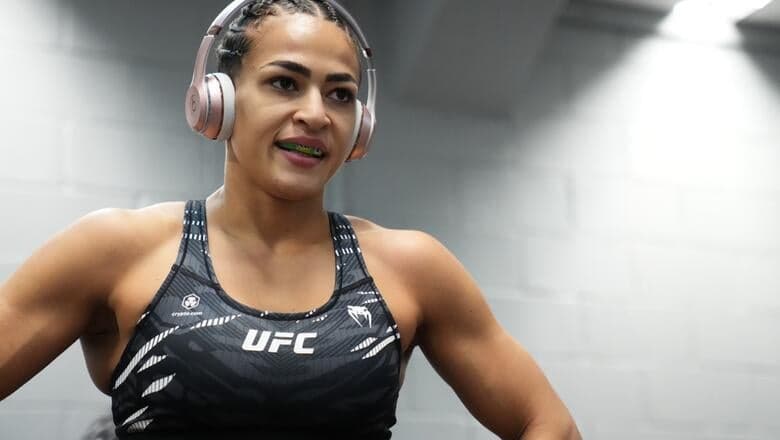
Bia Mesquita: the grappling record behind the MMA newcomer
Quick answer: Bia Mesquita is a Leticia Ribeiro black belt, an IBJJF Hall of Fame member, and the 2017 ADCC women's under-60kg champion. Her move into MMA followed a long grappling career rather than replacing an unfinished apprenticeship. Looking at individual events explains that background better than treating every world-title claim as the same achievement.
At the 2014 gi Worlds, Mesquita beat Luiza Monteiro 2–0 in the lightweight final and Michelle Nicolini 5–0 in the absolute final. Those two scorelines are a useful place to begin. They put names and actual matches beside the familiar description of a decorated BJJ athlete crossing into MMA.
Calling someone a newcomer depends on where you are standing. Mesquita could be new to the UFC and already have a substantial record against experienced grapplers. Neither fact cancels the other. Her career is worth reading in chapters, with the ruleset and the year left attached to each result.
Leticia Ribeiro was a teacher, not a footnote
BJJ Heroes' biography records that Mesquita began jiu-jitsu in 1996 and later trained in Saquarema under Luis Fernando at Vento Sul. Fernando encouraged her to train with Leticia Ribeiro in Tijuca. Ribeiro subsequently awarded her brown belt in June 2009 and black belt in March 2011.
That sequence gives the profile something more solid than a claim that she was born ready for elite competition. It names people and places involved in the development. It also leaves space for the work we cannot reconstruct from a short biography: the ordinary classes, corrections, and repetitions between the dated milestones.
A coaching relationship can matter without our inventing private conversations. There is no need to write an imagined speech from Ribeiro to make her role significant. The documented promotions and years of association already belong in the story.
For readers evaluating an academy, this is also a reason to look beyond a famous name on the wall. Ask who teaches the classes you will attend and how newer students receive instruction. A lineage tells you about a connection; a timetable tells you whether you can train there on Wednesday.
Two golds in 2014 were separate assignments
Graciemag's contemporaneous Worlds report records Mesquita's lightweight and absolute victories in Long Beach. It also describes an armbar win over Monteiro in the absolute semifinal. They met again in the lightweight final, where a sweep supplied the two-point margin.
That second meeting is a useful antidote to simplistic match predictions. A submission in one bracket did not mean the next match between the same athletes had to end the same way. We do not need to invent either competitor's adjustments to recognize that the recorded outcomes were different.
The absolute final against Nicolini adds another opponent to the weekend. Double gold is shorthand for two completed brackets, but the shorthand can hide the separate tasks inside them. Keep the division labels when searching for footage so you do not confuse the semifinal submission with the lightweight final.
Mesquita also won double gold at the 2014 Pans, according to Kid Peligro's event report. The point is the accumulation of distinct results across the season, rather than a vague assertion that one afternoon explained the whole career.
ADCC put a different title on the record
The official 2017 ADCC results name Mesquita as the women's under-60kg champion. The championship was held in Espoo, Finland. This is a no-gi title, and it should remain identifiable as such instead of being folded into a single undifferentiated pile of medals.
For a viewer who mainly follows gi Worlds, that distinction offers a different set of matches to explore. The jacket grips are absent. The event has its own competitive structure. What remains worth studying is how an athlete gets from an opening exchange to a position she can use.
Do not treat winning under both sets of conditions as proof that preparation is identical. Results show that Mesquita succeeded in both. They do not reveal the precise training schedule behind either campaign, much less establish an ideal schedule for a recreational blue belt.
Our comparison of gi and no-gi training covers the basic differences. The career record supplies examples of an athlete working across those differences, not an excuse to ignore them.
The Hall of Fame recognized an established BJJ career
The IBJJF's 2022 year in review lists Mesquita among that year's Hall of Fame inductees. Her inclusion preceded her professional MMA career. That chronology matters: recognition in jiu-jitsu did not depend on whether an MMA audience would later learn her name.
A Hall of Fame entry is a useful historical marker. It is less useful as a shortcut through every debate about the greatest competitor. Different readers value weight-class titles, absolute performances, no-gi results, or longevity differently. A ranking without an announced standard tends to become a contest over which category someone quietly left out.
Mesquita's record gives you enough to discuss without that detour. You can name the 2014 double-gold weekend and the 2017 ADCC title, then locate the relevant opponents and brackets. Those are claims another reader can check.
The same discipline applies when comparing eras. Use the event's own division names and the results from that year. Do not assume that a modern category label describes every older championship in exactly the same way.
MMA required adjustments that medals could not make for her
In a UFC interview before her October 2025 debut, Mesquita discussed adapting her ground game to an opponent who can strike. That is a concrete change in the task. The interview is more informative on this point than the broad claim that great jiu-jitsu automatically solves an MMA fight.
The distinction is visible even without pretending to know her full preparation. In a grappling match, an exchange can be assessed within that event's permitted actions. In MMA, an athlete has additional problems to account for. A familiar position does not remove those problems merely because its BJJ name remains familiar.
For a BJJ student watching the transition, curiosity is more useful than a loyalty test. A difficult MMA exchange does not erase an athlete's gi achievements. A successful submission does not prove that every sport-BJJ habit belongs unchanged in the cage.
Keep those claims separate. You can value a specialist's existing expertise while acknowledging that a new competitive setting requires new learning. Mesquita's own discussion of the adjustment provides a better starting point than guessing that she considered the move effortless.
The UFC debut had a specific opponent and finish
On October 11, 2025, Mesquita defeated Irina Alekseeva by rear naked choke at 2:14 of the second round. The UFC's event results describe takedowns and extended top work before the finishing back control. That is the result to record, with the opponent's name and the date intact.
The event account is also a reminder to watch what happens before a submission. A finishing clip can make the rear naked choke appear to be the whole performance. The route to the back is part of the fight too. A BJJ viewer can follow that route without pretending the surrounding MMA exchanges are irrelevant.
If you use the match for study, choose an observable question. How was the transition into back control reached? Where did the opponent's defensive hands go? What does the full sequence show that the finishing clip omits? Leave judgments about private tactical instructions out unless an attributable source supplies them.
Respect for the opponent belongs in that review. Describing the result accurately gives Mesquita full credit without turning the other athlete into a punchline.
The 2026 results extended the cage chapter
The UFC athlete record lists a first-round rear naked choke against Montse Rendon on March 14, 2026, followed by a first-round armbar against Melissa Mullins on June 20, 2026. Both occurred before this article's September publication date.
The different finishes are worth recording plainly. They do not require us to invent a prediction that one particular submission will define every future bout. An opponent's response is part of which attack becomes available, and the result sheet is not a transcript of the athlete's preferred plan.
For a compact career reference, keep separate columns in your own notes:
The promotion, event date, and opponent.
The recorded result, including the method where it is verified.
That simple separation prevents a grappling appearance from accidentally becoming an MMA win in a casual retelling. It also makes older coverage easier to read: an interview before a debut describes expectations, while an event result describes what actually happened. Both can be useful without being interchangeable sources.
A familiar submission is only one part of the connection
A BJJ student may recognize an armbar or rear naked choke immediately and still miss the work that allowed it. That is where this career becomes useful beyond a trophy count. Follow the position before the finish, and compare the surrounding constraints rather than merely matching the submission names.
You do not have to reproduce an MMA exchange during ordinary BJJ practice. Keep training within the class's rules and your instructor's plan. A productive question might concern holding a back-control position after the opponent begins turning, or maintaining top position after a transition. Those are understandable BJJ problems without adding strikes to a room that has not agreed to them.
Likewise, an athlete profile should not become a promise that a particular academy will produce the same results for everyone. Mesquita's achievements are hers. The practical decision for a reader remains where to receive good instruction, which classes are available, and what kind of training they want to pursue.
Before bringing a professional's technique into class, revisit good training-partner habits and agree on the practice with your partner.
Main photo: Mike Roach / Zuffa LLC, via UFC.
The takeaway
Mesquita's record has several distinct parts: years of gi competition, an ADCC championship, formal recognition from the IBJJF, and a subsequent MMA career. Preserving those distinctions makes the accomplishments easier to understand. Calling all of it a background in grappling leaves too much out.
Start with a dated event if you want to learn more. The 2014 Worlds and 2017 ADCC offer two different windows into the BJJ career; the October 2025 UFC debut supplies a later comparison. Read the result, find the full match where available, and keep the rules of that particular contest in view.
Find the training that fits your interests
Explore BJJ academies near you, then check whether a school's timetable offers gi, no-gi, or separate MMA classes. Ask about the class you intend to attend rather than assuming every program teaches the same material.
FAQ
Who gave Bia Mesquita her black belt? BJJ Heroes records that Leticia Ribeiro promoted her in March 2011. The same biography dates her brown belt promotion under Ribeiro to June 2009.
Did Bia Mesquita win ADCC? Yes. ADCC's official 2017 results list her as champion of the women's under-60kg division at the championship in Espoo, Finland.
When did she join the IBJJF Hall of Fame? The IBJJF includes her in its 2022 induction class. That recognition concerns her jiu-jitsu career and should not be confused with an MMA award.
Who did Bia Mesquita beat in her UFC debut? She submitted Irina Alekseeva by rear naked choke on October 11, 2025. The official event results record the finish at 2:14 of round two.
Related Posts
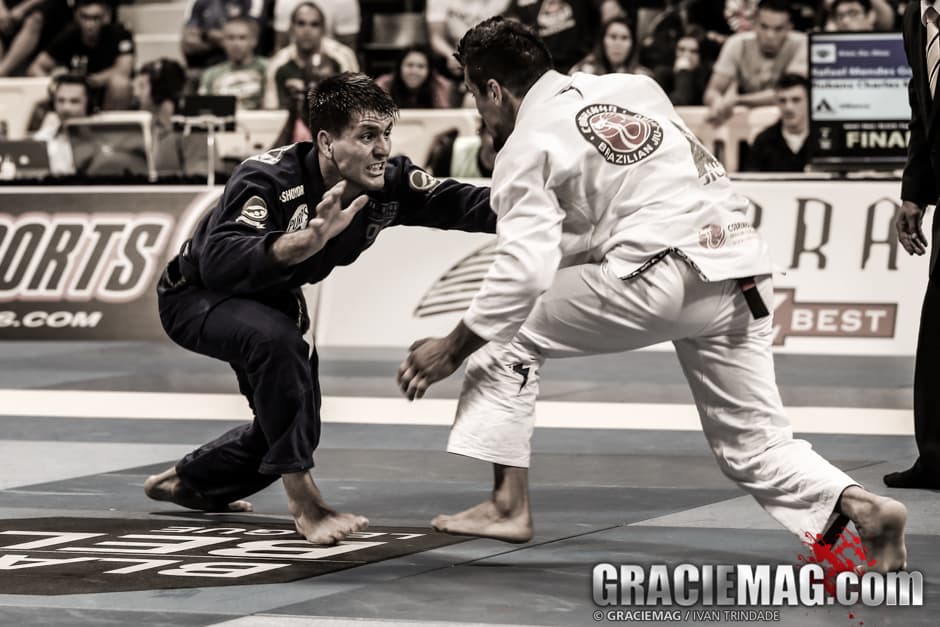
Rafael Mendes: six Worlds titles and a life after competing
Rafael Mendes won six featherweight Worlds titles and retired at 27. Explore his ADCC rivalry with Cobrinha and the academy he helped build.

Training with women in BJJ: listen before you roll
Be a better BJJ training partner with women: agree on intensity, provide honest resistance, ask before coaching or filming, and respect a declined round.
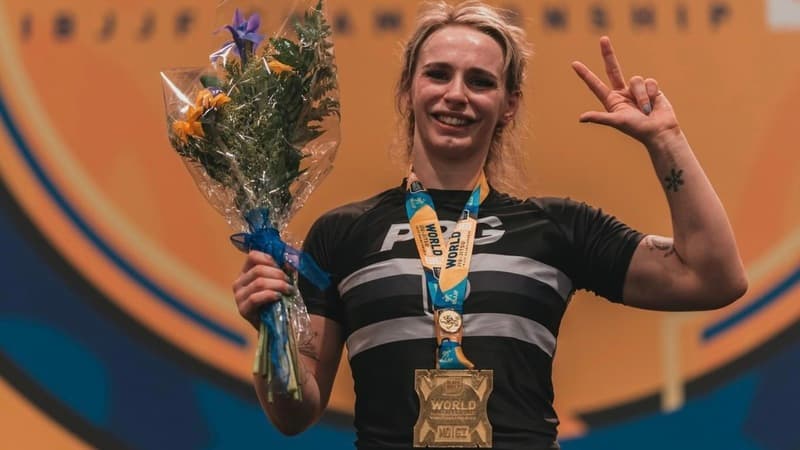
Ffion Davies: winning across gi and no-gi
Explore Ffion Davies's 2022–2023 championship results, from gi Worlds and ADCC gold to a World No-Gi double, with context for the matches behind the medals.
Comments (0)
Loading comments...