

How to learn from BJJ instructionals without wasting the money
Quick answer: Own fewer instructionals and study them harder. Pick one that teaches a connected system for a position you're already in every round, take notes with timestamps, and work a single chapter for about three weeks before moving on. Buying a twelfth instructional is almost always a way of avoiding the work required by the first one.
In February 2026, the database project GrappleDB counted the entire market: 3,393 titles from 1,228 instructors across BJJ Fanatics, Submeta and JiuJitsu X. Over 5,800 hours of tracked runtime. Buying all of it would cost $348,049 and take 241 days of continuous viewing.
You are not going to watch that. Nobody is. And yet the standard experience of the modern hobbyist is a hard drive with eleven half-watched titles on it and a game that hasn't changed in two years.
Access got solved. The remaining problem is that instructionals are very easy to consume and very hard to use, and the gap between those two things is where most people's improvement goes to die.
The catalog is a firehose, and it's designed that way
A few numbers worth knowing before you spend money.
The average instructional price has risen from about $78 in 2018 to $131 in 2025, while average runtime stayed flat around two and a half hours. More than half of all titles, 52%, sit at exactly $79, which is the anchor price of the market. Gordon Ryan's catalog averages $346 a title and would cost you $16,587 to own in full. John Danaher alone accounts for roughly 8% of all runtime in the market: 54 titles, 461 hours, 3,916 chapters. His Go Further Faster fundamentals bundle is 82.5 hours by itself.
Note the sale mechanic too. A Danaher volume lists at $197 and is very often on sale for $98.50; a Gordon Ryan title lists at $349 and shows up half off. If a price is discounted most of the time, the list price is a frame, not a price. Buy on the sale price and don't let the countdown timer do your thinking.
Video cannot see that your left elbow is out
They can't tell you your left elbow is out. They can't see that you're posting your hand at the wrong moment. They can't feel that your pressure is going three inches the wrong direction.
Video is one-way and jiu-jitsu is a correction sport. The genuinely hard part of learning it, the errors you can't perceive from inside your own body, needs a person with hands on you. The people who get the most from instructionals are usually the ones already training four times a week, solving a problem their coach helped them identify.
If you want a sense of how systematically the best in the world think about all this, our profile of John Danaher covers the teaching philosophy that produced most of the modern instructional format.
Systems versus collections
Instructionals come in two shapes, and you should know which you're buying.
A system teaches one position or chain of positions as a connected thing: entries, the controlling structure, the branches when they defend, the recoveries when it breaks. Danaher's series are the canonical example, which is why people love or resent them — you can't watch chapter 14 without chapters 1 through 13. Lachlan Giles' Anthology titles do it at a fraction of the price and length.
A collection is a set of good techniques grouped by theme. Useful, but it doesn't build structure. You end up with moves rather than a game.
Buy a system if you can't answer the question "what do I do when they defend that?" Buy a collection if you already have a game and you're looking for a specific missing piece. Most intermediates buy collections and wonder why nothing sticks. If you don't yet have a shape you're trying to build, start with our guide to building a BJJ game before you spend anything.
Why one is better than twelve
Owning twelve instructionals feels like preparation. It's usually procrastination with a receipt.
Every new title resets you to the pleasant part of learning: watching a very good grappler explain something clearly, understanding it, feeling smarter. The unpleasant part is the four weeks of trying it live, getting shut down, adjusting, getting shut down again, and finally finding the version that works on the purple belt who kept stopping you. That's where the learning lives, and there is always a new instructional available to help you skip it.
There's a data pattern that supports this. Half guard has 814 instructionals tagged to it, closed guard 608. The information is not the constraint. No one's stalled half guard is stalled because there wasn't enough content about half guard.
So: one at a time. Finish it, meaning you can hit two or three things from it on a resisting partner at your level, before you buy another.
How to study one properly
Treat it like a course, not like television.
Watch it once, badly. Whole thing, at normal speed, taking nothing in particular. You're building a map of what's in there, not learning yet.
Then take one chapter. Not one section. One chapter. Watch it three times: once to see it, once pausing to write, once at half speed watching only the part your notes say you don't understand.
Take notes you'll reread. The single biggest upgrade most people make is including timestamps and screenshots. A line like "top-side crossface, 0:14:22, his elbow is on the mat before the hip switch, mine isn't" is worth ten paragraphs of prose you'll never open again. Keep them wherever you already keep training notes; if that's your training log, put the position and the chapter reference in the same entry as the round where it failed.
Then go break it. The instructional is a hypothesis; the mat is the test. Bring the detail to positional sparring rather than a full roll. A roll gives you maybe two chances at it, a positional round gives you fifteen.
The three-week rule
Give any single idea from an instructional about three weeks of live attempts before you judge it.
The first week you'll be worse. You're adding a step and thinking about it, which slows everything down, and people will pass your guard in ways they couldn't before. Week two you'll get it once, probably against someone smaller. Week three is where it either starts appearing on its own or it doesn't.
Three weeks is arbitrary and I'll admit that. The point isn't the number, it's having a fixed window so the decision to abandon something is made on evidence instead of on how you felt about it on Wednesday. Most techniques that get abandoned in BJJ are abandoned in week one, which is the week they're guaranteed to fail.
Free is genuinely good now, and that changes the math
For a long time the case for paid content was simple: free content was scraps. That stopped being true. There are full-length structured breakdowns on YouTube from serious black belts, multi-part position studies, and channels like Bernardo Faria's that have published high-level instruction free for years.
Meanwhile subscription platforms shifted the economics again. Submeta runs around $25 a month for a large library including the whole Lachlan Giles catalog; BJJ Fanatics has its own subscription in a similar range. If you're the kind of person who buys three titles a year, a subscription is cheaper and lets you sample before committing.
The tradeoff: you own a purchase forever and you rent a subscription. If you'll genuinely rewatch something for five years, buy it. Otherwise subscribe, and put the difference toward seminars, which are still the highest-transfer paid instruction available because someone can correct you.
When the video contradicts your coach
This will happen, and it's the most socially delicate part of the instructional era.
First, check whether it's a contradiction at all. A lot of apparent conflicts are context: gi versus no-gi, IBJJF rules versus submission-only, a detail that works for a 145-pound competitor and not for you, or a coach teaching the version that's safest for beginners rather than the version that's optimal for black belts. Those aren't disagreements. They're different problems.
If it is a real disagreement, the etiquette is straightforward and most coaches are fine with it. Ask privately, after class, framed as a question about your own jiu-jitsu rather than a challenge. "I've been getting stuffed on this pass — I saw a version where the near arm goes here instead, does that work with what you're teaching us?" is a normal conversation. Standing up during class to say a famous black belt does it differently is not.
Also worth saying plainly: a coach who cannot handle that question is telling you something useful about the room. Most good ones will either explain why they teach it their way or say they haven't seen that version and want to look at it. Both are fine answers.
The takeaway
There are 3,393 instructionals and 5,800 hours of them, and your improvement is not being limited by any of that. It's limited by how many hours you've spent failing at one specific thing against someone who's trying to stop you.
The version of this that works is boring. One instructional. One position. Notes with timestamps. Three weeks of live attempts before you decide anything. When you can hit two or three things from it against a real opponent at your level, buy the next one.
The version that doesn't work is the one most of us have run at least once: a folder of purchases, a vague sense of having learned a lot, and a game that looks exactly like it did last year.
Give your study a place to live
Log what you drilled, what you tried live, and which chapter it came from, so the next time you open that instructional, you know exactly where you left off. Start a training log on Let's Roll →
FAQ
Are BJJ instructionals worth it? Yes, if you're already training consistently and using them to solve a problem you've identified on the mat. They're poor value as a substitute for mat time or as general education. A single well-chosen title studied properly over a couple of months will do more for you than five bought in a sale and half-watched.
Which BJJ instructional should I buy first? One that covers a position you're already in every single round, taught as a connected system rather than as a set of loose techniques. For most people that's guard retention, escapes, or half guard from whichever side you keep ending up on. Ignore whatever's trending — buy for the position that's currently costing you rounds.
How many BJJ instructionals should I own? Fewer than you think. One at a time, finished before the next. "Finished" means you can hit two or three things from it on a resisting partner at your level, not that you watched all the chapters. There are more than 3,000 titles on the market; the constraint on your progress has never been how many you own.
What if an instructional contradicts what my coach teaches? Check first whether it's context rather than conflict — gi versus no-gi, ruleset, body type, or a beginner-safe version of an advanced detail. If it's a genuine disagreement, ask your coach privately after class, framed around your own problem rather than as a challenge. Most good instructors welcome it. Correcting them in front of the class is the version that goes badly.
Related Posts

Mikey Musumeci gives up the belt to make room for MMA
Musumeci is vacating his UFC BJJ title to focus on MMA training. What he is leaving, what continues, and why the transition matters.
IBJJF membership: finish the paperwork before the deadline
IBJJF membership and tournament entry are separate steps. Plan documents, professor approval, renewals, and junior accounts before registration closes.
Choosing a BJJ seminar worth your time and travel
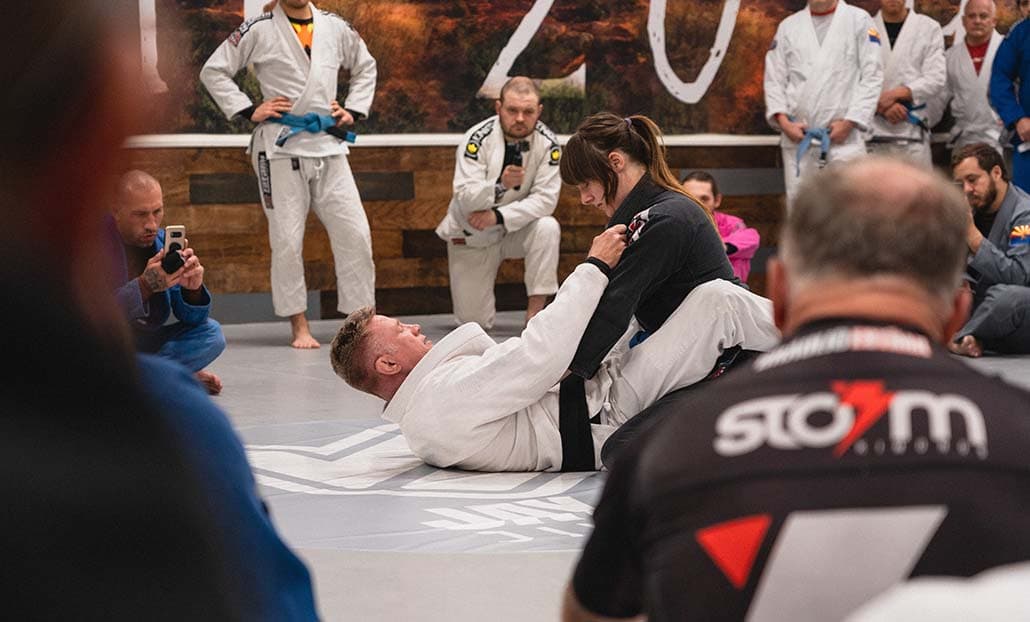
Choose a BJJ seminar by the subject, teaching format, access, and total cost. Know what to ask the host before buying a ticket.
Comments (0)
Loading comments...