
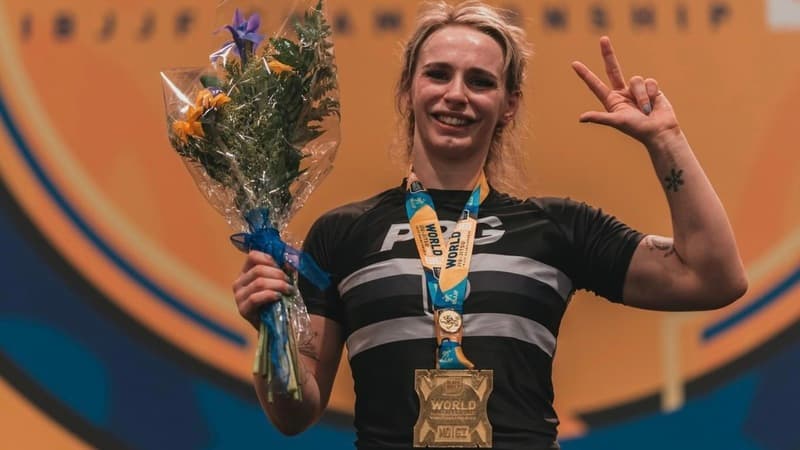
Ffion Davies: winning across gi and no-gi
Quick answer: Ffion Davies won the IBJJF adult black belt lightweight world title and ADCC's under-60kg division in 2022. Her results offer a useful case study in competing across gi and no-gi, without pretending the two formats demand identical preparation. Start with the actual matches and their scoreboards before trying to copy a signature move.
Two points can be enough. At the 2022 gi Worlds, Davies won her lightweight final against Janaina Maia de Menezes, also known as Janaina Lebre, by 2–0. The IBJJF's account describes an early kneebar threat, a takedown, and a lead that held. That is a different sort of performance from the uninterrupted submission sequence an editor might choose for a highlight video.
It is also a better introduction to her career than a collection of adjectives. Davies has competed under different scoring systems, with different clothing and different demands on the grips. Following a few dated results makes the scale of that work visible. It leaves room for close matches as well as dominant ones.
Swansea and Dublin belong in the story
BJJ Heroes' biography traces Davies's background to Swansea, Wales, and a youth career in judo that included the Welsh national junior team. It records her black belt promotion under Darragh O'Conaill at East Coast Jiu Jitsu in Dublin on November 27, 2018. Those are specific places and a specific coaching relationship, rather than the vague claim that a champion simply worked harder.
The judo background is relevant, but it should not become an all-purpose explanation for every later takedown. A childhood sport does not supply an annotated account of an adult athlete's decision-making. Nor does a promotion date tell us how many hours went into a particular passing sequence. We can acknowledge a foundation without inventing the training diary.
For a reader choosing where to learn, that distinction matters. An athlete profile can identify teachers and competitive results. It cannot tell you whether the Tuesday evening class at any particular academy will suit your schedule, budget, or current experience. Admire the career. Then ask practical questions about the room you can actually attend.
The 2022 gi final rewards a second look
The IBJJF's 2022 Worlds recap identifies Davies as the first British adult black belt gi world champion. The narrow final score deserves to stay beside that historic description. Winning a title does not require the winner to look comfortable throughout the match.
A sensible way to study that final is to separate the decisive scoring action from the work around it. Find the takedown. Then go backward and look at how the standing exchange became possible. Afterward, watch the period in which the lead has to be protected. Do not assume that every unsuccessful passing attempt was wasted simply because the score did not change.
That is a viewing method, not a claim to know her instructions from the corner. Without those instructions, nobody outside the team can confidently label every choice part of a prearranged plan. What the result does establish is that a small scoring margin and a world title can occupy the same match. A highlight package is free to skip that sort of tension. A competitor studying footage should keep it.
ADCC adds a second result, not a shortcut between rulesets
The official 2022 ADCC results list Davies first in the women's under-60kg division, ahead of Brianna Ste-Marie, with Bia Mesquita third. The event took place in Las Vegas. Put that result beside the gi title from the same year and the usual argument about which uniform produces the better grappler starts to look rather small.
Still, two gold medals do not prove that a recreational student should divide training time equally between both formats. The athlete's results are evidence of what she achieved. They are not a controlled experiment comparing two beginner curricula.
A more useful question for match study is where clothing changes the available solutions. Which grips disappear when the jacket is removed? Which positional problems remain recognizable? Watch the answer develop on screen instead of declaring that all gi techniques transfer unchanged or that none of them do. Our gi and no-gi comparison provides the basic distinctions if the vocabulary is still unfamiliar.
For your own calendar, the next event's format is a concrete constraint. Davies's ability to win across formats does not make the equipment requirements of your upcoming division optional.
The following gi season gives the first title context
The 2023 Worlds recap again lists Davies as the women's adult black belt lightweight champion. A second title provides a reason to compare seasons. It does not require us to describe the first as a fluke that needed correcting; the first result already stands on its own.
When comparing footage from two championships, resist the urge to invent a transformation. A changed opening grip might reflect the opponent's stance. A different pace could come from the score, the available space, or a phase of the match that your clip does not include. An athlete does not have to unveil an entirely new identity each year for the footage to be useful.
Instead, make the comparison small enough to support. Look at one position that appears in both matches. Record how it was reached and how it ended. If the available video does not show the whole exchange, leave the missing part blank. That sounds fussy until you see an online technical debate built around a clip that begins after the decisive grip was already secured.
December 2023 included two very different finals
At the 2023 World No-Gi Championships, Davies won both lightweight and the absolute division. The IBJJF's event report records a 21–0 lightweight final against Amanda Bruse. In the absolute final against Gabi McComb, it describes Davies escaping a triangle attack before taking the back and finishing with a rear naked choke.
Those accounts should not be compressed into the same sentence about dominance. One tells us about a large points margin. The other contains a dangerous position survived before the eventual finish. Both are victories, but the route matters if you are trying to learn anything from them.
There is a temptation to watch an elite athlete escape a submission and decide that tapping early in your own class is a failure of nerve. That is a poor bargain. A match report cannot assess the pressure on your neck or the condition of your shoulder. Use the footage to identify when trouble began. Leave the last-second escape attempt to appropriate supervised practice, and release immediately when a partner taps.
The more interesting technical study may be the transition after the danger ends. An escape creates another exchange. It does not stop the clock or obligate the opponent to remain still.
Build a small viewing file instead of a giant playlist
A Davies study folder does not need every available appearance. Start with a few complete matches that answer different questions. The following is an editorial suggestion for organizing that folder, rather than a reconstruction of her training program:
Keep a close points match so you can study work that does not produce a finish.
Add a gi match and a no-gi match with a recognizable position in common.
Save an exchange in which she has to defend before returning to offense.
Label each file with the event and year. Then add the timestamp where your chosen position begins. A folder named after an athlete becomes much more useful when you can find the exact exchange without watching twelve introductions and advertisements again.
Write observations before conclusions. “Opponent's right hand is on the mat” is visible. “Opponent is exhausted” usually requires more evidence. The same caution applies to saying Davies deliberately baited a particular attack. An action can create an opportunity without proving that every preceding detail was planned.
If you cannot locate full footage, say so in your notes. A recap can establish who won. It usually cannot settle a disagreement about the angle of a grip three minutes before the finish.
Borrow a problem, not somebody else's entire career
Suppose the part that interests you is passing after a standing exchange. Bring that problem to class: you reach top position, but the opponent immediately reconstructs a guard. That is a position your coach can examine. “Make my game like Ffion's” gives the coach much less to work with.
The same applies to physical comparisons. You do not need to speculate about an athlete's private lifting numbers or training volume to learn from a match. Those guesses tend to become excuses surprisingly quickly. First identify the visible decision. Then find a version of the position you can practice with a willing partner.
Your experiment might be modest: arrive on top after a controlled takedown entry and pause long enough to identify the opponent's nearest frame. Resume only after both people understand the starting position. The point is to connect two phases that your normal drilling separates, rather than recreate a world final at open-mat speed.
Keep the result local. If it helps your transition, keep working on it. If it does not, that is information about your present position and execution. It is not a referendum on an accomplished competitor or an academy you have never visited.
Our guard-passing guide can help you place one observed detail inside the passing problems you already encounter.
Main photo: IBJJF.
The takeaway
Davies's 2022 and 2023 results give a reader several ways into match study: a close gi final, success under ADCC rules, and a World No-Gi campaign that included both weight and absolute titles. The dates matter because they identify the performances being discussed. This is a focused look at that period, not a claim that her career stopped there.
Start with one complete match. Keep the scoreboard in view, separate visible actions from guessed intentions, and choose a single exchange to revisit. You will have something more useful than a list of medals and considerably less misleading than a personality theory built from a highlight reel.
Find a place to practice what you notice
Use the Let's Roll gym directory to find nearby academies, then check which gi and no-gi classes fit your week. A regular class you can attend gives those match notes somewhere to go.
FAQ
Where is Ffion Davies from? She is from Swansea, Wales, according to BJJ Heroes' athlete biography. Her background includes junior-level judo before her black belt BJJ career.
Who awarded Ffion Davies her BJJ black belt? BJJ Heroes records her promotion under Darragh O'Conaill at East Coast Jiu Jitsu in Dublin in November 2018. That historical affiliation should not be treated as a statement about her current training location.
Did Ffion Davies win gi Worlds and ADCC in the same year? Yes. The official results record her adult black belt lightweight gi world title and ADCC under-60kg title in 2022.
Should beginners copy her competition game? Use a match to choose a position worth understanding, then work on an appropriate version with your instructor. Copying a complete elite competition strategy is a much larger project than learning one transition, and a video cannot judge your readiness for a late submission escape.
Related Posts
Rafael Mendes: six Worlds titles and a life after competing
Rafael Mendes won six featherweight Worlds titles and retired at 27. Explore his ADCC rivalry with Cobrinha and the academy he helped build.

Training with women in BJJ: listen before you roll
Be a better BJJ training partner with women: agree on intensity, provide honest resistance, ask before coaching or filming, and respect a declined round.
Bia Mesquita: the grappling record behind the MMA newcomer
Follow Bia Mesquita's path from 2014 Worlds double gold and a 2017 ADCC title to her 2025–2026 UFC results, with dated sources and match context.
Comments (0)
Loading comments...