
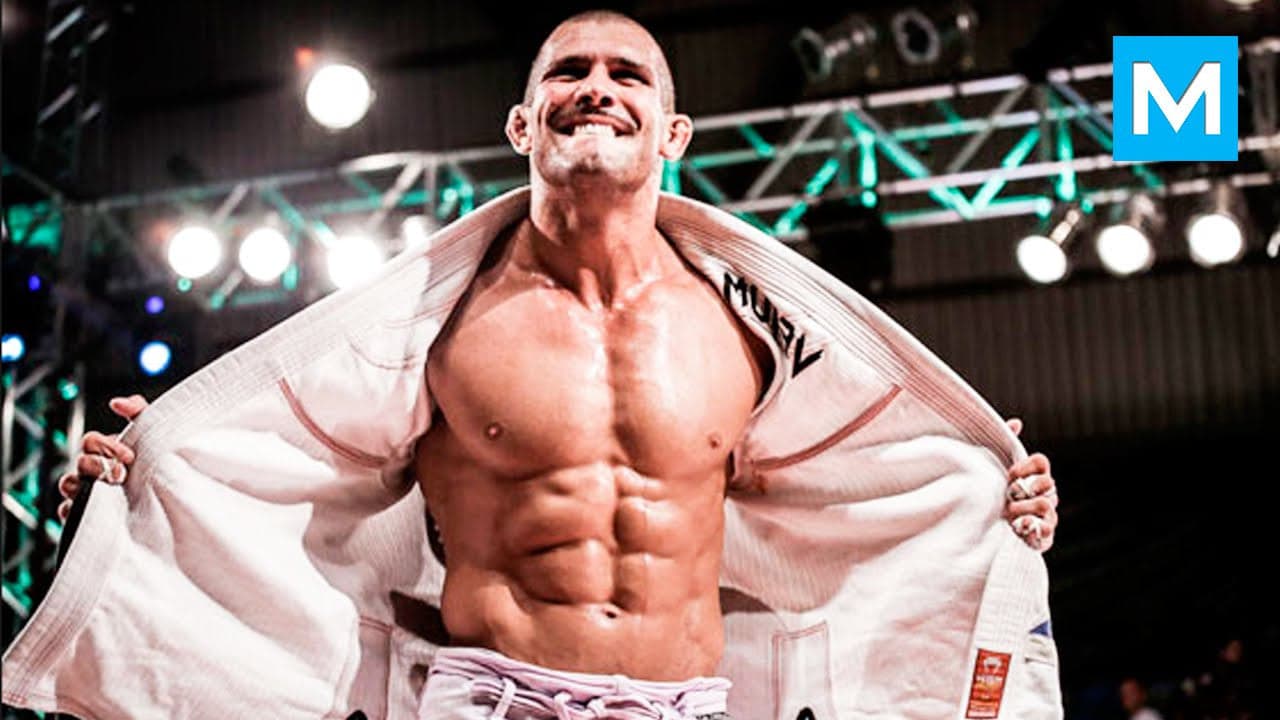
Rodolfo Vieira: the champion behind the pressure passing
Quick answer: Rodolfo Vieira won five adult black belt IBJJF World titles across 2011–2014 and the ADCC under-99kg championship in 2015. His reputation grew from an aggressive top game, but his career also includes a remarkable brown belt breakthrough and a move into professional MMA. Those chapters deserve to be understood separately rather than reduced to one nickname or one UFC result.
Two World gold medals in one weekend would be a career for many competitors. Rodolfo Vieira collected heavyweight and absolute gold in 2011, then kept adding weight-division titles while a new rivalry changed the open class around him.
Born in Rio de Janeiro on September 25, 1989, Vieira turns 37 today. It is a reasonable moment to look backward. The familiar images are of a man driving through somebody's guard; the fuller story involves a Rio team, an airport promotion, a difficult no-gi final, and the decision to become a beginner in parts of another sport.
The airport promotion followed a brown belt breakthrough
BJJ Heroes' biography places Vieira's start in jiu-jitsu at 13, with Arlans Maia and Bruno Souza. He later joined Julio Cesar Pereira's team, which became Grappling Fight Team. That background matters because a competitor is rarely the product of only the famous room printed beside his name at the end of a career.
In 2009, still a brown belt, Vieira won at the Abu Dhabi World Pro and defeated Braulio Estima along the way. On his return, Julio Cesar awarded him his black belt at the airport, according to the same biography.
The setting supplies the sort of detail that survives longer than a results table. It also puts the promotion in order: the brown belt achievement came first, the black belt followed. There is no need to invent a speech, a crowd reaction, or the exact contents of a conversation nobody here witnessed.
For a newer student, the surprising part is the overlap of belt levels in that particular competition. It is a historical circumstance, not a suggestion that your local white belt division should be treated as a rehearsal for challenging the black belts.
The 2011 double gold made the claim hard to argue with
The IBJJF's 2011 Worlds results put Vieira first and Bernardo Faria second in both adult black belt heavyweight and open class. GF Team appears beside Vieira's name in each category.
That is a useful corrective to the idea that a reputation is built entirely through spectacular finishes. A championship weekend is also a sequence of opponents, positions, and decisions that must keep working as the day goes on. The final photograph contains none of the rounds that made it possible.
The double result gave spectators two ways to understand him: as the best athlete in his weight division that weekend, and as the winner of the bracket that brought different sizes together. Those are related achievements, but they are not interchangeable. Counting them clearly is why his five World titles occupy four years rather than five.
Faria's presence in both finals also tells us something about the level of the opposition. We do not need to diminish the runner-up to explain the winner's accomplishment. A final is more meaningful when the other person remains a serious athlete in the story.
Five titles did not mean four identical seasons
Vieira added weight-division World gold in 2012, 2013, and 2014. The last of those came at super-heavyweight. In the official 2014 results, Faria again takes silver in Vieira's division, while Marcus Almeida takes open-class gold ahead of Vieira.
That pairing is part of the history people mean when they talk about Vieira and Buchecha. Their names were repeatedly attached to the same high-stakes conversation, but the individual results still matter. Vieira could win his own division and finish behind Almeida in the absolute during the same event.
It is tempting to flatten a rivalry into a winner and a loser for all time. That makes poor history. It erases the other divisions, the changing opponents, and the difference between winning one final and owning another person's entire career.
For viewers revisiting that period, keep the tournament and category visible beside the video. A heavyweight final and an absolute final may feature overlapping names while answering different competitive questions. The small label under the replay is doing useful work.
The passing reputation contains some surprisingly small decisions
Vieira's physical presence is obvious in competition footage. Less obvious is the risk of using that appearance as a complete explanation of what happened. If every successful pass becomes a story about strength, the observer has stopped looking at the exchange.
In a 2017 open-guard demonstration published by BJJ Fanatics, Vieira grips the near-side pants while controlling the far knee without taking the same kind of fabric grip. The accompanying explanation connects that choice to limiting the opponent's opportunity to establish spider or lasso control. It also emphasizes controlling the hips before settling down after clearing the legs.
That is a much narrower subject than being strong. It involves deciding where to attach yourself and where an attachment might give the guard player something useful. A spectator can understand the question without attempting the pass on somebody at full speed.
For your own training, bring that question to the instructor: which grip helps me, and which grip is quietly helping the person underneath? Our guide to becoming a better guard passer gives that discussion a broader starting point. The answer should fit the guard in front of you.
ADCC 2015 added a different kind of championship
The official ADCC 2015 podium lists Vieira as under-99kg champion, Felipe Pena as silver medalist, and Joao Assis as bronze medalist. Vieira also took bronze in the absolute, which Claudio Calasans won.
The final against Pena is especially useful for escaping the assumption that every famous passer's important victory must end in a pass and submission. Kid Peligro's report from the final day records a referee decision after two overtimes and describes the contest as a standing battle.
That result belongs beside the highlight finishes. It shows the range of problems a tournament can present even to an athlete with an established identity. Sometimes the championship is decided in the phase spectators are least inclined to associate with the competitor.
The gi and no-gi records therefore reinforce each other without becoming the same record. Winning Worlds does not automatically win ADCC. The opponent, permitted grips, and scoring circumstances have to be dealt with again. The differences between gi and no-gi are part of the story, not a footnote attached to a medal count.
The move to MMA was a new professional project
In November 2015, ADCC reported Vieira's plan to join American Top Team and pursue mixed martial arts. This was an announced change in direction after the ADCC title, not a move prompted by a lack of grappling accomplishments.
By August 10, 2019, he was making his UFC debut. The UFC's athlete record lists a second-round arm-triangle submission over Oskar Piechota. On February 10, 2024, he submitted Armen Petrosyan with the same named finish at 4:48 of the first round.
Those results show jiu-jitsu producing finishes in MMA. They do not establish that the transition was simple. Reaching a submission opportunity inside a cage involves a different set of problems from beginning a grappling match with no strikes allowed.
A fan who enjoys Vieira's gi work can follow that transition without demanding that every fight serve as a public exam for Brazilian jiu-jitsu itself. One athlete is making decisions against another trained professional. An entire martial art is not waiting outside the cage to receive its report card.
The Hernandez loss belongs in an honest profile
At UFC 258 on February 13, 2021, Anthony Hernandez submitted Vieira with a guillotine at 1:53 of the second round. The UFC's event report describes Vieira reaching mount early before Hernandez survived and changed the fight with strikes.
It was a significant defeat. It does not require mockery, an invented medical explanation, or an argument that the earlier World titles somehow stopped counting. Hernandez deserves credit for the fight he won; Vieira's grappling record does not need to be erased to provide it.
There is a familiar temptation here for recreational grapplers. Somebody with a lower nominal jiu-jitsu rank submits a decorated champion, and the discussion becomes entirely about belts. That leaves out the fight that occurred before the finishing grip. A result in MMA includes those preceding exchanges.
Keep the same courtesy for the people at your academy. A tap in a difficult round is an event, not permission to rewrite a person's whole training history. Context is useful at both ends of the competitive ladder.
A small viewing list is better than another greatest-ever argument
If you want to understand why Vieira remains a reference point, choose a few different settings instead of assembling only his fastest finishes. A useful starting list is:
A 2011 Worlds match, with the division clearly identified.
The 2015 ADCC final against Pena, including the standing exchanges.
One full UFC fight, followed by his open-guard teaching demonstration.
Watch the first engagement in each setting. What is each athlete allowed to grip? What position are they trying to establish? When the first attempt fails, does the next decision preserve control or abandon it?
These are observation prompts, not claims that Vieira follows one fixed sequence everywhere. They also make a better conversation after class than arguing about an imaginary match between athletes from different decades at different weights. You can disagree about a specific exchange and then replay it. An invented matchup offers no such remedy.
Our guide to learning from instructionals can help you carry one observation from that viewing list into a question for your coach.
Main photo: BJJ Fanatics; archive photograph of Rodolfo Vieira.
The takeaway
Vieira's place in jiu-jitsu rests on identifiable achievements: the 2011 double gold, the run of World titles that followed, and the 2015 ADCC championship. His move into MMA added another sporting record, with wins and losses that deserve their own context.
The pressure-passing reputation is a reason to begin watching. It should not be the point where the description ends. There are grip choices inside that reputation, opponents across from it, and a career that kept changing after the gi medals had already made him famous.
Find a room where you can study the details
Use the gym directory to explore academies and ask about the classes available for your experience level.
FAQ
How many IBJJF World titles did Rodolfo Vieira win at adult black belt? He won five: weight and absolute in 2011, followed by weight-division titles in 2012, 2013, and 2014.
Did Rodolfo Vieira win ADCC? Yes. He won the under-99kg division in 2015, with Felipe Pena finishing second. Vieira also earned absolute bronze that year.
Who awarded Rodolfo Vieira his black belt? Julio Cesar Pereira. BJJ Heroes describes the promotion taking place at the airport after Vieira returned from his 2009 Abu Dhabi World Pro success.
Should beginners try to copy his pressure passing immediately? Start with a detail your instructor can explain and supervise. A professional competitor's pace and intensity are not instructions for how to treat an inexperienced training partner.
Related Posts

Training with women in BJJ: listen before you roll
Be a better BJJ training partner with women: agree on intensity, provide honest resistance, ask before coaching or filming, and respect a declined round.
Bia Mesquita: the grappling record behind the MMA newcomer
Follow Bia Mesquita's path from 2014 Worlds double gold and a 2017 ADCC title to her 2025–2026 UFC results, with dated sources and match context.
Ffion Davies: winning across gi and no-gi
Explore Ffion Davies's 2022–2023 championship results, from gi Worlds and ADCC gold to a World No-Gi double, with context for the matches behind the medals.
Comments (0)
Loading comments...