
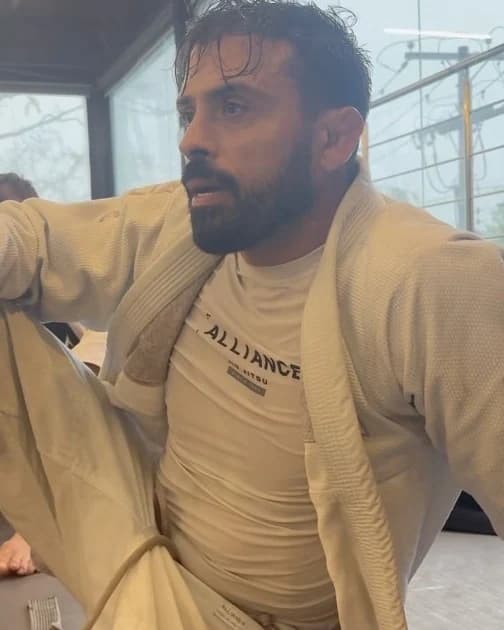
Mario Reis belongs in the featherweight conversation
Quick answer: Mario Reis won adult black belt featherweight world titles in 2003 and 2004. His later record includes major finals, podium finishes, and a 2014 Pan title, followed by a substantial coaching role. Study him through those distinct periods rather than treating the first championship as the whole career.
Mario Reis became an adult black belt world champion in the same year he received the belt. The year was 2003. It is an unusually clear place to start a profile because the change in competitive category and the result arrived together.
It is also a dangerous place to stop. An early championship can make the rest of a career read like an extended footnote: more matches, newer rivals, then coaching. Reis’s later record deserves better than that compression.
The useful question is what remained after the first result ceased to be a surprise. Other featherweights continued improving and winning. Reis had to keep meeting them as an established opponent rather than a new name.
The 2003 final gives the history a face
Graciemag’s retrospective identifies Alexandre “Soca” Carneiro as Reis’s opponent in the 2003 Worlds final and provides a link to the match. A named opponent is more useful than a sentence saying Reis conquered the division. It points to the actual competitive problem behind the title.
BJJ Heroes’ biography records Sylvio Behring awarding Reis his black belt in 2003. Those two facts belong together without requiring a prediction that the title was inevitable. A promotion is a recognition of development; a tournament asks whether the athlete can solve the opponents present that day.
For a viewer returning to the final, the task is to keep Soca’s work in the frame. Watch which options remain available to each athlete before the decisive exchange. Keep the full exchange in view rather than skipping straight to its ending.
A second title changed the comparison
Reis won again in 2004. Graciemag identifies him as the 2003 and 2004 world champion, and the historical athlete record lists both titles. The second result established that his first black belt season was followed by another successful championship campaign.
The difference is practical. A new champion can no longer rely on being unfamiliar to everybody in the field. Opponents have a result to study and a reason to prepare. A second title does not reveal every adjustment the athlete made, but it does prevent the first result from being treated as a lone exceptional weekend.
I think the temptation to call this domination is less helpful than keeping the seasons separate. Each championship has its own bracket. The record gives us two victories across editions, not permission to claim that every match in between was easy or that an athlete had become immune to a particular opponent. Repetition is interesting enough without absolutes.
The later Worlds podiums complicate the easy timeline
The BJJ Heroes record lists Worlds silver medals for Reis in 2005, 2006, and 2007, followed by bronze medals in 2008, 2009, 2010, and 2014. The 2006 silver came at lightweight, as the official Worlds results show; the career was not confined to featherweight. Those placements describe continued relevance alongside the absence of another adult black belt world gold in that listed period.
It would be possible to write this entirely as decline. That would be a narrow interpretation of a record that also shows him repeatedly reaching the late stages of a major championship. A final loss is still a loss. It is also different from failing to reach the final, and a careful profile can hold both facts at once.
The Let’s Roll profile of Cobrinha gives another entry into featherweight history. Reading careers beside one another helps prevent an era from becoming a single champion’s uninterrupted possession. The divisions contained opponents with achievements of their own, and those achievements are part of what made winning difficult.
The 2014 Pan result needs a footnote
The official 2014 Pan results list Reis first in male adult black belt featherweight and Gianni Grippo second. A contemporary BJJ Heroes results report describes the final as an agreement between teammates rather than a contested match.
That distinction should remain visible. The official podium establishes who received which placement. It does not, by itself, tell the reader that every final was fought through in the usual way. A writer who turns the podium into an invented match report would be adding something the evidence does not support.
There is no need to make this accusatory. Team closeouts are part of the historical record and can be described proportionately. The point is to label the achievement accurately: Reis received the title, and the reported final mechanism differs from winning a contested exchange. That is useful information for anyone comparing results across a career.
The semifinal still supplied a contested result
The same contemporary report records Reis beating Osvaldo “Queixinho” Moizinho 6–4 in the 2014 Pan semifinal. That gives the title run a competitive detail that the agreement in the final does not erase. The path and the final’s mechanism are separate parts of the same event.
A 6–4 semifinal gives a viewer a different kind of match to revisit from the agreed final. It also keeps Queixinho in the account as an opponent who made Reis work for his place.
This is a useful way to approach old competitions generally. Keep the event’s reported sequence intact. If a source establishes a contested semifinal and a closed-out final, do not force them into one generic description of a championship performance. The differences help a reader understand what the achievement actually consisted of, and they create better questions for watching the available matches.
Coaching adds work the medal count cannot measure
Reis’s own instructional site presents him through both his competitive titles and the athletes he has coached. The VF Comunica profile also identifies his later standing as a coach. The later coaching role gives the career another setting, with different students asking for help.
A successful coach has to make information usable by somebody else. The student may have a different build, a different experience level, or a different reason for training. An answer that worked for the teacher needs explanation and context before it becomes an answer the student can apply.
Reis’s own results give a prospective student reason to be curious about that instruction. They are not a substitute for asking who teaches the regular class or whether its level fits the visitor. A decorated past and a useful Tuesday evening class can be connected, but that connection must occur in the actual teaching.
Choose a small enough question to answer
A career spanning major titles and later coaching is too large to copy. The useful unit of study is one exchange or one competitive decision. Picking it carefully makes the historical material less intimidating and more informative.
For a first study session, try this:
Choose a complete match with the event and division clearly identified.
Mark one passage where the athletes’ available positions change.
Ask a coach which detail can be observed reliably and which explanation remains uncertain.
The aim is to avoid reading a highlight backward. Knowing the winner makes every earlier movement look purposeful in retrospect. Keeping the opponent’s remaining options visible gives the match room to be contested before we know how it ends.
Older footage adds a further practical limit. A camera angle may hide the hand that changes a grip, or a cut may remove the beginning of an exchange. If a detail is missing, it is better to name the gap than to borrow an explanation from a different match. A coach might identify several plausible routes from the visible position; the recording may not establish which one occurred. That uncertainty does not make the historical contest useless. It tells the viewer how much can reasonably be learned from that copy of it. A visible sequence and a complete mechanical explanation are related goals, but sometimes only the first is available.
The takeaway
Mario Reis’s two early world titles establish his place in featherweight history. The later silver and bronze medals, the precise circumstances of the 2014 Pan title, and the coaching work make the account richer. They show why a career deserves more than a best-results paragraph.
Begin with a named match, then let the evidence set the size of the conclusion. The 2003 final gives the first championship an opponent. The 2014 Pan record shows why placement and match history need to be read together. Both approaches make appreciation more exact.
Find somewhere to study the details
Compare local schools through Let’s Roll’s gym directory and ask how their classes help students work through competition footage.
FAQ
Who is Mario Reis? He is a Brazilian jiu-jitsu black belt under Sylvio Behring, an adult black belt featherweight world champion in 2003 and 2004, and a coach associated with Alliance. His historical record includes later major podium finishes.
Who did he face in the 2003 Worlds final? Graciemag’s retrospective identifies Alexandre “Soca” Carneiro and links to the match. That is a useful starting point for studying the first championship rather than relying only on a title list.
Did Mario Reis win the 2014 Pan Championship? The official results list him first in adult black belt featherweight. Contemporary reporting describes the final with Gianni Grippo as a teammate agreement, so it should not be written as a contested match that the source does not report.
What should a beginner take from his career? Start with one specific question from a complete match and discuss it with a coach. The article does not recommend copying an elite athlete’s schedule or treating a successful competitive move as automatically appropriate for every student.

Miles Serrano
Miles Serrano writes about competitors and the decisions that shaped their careers. He is more interested in the adjustment someone made in the third minute than in the medal count afterward.
Related Posts
ADCC 2026 results: the stories that survived the predictions
ADCC 2026 results from Krakow: Jaworski, Maciel, Crevar, Pena, the women's champions, and the superfight outcome, with official podiums and match context.
Xande Ribeiro: from absolute titles to the masters mat
Explore Xande Ribeiro's absolute Worlds victories, two ADCC titles, Six Blades, and the distinction between his 2022 Worlds farewell and later masters gold.
Bernardo Faria: the champion who kept asking questions
Follow Bernardo Faria from Juiz de Fora and Alliance to the 2015 Worlds and BJJ Fanatics, with context on his competition game and move into teaching.
Comments (0)
Loading comments...