
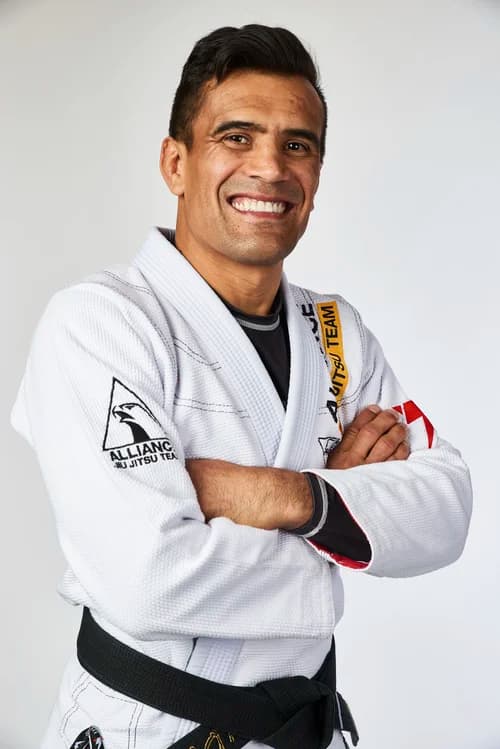
Cobrinha's 2017: five major titles at 37
Quick answer: Rubens Cobrinha Charles won the Europeans, Pans, Brazilian Nationals, gi Worlds, and ADCC in 2017, a season commonly called the super grand slam. He was 37 when he finished that run at ADCC. His career also includes four earlier consecutive gi world titles, making 2017 a late chapter in an already substantial record.
The 2017 ADCC under-66kg final ended 6–0 to Cobrinha against AJ Agazarm. For Cobrinha, that result completed a year containing titles at all four major IBJJF gi championships as well as ADCC. He was not introducing himself to the division. He had been winning gi world titles since 2006.
That distance between the first championship and the extraordinary final season makes him a particularly interesting figure to revisit. There is an early run of dominance, a period chasing an ADCC title, and then a year in which the gi and no-gi results line up. The career does not fit neatly into one uninterrupted peak.
The nickname arrived before the jiu-jitsu
Cobrinha means little snake. According to BJJ Heroes' biography, the nickname came from his capoeira years, referring to his agility and flexibility. He was born in Londrina and grew up in São Carlos before becoming known on BJJ podiums.
The same account places Mauro Pacífico in his early jiu-jitsu training and describes his later move to train with Fernando Terere. Terere awarded him his black belt in 2005, a promotion also recorded by Cobrinha's academy.
Those details are worth retaining because the nickname can sound like something invented for competition marketing. It belongs to an earlier athletic life. His movement background preceded the black belt, rather than emerging as a convenient explanation after he became famous.
Still, capoeira should not be asked to explain every BJJ result. Training in one discipline does not automatically supply the grips, positional decisions, or competition experience required in another. The teachers in this story matter. So does the work between beginning jiu-jitsu and competing successfully at black belt.
Four consecutive gi Worlds titles established the first chapter
Cobrinha's academy lists adult black-belt IBJJF world championships in 2006, 2007, 2008, and 2009, followed by a fifth in 2017. The four-year sequence is the foundation of his gi reputation. The later title adds a different kind of achievement: returning to the top after a substantial interval.
The academy also separates four no-gi Worlds titles from the gi results. That distinction explains why descriptions of his total championships can look different. A number may combine several competitions with world championship in their names. The useful question is which events the writer has counted.
For a new fan, the early gi run gives Cobrinha an identity independent of the rivalries that followed. He was already a repeated world champion before many viewers encountered a clip of him facing Rafael Mendes. That context should travel with the clip.
It also gives the 2017 Worlds result some weight beyond one good weekend. By then, eleven years separated his first and fifth gi world titles. The gap is visible in the dates even if you do not attach a theory about longevity or a training prescription to it.
The first ADCC gold required a different wait
Cobrinha was runner-up to Rafael Mendes at ADCC in both 2009 and 2011. The 2013 official results reverse their positions, with Cobrinha taking the under-66kg title and Mendes finishing second.
That first gold began another sequence. In 2015, Cobrinha won under 66kg again, this time with Bruno Frazatto listed as runner-up. His third consecutive ADCC championship came in 2017.
The order matters more than a claim that he simply dominated everything. The earlier silver medals remain part of the career. They show that the ADCC championship was something he pursued while already owning major gi titles, not a trophy that arrived automatically with his reputation.
For viewers, those editions also widen the cast beyond one opponent. Frazatto belongs in the account, as does Agazarm in 2017. A division is made of actual brackets and different matchups. Compressing the whole period into a single rivalry loses some of what Cobrinha had to do to keep winning it.
The 2017 gi season was already remarkable by June
Before ADCC arrived, Cobrinha had won the Europeans, Pans, Brazilian Nationals, and Worlds. FloGrappling's September 2017 report identifies that four-event run as the gi grand slam, with the subsequent ADCC victory completing the expanded achievement.
At Worlds, the official featherweight podium lists Leonardo Saggioro second and Gianni Grippo and Shane Jamil Hill-Taylor in the bronze positions. Graciemag's contemporaneous finals report records Cobrinha beating Saggioro after a 2–2 points tie, with advantages 1–0 in Cobrinha's favor.
That narrow final sits inside the big season. It is a useful detail because five championship titles can sound like five processions with no difficult minutes. The recorded score supplies a different picture: the Worlds gold was decided within the event's scoring structure, against an opponent who finished level on points.
Give Saggioro his name and the final becomes more interesting. There is no need to describe him as an obstacle placed in the champion's way. He was the other finalist, pursuing the same title.
Wrestling was part of the late-career work
Cobrinha's ADCC final against Agazarm offers a different image from the familiar guard-player label. In its 2018 account of his wrestling training, ADCC describes the 6–0 win and his work with coach Kenny Johnson. The article reports Cobrinha saying after the match that he had trained wrestling for six years.
That is a specific addition to the biography. An established BJJ world champion was still working with a coach on another part of grappling. His earlier gi achievements did not eliminate the need to learn the standing exchanges relevant to a different event.
For the recreational reader, the useful idea is modest. An area you do not know can remain a legitimate training subject even after you become competent elsewhere. You do not need to claim Cobrinha's results as a forecast for your own takedowns to appreciate that choice.
Our gi and no-gi training comparison introduces the broad differences. This particular final gives the discussion a concrete reference: a named opponent, a score, and documented wrestling preparation, rather than a blanket argument that one format is inherently superior.
The last bracket completed the five-event season
Jiu-Jitsu Magazine's event report lists Cobrinha's 2017 ADCC opponents as Uranov Zhakshylyk, Kuba Witkowski, Paulo Miyao, and Agazarm. He won the final without conceding points, and FloGrappling states that no opponent scored points on him during the tournament. That is a claim about points, not a claim that every match ended by submission.
The ADCC championship results confirm his under-66kg title in Espoo, Finland. With it, the year contained this set of championships:
IBJJF Europeans and Pans.
Brazilian Nationals and IBJJF Worlds.
ADCC under 66kg.
The list spans gi and no-gi competition. That is what makes the season more specific than a long unbeaten weekend. It required successful appearances at separate events, followed by the ADCC campaign later in the year.
Cobrinha was 37 at the time, as the contemporary report notes. Age is relevant to the story without becoming a slogan. His result does not prove that physical demands disappear in your thirties, or that every older recreational athlete should imitate an elite competitor's schedule. It describes what he achieved.
The academy provides a second way to encounter the name
For someone who began BJJ after those championships, Cobrinha may first appear as the name of a Los Angeles academy. The school identifies him as its head instructor and lists its location on Wilshire Boulevard. His public role includes teaching, not simply preserving a competition archive.
The IBJJF's 2026 article on Alliance's competitive network identifies Cobrinha BJJ as the Los Angeles affiliate and names Kennedy Maciel, Jalen Fonacier, and Cleber Sousa among its competitors. That is a later chapter with other athletes doing the competing.
An academy's team results are one way to learn about it. They do not answer every question a visitor should ask. A recreational student still needs to know which classes accept visitors, who teaches the relevant session, and what the expected pace is. Those are normal questions even at a school with a celebrated founder.
This distinction lets the competitive history remain impressive without turning the profile into an untested review of every class. We have not attended a session for this article. The documented record and the academy's published information are the basis of the spotlight here.
Our guide to drilling BJJ can help you frame a small practice question before bringing a detail from competition footage to class.
Main photo: Cobrinha BJJ.
The takeaway
Cobrinha's career is worth remembering in more than one phase. The four consecutive gi world titles established him early. The first ADCC gold arrived after two runner-up finishes. The 2017 season then combined the four major gi championships with a third straight ADCC title.
The wrestling work is one of the most useful details within that history. It names something he was still learning after he was already a champion. Revisit the 2017 final with that context and the 6–0 score becomes more than another line in a list of medals.
Find instruction that matches what you want to learn
Use the gym directory to explore academies, then ask about the classes you would attend. If standing grappling is a priority, ask how it appears in the timetable and how students are introduced to it.
FAQ
How many adult black-belt gi Worlds titles did Cobrinha win? His academy lists five IBJJF titles: 2006, 2007, 2008, 2009, and 2017. Counts that include no-gi Worlds or other championships use a different total.
What was Cobrinha's super grand slam? In 2017 he won the Europeans, Pans, Brazilian Nationals, gi Worlds, and ADCC. The phrase describes that combined season rather than a separate tournament with its own bracket.
How many times did Cobrinha win ADCC? He won the under-66kg division in 2013, 2015, and 2017. The official results distinguish those titles from his earlier runner-up finishes in 2009 and 2011.
Who taught Cobrinha wrestling? The documented preparation discussed here was with Kenny Johnson. ADCC's 2018 article connects that work to the 2017 final against AJ Agazarm; it does not provide a complete account of every coach or training session in his career.
Related Posts

Training with women in BJJ: listen before you roll
Be a better BJJ training partner with women: agree on intensity, provide honest resistance, ask before coaching or filming, and respect a declined round.
Bia Mesquita: the grappling record behind the MMA newcomer
Follow Bia Mesquita's path from 2014 Worlds double gold and a 2017 ADCC title to her 2025–2026 UFC results, with dated sources and match context.
Ffion Davies: winning across gi and no-gi
Explore Ffion Davies's 2022–2023 championship results, from gi Worlds and ADCC gold to a World No-Gi double, with context for the matches behind the medals.
Comments (0)
Loading comments...