
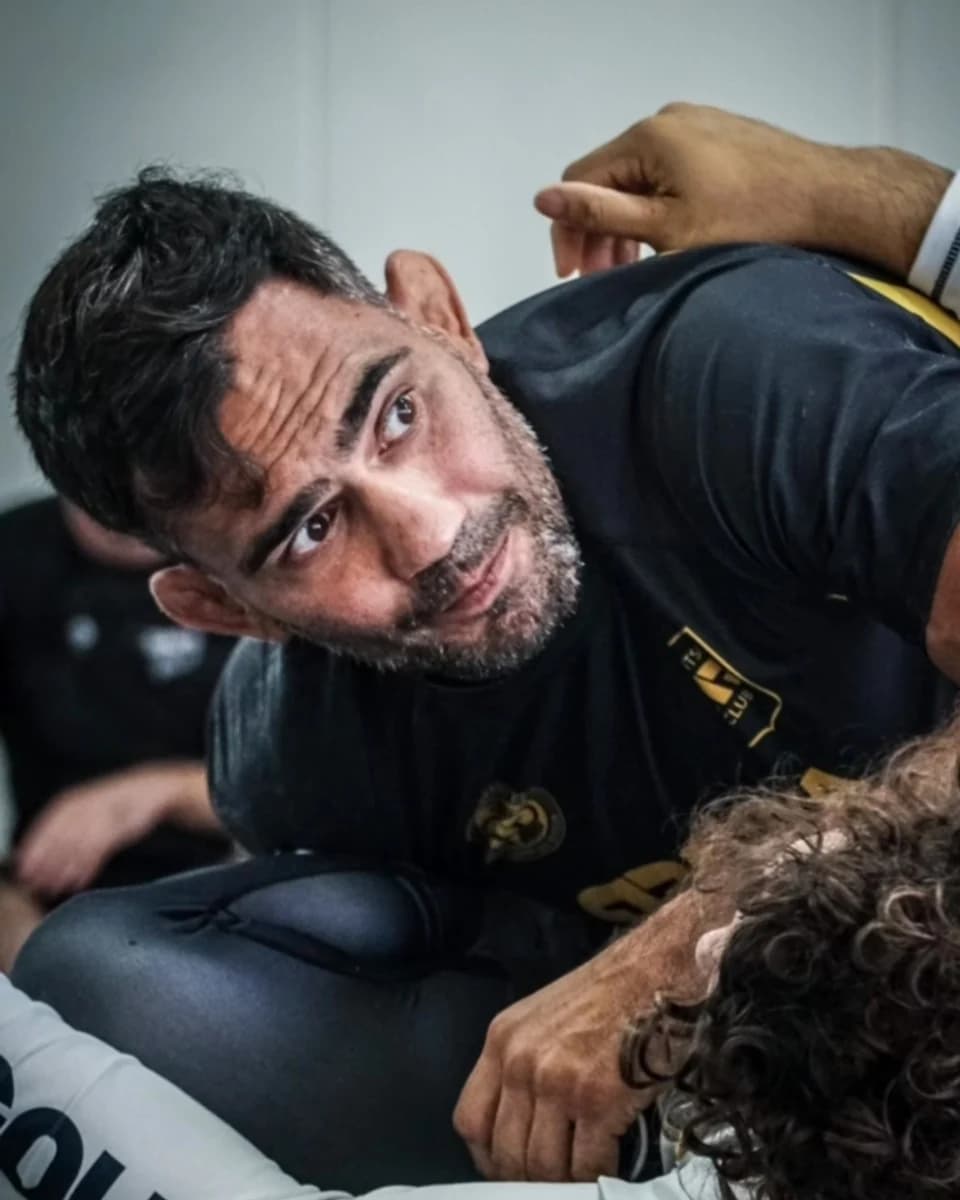
Lucas Leite took his half guard into a heavier bracket
Quick answer: Lucas Leite won the 2007 gi Worlds at middleweight and later collected major results at heavyweight, including No-Gi Worlds gold. His half guard reputation is easier to understand when the division labels stay attached to those results. His published teaching also includes how to pass the position that made his name.
Lucas Leite's 2007 world title sits under middleweight. His 2015 world silver sits under heavyweight. Eight years and two different lines in the results archive make a better opening to his career than a promise that one guard can make size irrelevant.
Leite is closely associated with the Coyote Half Guard. The association is useful, provided it sends us toward the rest of his work rather than replacing it. There is a competitor across several events here, and an instructor who has also published a course on defeating his own favored position.
Start with the middleweight title and the correct Lucas
The 2007 IBJJF Worlds archive lists Lucas Leite first in adult black belt middleweight, representing Brasa. André Galvão appears second, with Murilo Santana and Gustavo Campos in the bronze positions. It is a specific title in a substantial field.
A neighboring result matters for the reader trying to follow the name: Lucas Lepri won lightweight at the same event. Leite and Lepri are different competitors, even if a quick search or a hurried conversation can collapse them into the same half-remembered Lucas.
A viewing list beginning here should keep that middleweight label attached. It identifies the competitive starting point for the category changes that follow.
The no-gi title came before the heavier category
At the 2009 No-Gi Worlds, Leite won adult black belt middleweight, with Carlos Diego Ferreira second.
The chronology is useful. It establishes success in both forms before the heavyweight results discussed below. We do not need to describe the later division choice as a sudden discovery that his preferred position worked.
For a reader comparing performances, I would separate changes in clothing from changes in the opposition's category. Otherwise, several differences arrive together and get credited to a single explanation. A competitor can retain recognizable preferences while the grips available and the bracket around them change.
That makes the earlier no-gi title a useful baseline. The later heavyweight results changed the category, while the form of competition remained no-gi.
Heavyweight gold makes the division change concrete
The 2011 No-Gi Worlds archive places Leite first at adult black belt heavyweight. Roberto Camargo de Alencar is second, with Kevin Casey and Diego Gamonal Nogueira sharing third. This is a different category from the earlier middleweight title.
Alencar had won heavyweight in the same 2009 No-Gi results that placed Leite first at middleweight. By 2011, the two names occupied the top places in one heavyweight category. That crossover is a concrete way to understand the change without inventing what either man weighed away from the official competition.
The success is Leite’s, rather than a claim that a smaller recreational student should seek the largest available opponent. His event entries and experience belong in the account together. A class partner or next tournament division still needs to suit the person making that choice.
I find the restrained version more interesting anyway. It leaves a real question for study: which parts of a recognizable game remain available when the category changes? The answer deserves a match, rather than a slogan about technique overcoming all size.
A second heavyweight title keeps the story from becoming one weekend
Leite appears first again at heavyweight in the 2014 No-Gi Worlds results. Jackson Sousa is listed second, with Mauro Celso Santiago and Timothy-Michael Spriggs in the bronze places. Leite and Sousa both appear under CheckMat on that historical podium.
The contemporary BJJ Heroes event report adds a detail the podium alone cannot: it identifies Leite and Sousa’s division finish as a teammate closeout. Its match list also records Leite advancing past Morris Ayala on advantages and beating Spriggs 8–0. The article’s stage labels are inconsistent, so those opponents and outcomes are more useful here than assigning each a round.
That makes this title run distinct. There were recorded matches to reach the finish, followed by teammates occupying the first two places without a contested final between them. Calling the whole result a victory over Sousa would erase that distinction. Calling the closeout an absence of competitive work would erase the earlier matches.
The heavyweight title remains on Leite’s record. The route is more interesting once the result has its actual shape.
The gi silver puts a limit beside the success
The 2015 gi Worlds results place Alexandre Couceiro Ribeiro first at heavyweight and Lucas Joas Gomes Leite second. Jackson Sousa and Timothy-Michael Spriggs share bronze. The longer registered name helps connect Leite to the simpler name used on earlier lists.
Graciemag’s June 1, 2015 results report records Ribeiro’s winning score as 4–2. Unlike the previous year’s No-Gi finish with Sousa, this account records a contested final. The two podium lines have different stories underneath them.
Four points to two tells us the match was decided on that score. It does not tell us the entire sequence of attacks, and I would not reconstruct one from the total. What it does give the reader is a specific contest to seek out: Leite against Ribeiro, at heavyweight, in the gi, in 2015.
For readers building their own competition plans, our weight-division article starts with a different task. You need an appropriate entry for your next event. Leite's career is material to study, rather than a recommendation to imitate his category choices.
The Coyote syllabus includes the work before the sweep
The publisher's chapter list for The Coyote Half Guard moves through underhook entries, dogfight sweeps, responses to a whizzer, and defenses against knee-slice and backstep passing. Later chapters cover routes into the back. That is a broader teaching outline than a single named sweep.
The distinction is useful when deciding what to study. Recognizing a finishing movement is different from understanding how the bottom player obtained the connection that made it available. A repeated position has an arrival, a response from the other person, and somewhere to go afterward.
A practical viewing note might separate those moments:
Identify the starting position before naming the attack.
Record the opponent's response rather than skipping directly to the score.
Ask which connection remains when the first option fails.
These are proposed questions, not claims about unseen footage. Take one question into supervised practice and keep the task small enough for a partner to give useful resistance. Collecting every chapter title is a poor substitute for finding out which part you do not understand yet.
The no-gi outline changes the problems around the same specialty
Leite's no-gi Coyote course lists pressure-passing problems, D'Arce defense, knee-slice responses, and routes through dogfight. Its published outline also includes material on escaping shoulder pressure and countering the backstep. The threats around the favored position receive their own space.
That is the part of specialization I would keep. A position becomes more useful to study when its problems are named, rather than edited out of the description. Knowing where an opponent can interfere gives the student a more realistic question for the next lesson.
The product page is evidence of what the publisher says the course covers. It is not an independent test of every sales claim surrounding it, and this article does not claim to have reviewed the full paid course. There is enough in the outline to see that the teaching extends beyond a clean demonstration with no response.
For a newer reader, the half-guard introduction supplies the basic orientation. Use a coach to connect that map to your actual training, especially before trying unfamiliar counters or submission defenses with another person.
He also published the passing side of the argument
Killing the Coyote is Leite's course on passing and countering half guard. The syllabus includes passing with an underhook, dealing with a half-butterfly hook, escaping lockdown, and defending Coyote and dogfight positions. A specialist has put the opponent's task into the teaching catalog, too.
That is my favorite detail in this account. It keeps a recognizable game from becoming an identity the reader feels obliged to defend. The player on top has a problem worth understanding, and the bottom player's success depends partly on how well that problem is solved.
Imagine a supervised positional round in which one partner is trying to establish their half guard and the other is trying to pass. That is an example of a learning arrangement, not a drill attributed to Leite. Both partners should understand the starting point, the permitted resistance, and when to reset.
Reading the two sides together gives the specialist's reputation a more useful shape. Instead of treating Coyote as a magic word, you can ask what holds the position together and which choices begin to take it apart. Those questions can survive the end of a highlight clip.
The teaching week extends beyond a specialist’s course
The Lucas Leite BJJ website in La Habra, checked November 4, 2026, lists him as head instructor alongside Lavinia Barbosa, Daniel Diniz, Christian Feliciano, and William Padilha. Its timetable separates adult beginner sessions from advanced and competition classes.
One concrete contrast is Monday’s adult beginner gi class and Wednesday’s adult beginner no-gi class. The site also lists gi and no-gi competition sessions on Tuesday and Thursday mornings. These are published program arrangements to confirm with the academy, rather than a promise that Leite personally teaches every listed hour.
The contrast fits the rest of this profile. A recognizable specialist’s name can sit above a school that has to serve students with different experience and different reasons for coming. An introductory student needs an appropriate first lesson before there is any reason to argue about a heavyweight final.
The takeaway
Leite's record moves from middleweight success to heavyweight results, across gi and no-gi competition. Keep those event names and category labels attached. They make the achievement concrete without requiring a claim that size stopped mattering.
His teaching catalog adds another useful complication: the athlete identified with a half guard also offers the passing side. Study the connection between an option and its counter. That is a more workable task than trying to copy an entire career from the name of one position.
Give the study a place to happen
Find a suitable training room through the Let’s Roll gym directory, then ask the coach how to practice one specific question with a partner.
FAQ
Are Lucas Leite and Lucas Lepri the same athlete? No. The 2007 Worlds archive lists Leite as middleweight champion and Lepri as lightweight champion. They are separate competitors.
Did Leite win heavyweight No-Gi Worlds gold? Yes. The official results list him first at adult black belt heavyweight in 2011 and 2014. Those category labels differ from his earlier middleweight titles.
Did he win the heavyweight gi Worlds in 2015? No. The official archive lists him second behind Alexandre Ribeiro. The silver belongs in the account alongside his first-place results.
Does his teaching cover passing half guard? Yes. His published Killing the Coyote syllabus covers passing and counters to several half-guard positions. That is separate from his courses teaching the bottom position.

Miles Serrano
Miles Serrano writes about competitors and the decisions that shaped their careers. He is more interested in the adjustment someone made in the third minute than in the medal count afterward.
Related Posts
ADCC 2026 results: the stories that survived the predictions
ADCC 2026 results from Krakow: Jaworski, Maciel, Crevar, Pena, the women's champions, and the superfight outcome, with official podiums and match context.
Xande Ribeiro: from absolute titles to the masters mat
Explore Xande Ribeiro's absolute Worlds victories, two ADCC titles, Six Blades, and the distinction between his 2022 Worlds farewell and later masters gold.
Bernardo Faria: the champion who kept asking questions
Follow Bernardo Faria from Juiz de Fora and Alliance to the 2015 Worlds and BJJ Fanatics, with context on his competition game and move into teaching.
Comments (0)
Loading comments...