

A loop-choke grip needs a head position worth keeping
Quick answer: The loop choke is a gi submission that uses a collar grip with the defender's head in a particular relationship to the attacking arm and torso. Reaching the collar does not establish that relationship by itself. Learn the version your instructor teaches, practise controlled entries, and release immediately on any stop signal.
The collar grip survives, so the attacker assumes the choke must still be there. Meanwhile, the opponent has raised their head, changed angle, or begun moving past the legs. A hand can hold yesterday's position surprisingly well.
That is the loop-choke problem I would start with. The submission is attractive because an apparently ordinary collar grip can become an attack. The same familiarity makes it easy to keep pulling after the configuration has changed. Learning when to leave the grip can clarify the entry as much as learning how to establish it.
Identify the version and the starting position
Loop-choke lessons do not all begin from the same place. A guard-based entry and an attack during a different positional exchange can use related collar mechanics while presenting different control problems. Ask which version you are studying before combining details.
Rafael Lovato Jr.'s loop-choke lesson is one primary instructional reference. Another is the Gracie University lesson listing, which places a loop-choke lesson within guard submissions. Access and the amount of public instruction differ across platforms.
Use a coherent coached example. Identify where the defender's head begins, where the attacking elbow sits, and what the guard or upper-body connection is doing. Those relationships explain the opportunity. A title containing loop choke does not guarantee that two demonstrations share the same entry.
The collar grip is an opportunity rather than a result
A grip can influence posture before it becomes part of a submission. The defender can still adjust their distance or hand-fight the connection. Treat that contest as part of the technique instead of skipping directly to the finishing shape.
Ask the receiving partner to show when they can raise their head freely and when the taught control begins to limit that movement. The instructor can inspect whether the grip and body relationship match the lesson. This can be done without pressure intended to finish the choke.
There is a useful counterexample. If you have a collar grip but the defender is upright and outside the required angle, the finish may not be available at all. Keeping the same hand position does not obligate you to attack. Rebuilding the guard or changing the connection can be the appropriate next task.
Notice the head before committing the rest of the body
The defender's head position is a changing part of the exchange. An attacker who starts moving before recognizing that change may commit to a shape the opponent has already left. The resulting scramble can be mistaken for a timing problem when the original opening was absent.
Study the first moment your instructor considers the entry available. Ask what a defender would do to remove it. That question can reveal the difference between an attack that is genuinely connected and one completed only because the receiver is standing still.
Our closed-guard posture article examines what keeps an upper body folded. The same general reading skill helps here, even when the exact guard differs. Find the connection that limits posture before assuming that a downward head position will remain available throughout the next movement.
A rotation cannot repair a missing connection
Some loop-choke variations include a turn or a more pronounced rolling action. Those movements can make the technique look like a single dramatic event. The control that makes the movement appropriate should be established before you try to reproduce the event at speed.
If the instructor is teaching a rotating version, ask to pause before the rotation begins. Identify what prevents the defender following the turn, lifting out, or changing the angle. The coach should decide how the receiver responds and how the partners end the repetition.
Do not add a roll to an entry you cannot yet recognize. It can change where both bodies land and how pressure is applied. A controlled lesson can stop at an earlier checkpoint while you learn the setup. That is a more useful limit than hoping speed will make an uncertain position look like the demonstration.
Let the defender remove the opening on purpose
A meaningful early exercise can give the receiver a choice between maintaining the taught head position and recovering posture. The attacker then has to recognize whether the loop-choke entry is still appropriate. Finishing pressure can remain excluded.
Here is an editorial practice proposal to discuss with your instructor. It is deliberately narrower than a full round.
Start from the exact collar grip and guard arrangement shown in the lesson.
Permit one agreed posture recovery or grip-removal action.
Stop when the entry disappears, the taught checkpoint is reached, or either person signals.
The attacker should be allowed to decline the choke. That makes recognition part of the exercise. If every repetition must end in the submission, the receiver will eventually have to cooperate with a configuration that no longer exists. You will have practised the appearance rather than the decision.
Do not cling to the grip while losing the larger position
A collar grip can feel valuable enough to defend long after the opponent has begun passing. That is an ordinary tradeoff to examine with a coach. It is not proof that the choke was almost finished or that keeping the grip was necessarily wrong.
Ask what the hand could have done instead at the relevant moment. Could it have rebuilt a frame, protected the guard, or established another connection? The answer depends on the actual position. The useful comparison is between available actions, not between an attacker's commitment and a defender's stubbornness.
Our guard-retention article helps separate preserving the guard from recovering after a pass has progressed. In your loop-choke attempt, identify which stage you were in when the grip stopped serving the original attack. That point often belongs earlier than the final loss of top or bottom position.
A quick tap does not remove the need for control
The loop choke should be learned with the same clear stop agreement as any other submission. Release immediately on a tap, verbal stop, or request to reset. If the partner reports an unclear or uncomfortable alignment, ask the instructor to rebuild it before the next attempt.
Do not use surprise as evidence that the technical setup was sound. A receiver unfamiliar with the entry may react late or tap from uncertainty. Their stop ends the repetition either way. Afterwards, the coach can distinguish the intended connection from a mistake that happened to produce discomfort.
The receiving role is therefore active. Say when the head position no longer matches the lesson. Ask to slow down a transition you cannot follow. The aim of practice is learning the attack and its boundaries, rather than producing a tap that neither partner can explain.
A useful comparison can keep the partner and collar grip constant while changing only the defender’s head position. Ask the instructor to demonstrate both arrangements. The contrast helps you identify why the same hand placement can belong to an available attack in one repetition and a guard-control question in the next.
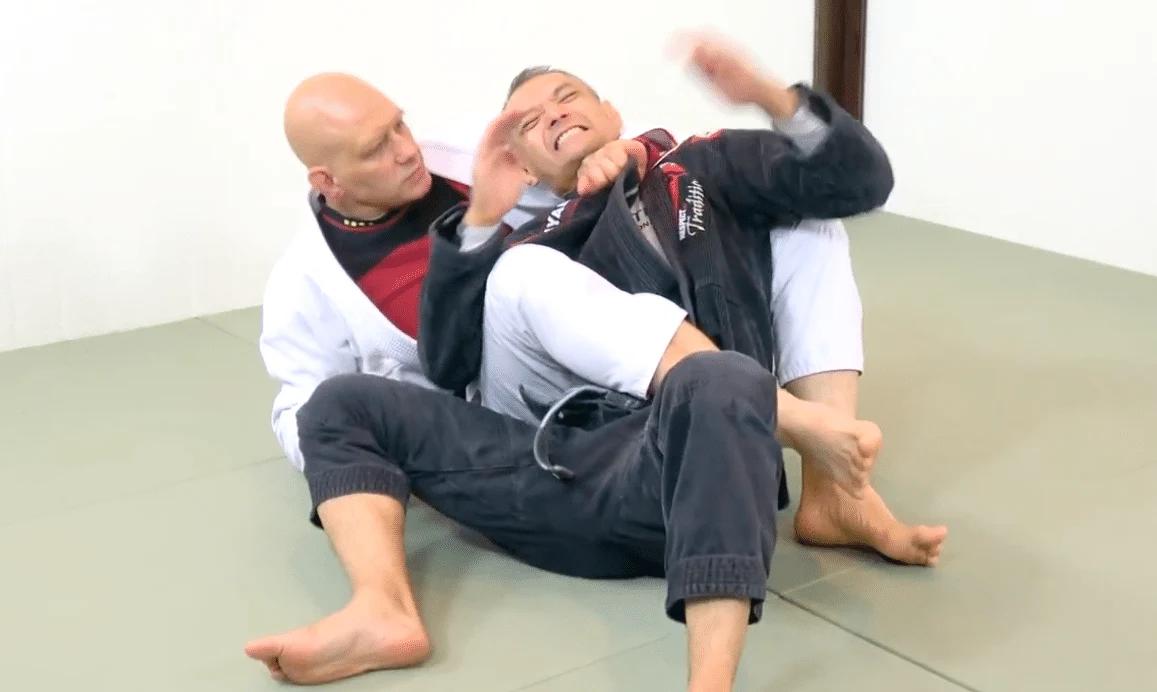
Main photo: live.atosbjjondemand.com (source publisher; photographer not identified). Atos instructional still from Cross Collar Grip & Loop Choke — Part1.
The takeaway
Learn the loop choke by identifying the head-and-collar relationship that makes the entry available. Then study the defender's way of removing it. The grip may remain in your hand after the useful opportunity has gone, so it cannot be your only guide to the next action.
At the next supervised practice, ask the receiver to recover posture in one agreed way. Recognize when you should abandon the entry and rebuild the position. That decision belongs beside the successful setup in your notes. It tells you whether you are learning an attack or simply becoming reluctant to release a collar.
Find the right supervised gi session
Use Find gyms to locate an academy, then confirm the class level and visitor arrangements with the host. Ask which session covers fundamentals appropriate to your experience before assuming that a particular choke will be included.
FAQ
Is every collar grip a loop-choke opportunity? No. The defender's head, the attacking arm, and the surrounding position need to match the taught entry. A collar grip can remain useful for another task even when the loop choke is absent. Ask your instructor to show both situations.
Do I need to roll to perform a loop choke? Versions differ. Learn the coherent variation your coach demonstrates before adding a rotation from another lesson. The movement changes the landing and pressure, so its control and stopping condition need supervised practice with a partner who understands the task.
Why do I get passed while holding the grip? The original attacking relationship may have disappeared while you kept the collar. Have the coach inspect when a framing or guard-recovery action became available. The final pass alone cannot explain whether the first entry or a later decision caused the problem.
How can the receiving partner help during drilling? Follow the agreed posture or grip-removal task, communicate uncertainty, and stop immediately when needed. An honest limited response teaches the attacker to recognize the opening. The receiver should not have to remain folded merely so every repetition ends in a choke.

Nina Okada
Nina Okada explains positions the way a good training partner does: one problem at a time, with the limits of the explanation said out loud. She is careful about the difference between what footage shows and what it only suggests.
Related Posts
The bow-and-arrow choke changes the job of back control
A collar grip is only part of the bow-and-arrow choke. Study the shift from back control to the finishing angle and what the defender can recover.

Your arm triangle has an arm problem before a squeeze problem
The BJJ arm triangle depends on the trapped shoulder and the attacker's body position. Learn what to inspect before adding finishing pressure.

The BJJ gift wrap controls an arm before it takes a back
Gift-wrap control changes what a mounted defender can do with one arm. Study that control before chasing the back-take highlight.
Comments (0)
Loading comments...