
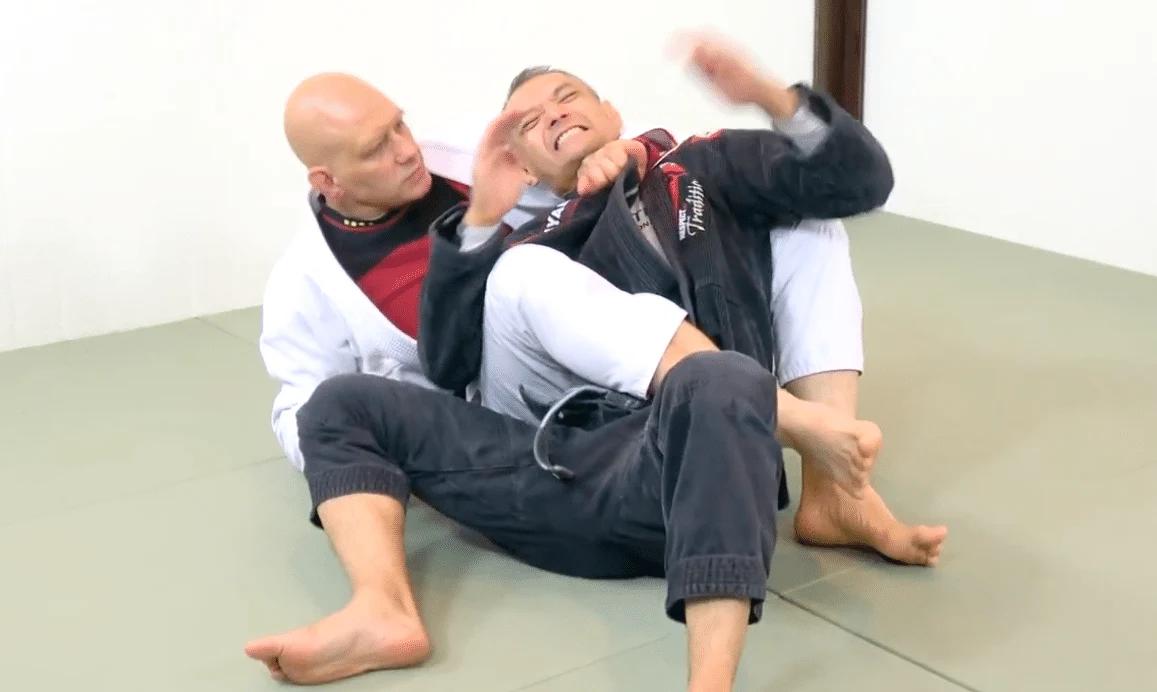
The bow-and-arrow choke changes the job of back control
Quick answer: The bow-and-arrow choke uses the gi collar within a position that changes the defender's ability to turn and follow. Securing a collar grip does not by itself establish the whole attack. Learn the coached transition from back control, practise with controlled pressure, and release immediately on a stop.
The hand reaches the collar, and the attack suddenly looks close to finished. That is the seductive part of a bow-and-arrow demonstration. The cloth is visible. The connection that lets the attacker change angle without losing the defender can be much harder to see.
I would study that transfer first. A person can have a strong collar grip while the defender's shoulders are already escaping. The same grip can then become a reason to cling to a lost position instead of recognizing the moment to recover control. The submission deserves more than a photograph of the hands.
Locate the control before naming the finish
Begin with the back-control arrangement your instructor actually teaches. Identify the upper-body connection and the position of the defender's hips. Then watch what changes as the attacker moves toward the bow-and-arrow configuration.
Rob Biernacki's lesson published by Grapplearts presents a specific coached finish. It is a primary place to see the full relationship rather than collecting finishing cues without their starting position. The lesson's claims about effectiveness should remain the instructor's claims, not a guarantee for your own practice.
For a first explanation, ask what stops the defender turning to face the attacker. A collar grip can contribute to that answer, but it may not be the entire answer. Find the relevant body and leg controls before moving on to the pressure that produces the tap.
The gi supplies a handle with changing tension
The collar is part of the attack, and its slack and position matter. A grip that feels secure while both people sit still can change as the defender turns or the attacker adjusts their distance. Holding harder does not necessarily remove the slack created elsewhere.
Have the instructor show the relationship between hand placement and body position without applying the finish. The receiver can identify when a turn becomes available and when it is limited. That gives you a more useful description than the grip felt strong.
Do not import a no-gi hand connection into the same explanation without asking what replaces the cloth's job. A similar body angle can belong to another submission or control. The name bow and arrow usually points to a gi attack for a reason. A familiar silhouette does not make the grips interchangeable.
Turning away from the back can be part of the attack
Back control normally asks the attacker to stay attached as the defender moves. The bow-and-arrow transition can deliberately change that relationship. The attacker does not simply remain in an ordinary back-control picture and pull harder on the collar.
This creates a useful learning question. At what point does the original control give way to the new configuration? If the defender regains a shoulder turn during the transfer, the finish may no longer be available as demonstrated. Your hands can remain busy while your body has already lost the required position.
Our back-control overview provides the larger map. Use it to keep retaining the back and completing a particular collar attack distinct. Each is a legitimate task. They should be connected intentionally, rather than treating either one as evidence that the other has been achieved.
Follow the defender's first useful escape movement
A bow-and-arrow highlight often begins late, after the hardest control work has happened. For study, the defender's first useful adjustment may matter more than the eventual tap. Look at which shoulder or hip they attempt to move and which connection prevents it.
Kesting's bow-and-arrow escape lesson gives a primary defensive perspective on the same family. Study the escape with an instructor and match it to the actual starting configuration. A defence shown before a grip settles cannot automatically be inserted after every part of the attack has changed.
During your own controlled practice, ask the receiver to make one taught adjustment. The attacker can then learn whether the control follows that movement. There is no need to turn the experiment into a contest over how long somebody can resist a choke.
Practise the transition with the finish switched off
A useful early task is arriving in the intended configuration while keeping finishing pressure out of the exercise. Start from the coach's back-control arrangement, move toward the demonstrated angle, and stop at a named checkpoint.
Here is one editorial proposal to adapt with an instructor. Its value is making the transfer visible, not prescribing a training dose.
Decide which defensive turn the receiver may attempt.
Agree that a tap or verbal stop ends the repetition immediately.
Reset when the taught finishing configuration is reached or the original control is lost.
The receiver can offer honest resistance within those limits. The attacker should be allowed to recognize a lost position and return to control instead of forcing the submission. That decision is part of learning an attack that changes the shape of the back-control exchange.
Do not use the collar to drag an unclear position into place
A strong grip can tempt an attacker to keep pulling after the receiver's body has moved somewhere unfamiliar. Stop there. The next useful action is asking the instructor to identify the configuration, not testing whether greater tension will rescue it.
The receiver's feedback matters. If they report discomfort in a different place from the intended lesson, release and rebuild. A tap is an instruction to stop, not a certificate that the submission was technically correct. The coach should interpret the position before the next attempt.
Our catch-and-release article explains why a practice agreement belongs before the submission. Apply it to the exact transition. Is the exercise about retaining the collar grip, arriving at the angle, or applying the finish? Those are related tasks with different boundaries, and both partners need to know which one they have accepted.
Give a failed attack a more useful name
The choke did not work is too broad to guide the next lesson. Perhaps the collar grip was never established. Perhaps the defender turned during the transfer. Perhaps the finishing configuration was reached, but the coach identified an alignment problem. Each possibility begins at a different moment.
Write the first observation you can support. For example, the defender's far shoulder reached the mat before you had organized the new leg position. That is a sequence. You can bring it to the coach without pretending to know which technical adjustment will solve it.
If a video hides the relevant shoulder, say so. A grip remaining visible throughout the clip cannot prove that the rest of the control remained effective. Good analysis can end at the edge of the available view. The next practice can then examine the part the camera could not show.
The reset should be as deliberate as the entry. Have the instructor show how to remove tension and return the partner to an ordinary position when the exercise ends. A receiver who has been turned away should not have to guess which connection will be released next or when they can safely move with the attacker.
Main photo: grapplearts.com (source publisher; photographer not identified). Illustrative still from Grapplearts’ bow-and-arrow escape lesson.
The takeaway
Learn the bow-and-arrow choke through the transfer between back control and its particular finishing configuration. Identify how the collar grip works with the rest of the body, and what stops the defender turning as that relationship changes. The grip is recognizable because it is visible. It is not necessarily the whole explanation.
For the next supervised session, practise reaching the named checkpoint without applying the finish. Let the receiver attempt one agreed turn. If the connection disappears, stop there and inspect it. That gives you a specific positional question before the lesson becomes a test of pressure.
Find a gi class that fits your experience
Use Find gyms to locate an academy, then ask the host which session suits your level and visitor arrangements. Learn a collar-choke transition under supervision with an explicit agreement about when the repetition ends.
FAQ
Is the bow-and-arrow choke a gi technique? The familiar attack uses the gi collar. Other submissions can have related body angles, but removing the cloth changes the available control. Ask an instructor to explain the actual no-gi configuration rather than assuming a different grip makes the same technique work unchanged.
Does a deep collar grip mean the choke is finished? No. The defender's shoulder and hip position, your angle, and the rest of the control still matter. A visible collar grip cannot establish that the full finishing configuration is present. Have the coach inspect the position before adding pressure.
Can I practise without making my partner tap? Yes, when the instructor and partner agree on a transition or control task. Define the checkpoint and permitted defence, then stop there. Any tap or verbal stop ends the attempt immediately, including during a drill that was meant to exclude finishing pressure.
What should I review after losing the attack? Find the first lost relationship you can actually observe. The defender may have recovered a shoulder turn or the grip may have changed before the final attempt. A specific sequence helps the coach more than a general claim that the choke fails against everybody.

Nina Okada
Nina Okada explains positions the way a good training partner does: one problem at a time, with the limits of the explanation said out loud. She is careful about the difference between what footage shows and what it only suggests.
Related Posts

Your arm triangle has an arm problem before a squeeze problem
The BJJ arm triangle depends on the trapped shoulder and the attacker's body position. Learn what to inspect before adding finishing pressure.

The BJJ gift wrap controls an arm before it takes a back
Gift-wrap control changes what a mounted defender can do with one arm. Study that control before chasing the back-take highlight.

S-mount is worth holding before you reach for the armbar
S-mount changes the base above a defender's shoulders. Study the arm isolation, the transition, and the point where control actually disappears.
Comments (0)
Loading comments...