
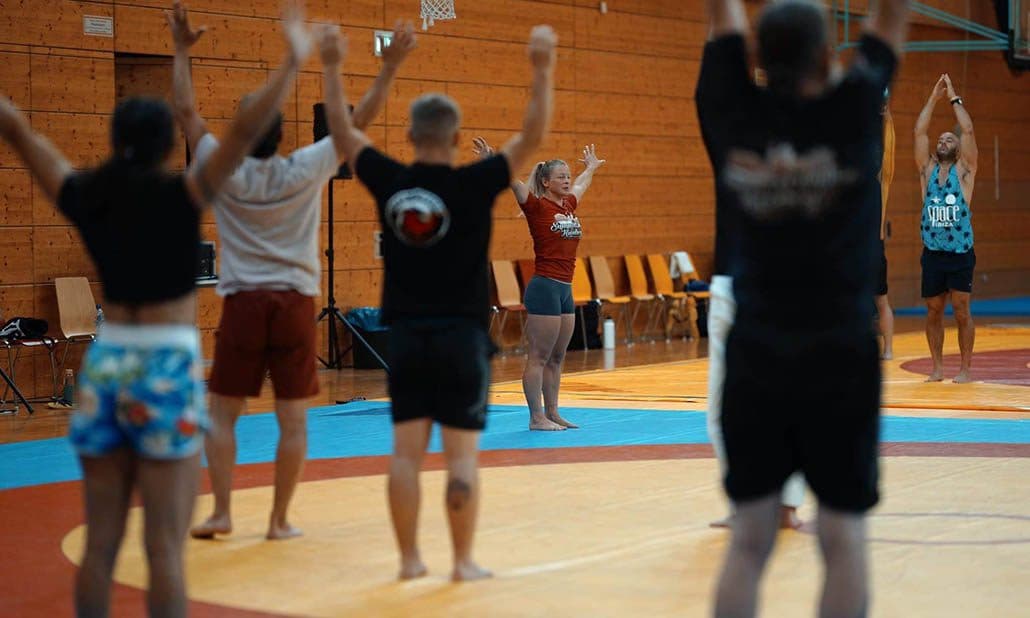
Why experienced BJJ students still belong in fundamentals
Quick answer: An experienced BJJ student can use a fundamentals class to refine execution, revisit neglected positions, and practice making a familiar movement work under the conditions being taught. Follow the coach’s lesson instead of turning it into an advanced class for your partner. Familiar material becomes useful when you give yourself a precise job.
Knowing the name of the escape is not the same as escaping. You can recognize every step in a demonstration and still lose the position when someone controls your near elbow or shifts their weight at the wrong moment.
That gap gives an experienced student a reason to return to fundamentals. The class does not have to contain a new technique to contain useful work. It does need your attention, and your partner deserves more than a distracted person waiting for the advanced session to begin.
Choose a detail smaller than the whole technique
If the day’s lesson is a familiar escape, choose one part you cannot yet explain or execute reliably. It might be the direction of the first movement, the timing of a frame, or the point at which the hips should move. Keep the question inside the lesson the coach is teaching.
A broad aim such as getting better at escapes is difficult to assess over a few repetitions. A narrower aim lets you notice something concrete. Did your elbow remain in the intended position? Did you create space before trying to insert the knee? Ask the coach which detail deserves your attention if you cannot identify one.
This approach does not require secretly making the exercise harder. It asks you to be more exact about the same task. Your partner can give the prescribed reaction while you improve the part you have previously rushed past.
The useful discovery may be small. Small is acceptable when it addresses a mistake that appears repeatedly in your training.
Follow the demonstration before adding your version
Experienced students bring habits into class. Some are helpful; some belong to a different variation; some are simply the way the movement has always felt. A fundamentals session gives you a chance to see those habits clearly.
Try the version being taught before replacing it with your preferred one. There may be a reason the coach has chosen a particular grip or sequence for that group. If the reason is unclear, ask at an appropriate point rather than quietly changing the task for both you and your partner.
You do not have to erase what you already know. You need to distinguish the lesson in front of you from the version you arrived expecting. That distinction makes a later comparison more useful.
After practicing the demonstrated movement, you can ask how it relates to your usual approach. The conversation is better when you have actually tried both, rather than rejecting the new detail because the technique’s name sounded familiar.
Give a newer partner room to do the work
If your partner is less experienced, your job is not to fill every pause with instruction. Let them attempt the movement, notice where they become uncertain, and ask whether they want a reminder or the coach’s help.
Answer the question they asked. A beginner who has forgotten which hand holds the sleeve does not necessarily need a tour of three alternative grips and the counter to each. Too much information can make it harder to return to the next repetition.
Avoid completing their movement for them unless the exercise calls for that assistance. If you move yourself into the final position before they have found the setup, you may hide the very problem they need to solve.
Our guidance on training-partner feedback offers a useful principle: keep the feedback specific and connected to the agreed task. Your experience is most helpful when it makes the next attempt clearer.
Do not turn cooperation into a surprise test
A drilling partner should know what resistance to expect. If the coach has asked for a cooperative repetition, suddenly shutting down the movement to prove that it has a counter changes the exercise without agreement.
That can be especially confusing for a newer student. They may think they have misunderstood the technique when you have actually introduced a different problem. Bring the counter to the coach as a question instead of springing it on your partner.
When the class moves to positional practice, follow the stated goals and level of resistance. If those instructions leave room for adjustment, agree on the adjustment before starting. The drilling-to-live-rounds guide explains why the transition deserves its own plan.
An experienced student can test a detail without turning every exchange into a contest. The test needs a defined question and a partner who knows what is happening. Otherwise, you are gathering reactions to a surprise rather than useful information about the lesson.
Use repetition to compare, not to switch off
Repeated attempts give you an opportunity to compare what changed. That only works if you pay attention to something besides reaching the final position. A successful repetition can still contain a rushed setup that would be difficult to reproduce.
Choose a simple observation and keep it consistent for a short set. For example, notice whether you remain balanced while changing grips or whether you have to restart your hip movement. These are practice prompts, not universal tests of a technique’s quality.
A small review can help:
What happened on the smoothest repetition?
What changed on the awkward one?
Did the starting position remain the same?
Which part needs the coach’s eye?
Do not turn the set into a scorekeeping exercise against your partner. You are comparing your own attempts under an agreed condition. A partner’s clear, repeatable response is useful precisely because it helps you see your part of the movement.
Familiar positions expose selective knowledge
An experienced grappler can have a broad game and still avoid particular positions. Perhaps you normally stand to open a guard and have little practice with the seated method being taught. Perhaps you escape one direction so reliably that you rarely explore the other.
Fundamentals can give those neglected areas a place in the week. You do not have to replace a dependable method. You can learn what the alternative asks of your posture, grips, or timing and then decide with your coach where it belongs.
Be careful with the word basic. It describes the place of the material in a curriculum, not a guarantee that every experienced student performs it equally well. An apparently simple task may reveal a habit that has remained hidden because your preferred route usually works.
That discovery is more useful than performing the lesson perfectly by changing it back into your favorite sequence. Give the unfamiliar part enough time to become visible.
Ask a question that serves the class you are in
A fundamentals class may not be the right setting for a long discussion of a rare competition exchange. That does not make the question unimportant. It means the coach has a group and a lesson to manage.
Keep an immediate question close to the demonstrated position. If it opens a much larger topic, ask whether to discuss it afterward or in another session. A good question can be brief and still be technically serious.
Notice whether the coach is answering for the whole group or helping you individually. If the explanation is public, leave room for the intended level of detail. You can ask for the next layer later without making the newer students sit through a conversation they cannot yet follow.
This is not a request to hide your experience. It is a way to use that experience with awareness of the room. The class should remain accessible to the people for whom the foundations are still new.
Decide how fundamentals fits your actual week
Not every academy uses the same class structure. Some fundamentals sessions are specifically reserved for beginners; others welcome a wider range of experience. Confirm the policy rather than assuming your rank guarantees a place in any class.
If attendance is appropriate, decide what the session contributes. It might provide a lower-complexity practice block, a chance to revisit a position, or access to a coach whose explanation helps you. Avoid promising yourself that one class type will solve every training problem.
Review the fit after a few sessions. Can you name details you have worked on? Are you following the lesson? Is your participation useful to your partners? If the answer is unclear, ask the coach how to make the time more productive.
The aim is a sensible training week, not a badge for being the senior student who attends beginner classes. Your reason can remain practical and private: there is something in the material you want to do better.
Main photo: BJJ Globetrotters; illustrative archive photograph.
The takeaway
Fundamentals can give experienced students precise work when they approach familiar material with a specific question. Follow the demonstrated version, respect the exercise’s resistance level, and use repeated attempts to notice what you normally miss.
A newer partner should benefit from your attention without inheriting an unsolicited second curriculum. Help them find the next step, involve the coach when needed, and leave space for both of you to learn.
Find the right session
Browse gyms on Let’s Roll and ask which classes suit your experience and the areas you want to practice. Class names alone do not tell you who can attend.
FAQ
Can a purple or brown belt attend a fundamentals class? That depends on the academy’s policy. Ask first. If experienced students are welcome, arrive ready to follow the lesson and contribute appropriately to partner practice.
Should I show a beginner my preferred variation? Start with the coach’s version. Offer a brief reminder if the partner wants one, and ask the coach before adding a variation that changes the exercise.
What if I already know every technique being taught? Choose a specific execution detail or neglected side to examine within the lesson. Recognizing a technique does not remove the opportunity to make your performance more consistent.
Is fundamentals enough for all of my training? The answer depends on your goals and the classes available. Discuss the balance with your coach rather than assuming one label describes the complete range of practice you need.

Owen Bellamy
Owen Bellamy writes for the person training twice a week around a job. Nothing he suggests requires quitting the job.
Related Posts
Jiu-jitsu in Montreal: build the visit around a real class
Plan BJJ training in Montreal around confirmed classes, language arrangements, winter travel, visitor policies, and equipment that is ready to use.
Competing in gi and no-gi on the same day takes two plans
Prepare for gi and no-gi competition on the same day with separate rule checks, complete outfits, schedule coordination, and a realistic second-bracket plan.

BJJ gi pants that fit standing up can still fail on the mat
Check BJJ gi pants at the waist, rise, knees, and cuffs so a good-looking size label becomes a uniform you can actually move in.
Comments (0)
Loading comments...