
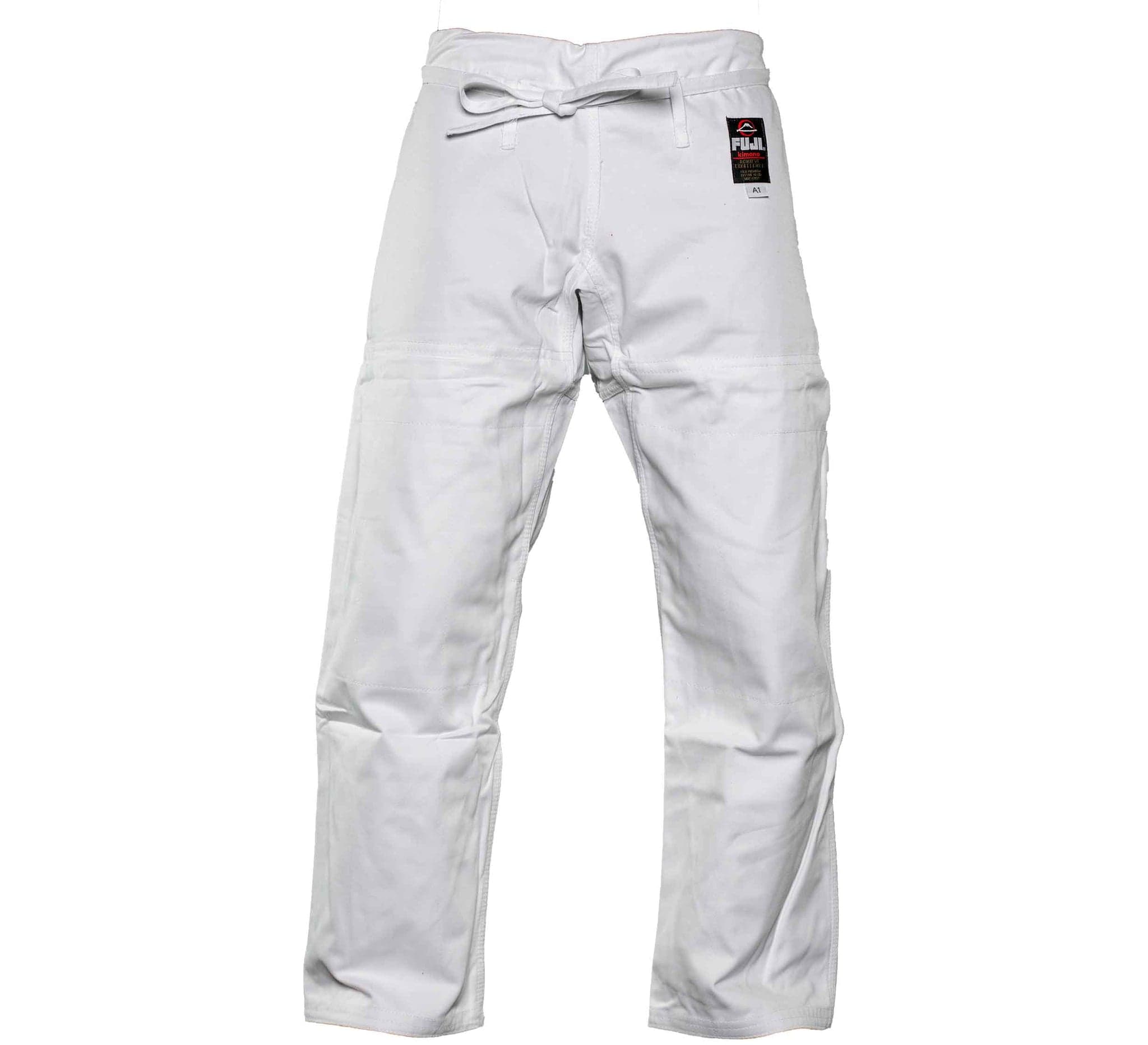
BJJ gi pants that fit standing up can still fail on the mat
Quick answer: BJJ gi pants should stay secure at the waist while allowing you to squat, kneel, and move the hips without the fabric binding. Judge the waistband, rise, thighs, and cuffs separately, and check the specific event's requirements if the trousers are intended for competition.
The trousers look fine until you try to sit down. Then the waistband moves, the knees tighten, and the jacket becomes an emergency privacy measure. The size chart has technically sold you a pair of pants. Whether it has sold you a usable pair is still under review.
Gi pants deserve their own fitting decision. A jacket that fits well cannot compensate for trousers that restrict the movement you came to practice. Fortunately, the checks are more useful than staring at an A-size label and hoping it explains everything.
Fit the trousers independently of the jacket
A gi sold as a set may assume proportions that do not match yours. The jacket can fit while the trousers are too long, too tight through the seat, or difficult to secure. That does not mean you have misunderstood your height. It means one label is covering several measurements.
Check whether the seller offers separate trouser sizes, replacement pants, or a different cut. Ask about the actual garment measurements when the published chart leaves an important question unanswered. Height and weight ranges are a starting point, not a description of every person's shape.
Compare with a pair you already use comfortably, if available. Lay both garments flat and measure the same points in the same way. A waistband measurement taken under tension is not directly comparable with one taken relaxed, and a total length does not tell you the rise.
If ordering online, read the exchange conditions before removing tags or washing the set. The goal is to preserve a straightforward option if the fit is wrong. Planning to shrink a poor fit into submission is an uncertain purchasing strategy, particularly when only one part of the garment needs to change.
Secure the waist without using it to solve everything
The waistband should stay in place during ordinary movement without requiring an elaborate knot that takes longer to undo than the class. Learn how the particular drawstring is intended to work. Different constructions can feel unfamiliar even when the overall size is suitable.
Tie it as instructed, then move. If the waistband repeatedly slips, examine the size and cut as well as the knot. Tightening harder may not solve trousers that sit in the wrong place or provide too little room through the hips.
Avoid turning belt tension into a permanent repair. The belt belongs to the gi setup, but it should not be the only thing preventing the pants from moving. You will still kneel, turn, and have the jacket pulled during class. The trousers need to function as trousers through those changes.
Check the ends of the drawstring and any loops. Loose components should not create an avoidable snag, and damaged loops deserve attention before training. If something is unclear, ask the seller or an instructor familiar with the garment instead of improvising a modification that changes how it fits.
Give the rise and seat room to do their job
The rise is the part many buyers notice only after it has failed them. Trousers can have the correct total length and still pull uncomfortably when you bring a knee toward your body or sit into a squat. The missing space may be above the thigh rather than below it.
Try ordinary positions within your comfortable range. Kneel, sit, and move one leg forward as you might during a basic drill. You are checking clothing, not testing flexibility. Stop if the garment or movement causes discomfort; a fitting exercise does not need to become a mobility assessment.
Notice where the tension begins. Fabric pulling across the seat, a waistband dragged downward, or a crotch seam that becomes restrictive can point to different fitting problems. Describe the location to the seller when asking about another cut. Saying the pants are generally wrong gives them less information.
Extra length at the ankle will not necessarily repair a restrictive rise. This is why sizing up can create a new problem while leaving the original one partly intact. A different proportion or cut may be a better option than simply choosing the next number on the chart.
Check the knees during movement, not a pose
Gi trousers have to accommodate repeated bending while another person may also be controlling the fabric. A pair that feels comfortable with straight legs can become restrictive when kneeling or changing levels. Try the movements you can safely reproduce without a partner before deciding the fit is settled.
Pay attention to the space around the knee and thigh. The fabric should allow normal movement without requiring you to drag the cuff upward before every bend. Excess material is not automatically better either; very loose pants can become awkward to manage and may fall outside a competition's fit requirements.
Reinforced panels can change how a garment feels even when the size is familiar. A heavier knee section may sit differently from the fabric around it. Assess the actual pair instead of assuming that every model from the same brand will behave identically.
If a comfortable training partner helps you check movement, keep the task light and specific. There is no need for a full round in an untested purchase. A few appropriate positions can reveal a problem before sweat, wear, or removed tags complicate an exchange.
Treat cuff length as its own question
The cuffs should not become something you step on or continually rearrange. At the same time, a short trouser leg is not automatically acceptable for every competition. Training preference and event compliance are separate questions, and both deserve an answer before alteration.
For an IBJJF event, consult the organization's uniform requirements and any event-specific updates. Other organizers have their own rules. Do not rely on a seller's general description of a gi as competition ready to establish that this particular size fits you within the relevant requirements.
If hemming is an option, ask someone qualified to assess how the alteration affects the cuff and reinforced construction. Cutting first and checking later is a difficult sequence to reverse. The fact that a seam can be sewn does not settle whether the result is suitable for training or an inspection.
Recheck length after following the manufacturer's care instructions. Fabric behavior varies, so avoid promising yourself an exact change from a wash. If the original fit is clearly wrong and an exchange is available, that may be simpler than trying to engineer a precise amount of shrinkage.
Use a short fitting routine before committing
A repeatable check is more useful than a long argument about whether one brand runs large. Use the same ordinary movements each time and note where a garment becomes restrictive or unstable. That gives you a basis for comparing cuts without pretending there is one ideal shape for everyone.
Before keeping a pair, check:
The waistband remains secure after several changes of position.
Sitting and kneeling do not create uncomfortable seam tension.
The thighs and knees allow the movement your training requires.
The cuffs stay manageable and meet any relevant event rules.
The return or alteration decision is clear before washing.
Wear the clean underlayers you normally use for class during the check. A fit assessed over different clothing may not tell you much about the actual training setup. Keep the fitting conditions consistent enough that the comparison means something.
The wider BJJ gi buying guide can help with the whole uniform. For trousers, resist the temptation to let a good jacket close the discussion. The part below the belt has its own job and should be allowed its own decision.
Keep fit separate from the garment's remaining life
A familiar pair can stop being suitable even though the size still feels right. Drawstrings wear, seams loosen, and fabric can become damaged. Inspect the areas that take repeated tension rather than judging the trousers only by their appearance while folded.
If a tear develops, ask whether a repair can restore a smooth, secure surface without creating a new snag or bulky edge. A qualified repairer and the instructor may help assess ordinary training use. Competition acceptance remains a separate question for the relevant rules and officials.
Do not force another month of use solely because the trousers are comfortable. The article on when to replace a BJJ gi separates cosmetic wear from problems that affect use. Familiarity is a reason to record the measurements for the next purchase, not a guarantee that damaged clothing remains suitable.
When you do find a useful fit, save the model and measurements. Brands can change cuts, and an A-size remembered several years later may not identify the same garment. A small record can save you from repeating the entire waistband investigation at the next checkout.
Main photo: FUJI Sports; illustrative gi-pants product photograph.
The takeaway
Fit gi pants through the waist, rise, seat, knees, and cuffs separately. Move in them before deciding, and preserve your exchange options if the cut is wrong. A matching jacket is pleasant; it is not evidence that the trousers work.
Check competition requirements before buying or altering a pair for an event. Once the fit is settled, keep an eye on wear so a comfortable garment does not quietly become an unsuitable one.
Check the uniform expectations where you train
Find BJJ gyms on Let's Roll, then confirm the academy's clothing requirements before purchasing a uniform specifically for its classes.
FAQ
Should gi pants feel tight when I squat? They should allow your normal training movements without uncomfortable restriction. Check the rise, seat, and thigh cut as well as the waistband size if bending pulls the fabric tight.
Can I buy a different size for the jacket and trousers? Some sellers offer separate pieces or mixed sizing. Ask about the available options and exchange policy rather than assuming a complete set must fit both areas equally well.
Will washing fix pants that are too large? Follow the manufacturer's care instructions and avoid relying on a precise amount of shrinkage. An exchange may be more predictable when the original size or proportions are clearly wrong.
Can I hem gi pants for competition? Check the event's requirements and ask a qualified repairer about the construction before altering them. A neat hem alone does not establish that the finished garment passes uniform inspection.

Kit Langford
Kit Langford covers the louder parts of jiu-jitsu — the marketing claims, the arguments, the gear that promises more than gear can deliver. The jokes are expected to survive a fact-check.
Related Posts
Competing in gi and no-gi on the same day takes two plans
Prepare for gi and no-gi competition on the same day with separate rule checks, complete outfits, schedule coordination, and a realistic second-bracket plan.
Jiu-jitsu in Montreal: build the visit around a real class
Plan BJJ training in Montreal around confirmed classes, language arrangements, winter travel, visitor policies, and equipment that is ready to use.
How to ask a BJJ coach a question they can actually answer
Ask better BJJ questions by showing the position, the response that stopped you, and the detail you need to test next.
Comments (0)
Loading comments...