
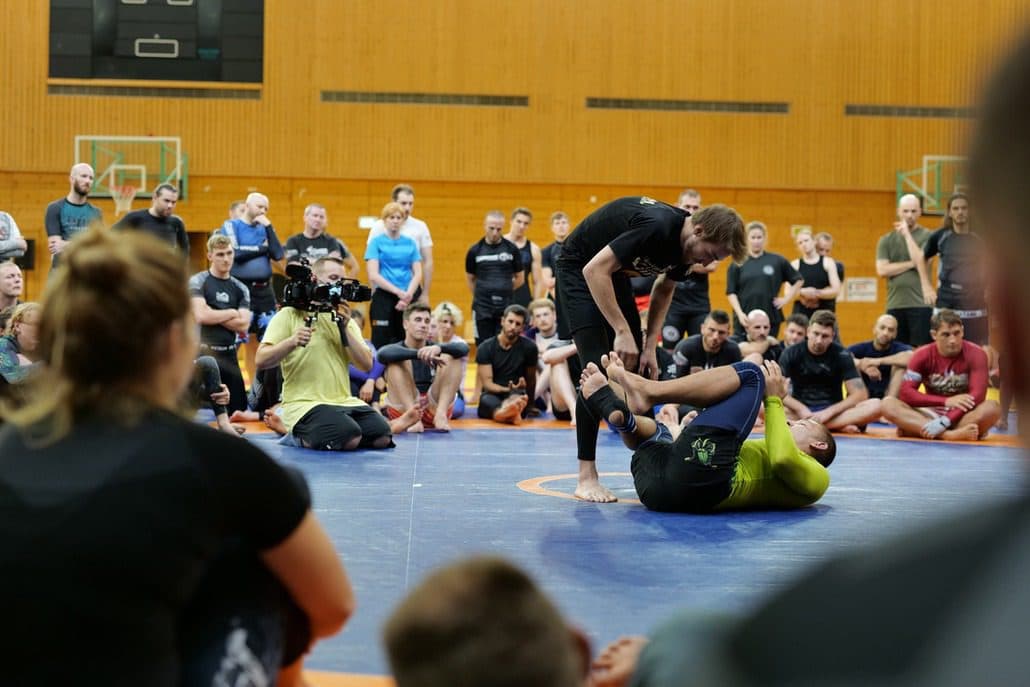
Make the gap between BJJ drilling and live rounds smaller
Quick answer: To connect BJJ drilling with live rounds, practice the decision that makes a technique appropriate rather than repeating only its final movement. Start from a clear position, add one realistic partner response, and increase freedom gradually with your instructor's guidance.
The technique works during drilling. The partner gives the expected position, the steps arrive in order, and the finish makes sense. Then the round begins and the opportunity seems to vanish. The student remembers the movement but cannot find a place to use it.
That gap does not automatically mean the lesson was poor or the student forgot everything. The task changed. A cooperative repetition made the action available; the live round requires recognizing the conditions, establishing the necessary controls, and adjusting when another person interrupts. Those parts deserve practice too.
Locate the missing task
Before adding more repetitions, ask where the attempt breaks down. You may be unable to reach the starting position. You may arrive there without the grip the lesson assumed. Or you may recognize the opportunity only after the partner has already changed it.
Those are different learning problems. Repeating the final movement will not necessarily help establish the missing grip. Starting every round from a fully secured position will not teach the earlier entry. A useful practice plan begins at the point that needs attention.
Ask your instructor to watch one attempt or help reconstruct it after class. Describe what you expected and what actually happened. Keep the question narrow enough that the answer can be tested in the next few repetitions.
A good outcome might be surprisingly small: noticing a frame earlier, correcting the distance, or releasing a grip that has stopped helping. The whole technique does not need to be replaced just because one condition was missing. First identify the part that prevented the rest from becoming available.
Make the starting position honest
Two repetitions can look similar while beginning from different conditions. In one, the partner's elbow is already separated. In another, it remains connected to the body. The movement that follows may need a different setup, even if both students call it the same technique.
Have the coach define the starting controls and body positions clearly. Both partners should know what is being supplied and what the learner must establish. That prevents a cooperative drill from quietly removing the hardest part of the task without anyone noticing.
Grapplearts' discussion of correcting position is a useful reminder that arriving somewhere does not guarantee the position is ready for the next action. Check the actual arrangement instead of assuming the label supplies every required detail.
Keep the setup repeatable at first. If every repetition begins from a different grip, angle, and distance, it can be difficult to identify why the outcome changed. Variation is useful when introduced deliberately. It is less useful when neither partner realizes that they are practicing a different problem each time.
Add one response the learner can recognize
Once the basic movement is understood, ask the partner to provide one agreed response. The learner then has to identify that response and make the appropriate next choice. The coach should select the task and the amount of resistance for the people involved.
The response should be realistic enough to matter but limited enough to study. A partner who does nothing provides little new information. A partner who uses every available defense immediately may remove the opportunity before the learner can recognize what happened.
For example, the task might involve establishing a particular control while the partner attempts one specific way to prevent it. The round can end when the control is established or the defensive checkpoint is reached. No submission finish is required unless it is part of an appropriate, clearly agreed exercise.
The purpose is not to guarantee success. It is to make the decision visible. A failed repetition can be useful if the learner understands which condition changed and can ask a better question. A successful repetition is less useful if nobody can explain why it worked.
Agree on where the exchange ends
A focused drill can lose its purpose when every attempt turns into a full round. The original problem appears once, then the partners spend several minutes somewhere unrelated. Both may get good exercise while receiving very little practice on the intended decision.
Choose a reset condition with the instructor. It might be a stable positional checkpoint, a cleared grip, or a recovered guard. Make sure both partners can recognize it without stopping to negotiate each time.
A simple planning conversation can cover:
The exact starting position and controls.
The action each partner is allowed to attempt.
The level of pace and resistance appropriate to the task.
The point at which either partner resets the exchange.
The question to discuss after a short set of repetitions.
Keep the conversation brief enough that it supports training rather than replacing it. The aim is shared understanding. Once both people know the task, they can work with fewer interruptions and give feedback about the same part of the exchange.
Increase freedom without increasing everything at once
After one response becomes recognizable, the coach can add another. The learner now has to distinguish between two possibilities rather than reacting to a single expected action. That changes the task even if the pace remains moderate.
More freedom does not have to mean more force. A partner can vary direction or timing while keeping the physical intensity appropriate. Separating those variables can make the practice more informative, particularly when a student is still learning how to recognize the situation.
If the exercise becomes confusing, reduce one part of the difficulty. Return to a clearer starting position, a narrower range of responses, or a slower pace. This is an adjustment to the task, not a verdict that the student is incapable of learning.
Our guide to being a good training partner describes the cooperation behind useful resistance. The partner should challenge the decision honestly while respecting the agreed scope. Secretly turning a limited drill into an unrestricted contest makes the result harder to interpret and the practice less predictable.
Bring the problem into a broader round
Eventually the learner needs to encounter the decision among other possibilities. A broader positional round can provide that step before an unrestricted round. Start in a relevant area of the game, allow more responses, and keep a clear endpoint so the same family of problems returns often enough to study.
The learner should not force the technique every time. Part of progress is recognizing when the desired conditions are absent and choosing something else. A round that contains no attempt may still show good judgment if the opportunity never appeared.
Afterward, review whether the student noticed the relevant moment. Did the starting control become available? Was there enough time to act? Did the partner's response make the planned follow-up unsuitable? These questions preserve the connection between the focused drill and the broader exchange.
Avoid demanding that the lesson appear immediately against every partner. Differences in experience, style, and position affect what opportunities arise. Look for evidence that recognition and decision-making are improving, then let the instructor adjust the next practice task based on what actually happened.
Keep the review short enough to use next time
A useful post-round note can fit in a few lines. Name the position, identify the missing condition, and record one adjustment to test. That is easier to bring back to the mat than a long account of everything that felt difficult.
Ask the partner what they noticed. They may have felt an early grip change or a moment when their defense became less secure. Their account is useful information, not necessarily the final technical explanation. Bring uncertainty to the coach rather than turning two incomplete memories into a confident diagnosis.
Also record what became clearer, even if the final outcome did not change. You may now recognize the right moment but need more practice establishing the control. That is a different task from not seeing the opportunity at all.
The next session can begin from that distinction. You are no longer choosing between endless cooperative repetitions and hoping something appears in sparring. There is a middle stage where the relevant decision can be practiced with enough resistance to matter and enough structure to understand. Used well, that stage gives both partners a more useful job.
Main photo: BJJ Globetrotters; illustrative archive instructional photograph.
The takeaway
The gap between drilling and live rounds often contains several separate tasks: finding the position, establishing the controls, recognizing a response, and choosing what comes next. Identify the missing task before deciding that the whole technique needs more repetitions.
Use a clear starting position, one meaningful partner response, and an agreed reset. Then add freedom with your instructor's guidance. The aim is to make an appropriate decision in a changing exchange, not to force a rehearsed movement into every round.
Find a room for thoughtful practice
Explore BJJ gyms on Let's Roll and ask an instructor to help turn one problem from your live rounds into a focused, manageable practice task.
FAQ
Why does a BJJ technique work in drilling but fail in sparring? The live round may require entry, control, timing, or recognition that the cooperative drill supplied automatically. Identify the first missing condition before assuming the final movement is the only problem.
Should my partner resist every repetition? The appropriate resistance depends on the learning stage and task. Begin with a clear setup, then add agreed responses under the instructor's guidance rather than switching unpredictably between cooperation and full resistance.
What is a useful reset condition? Choose an observable checkpoint related to the task, such as establishing a control or reaching a position. Both partners should understand it so the relevant decision can be practiced repeatedly.
How do I know the practice is helping? Look for clearer recognition, more appropriate choices, and specific improvements in the exchange. Completing the whole technique immediately against every partner is not the only useful sign of progress.

Owen Bellamy
Owen Bellamy writes for the person training twice a week around a job. Nothing he suggests requires quitting the job.
Related Posts
Otávio Sousa: three world titles in the hardest kind of company
Otávio Sousa’s 2012, 2013, and 2016 world titles tell a richer story when the other names on the middleweight podium stay in view.

Mikey Musumeci gives up the belt to make room for MMA
Musumeci is vacating his UFC BJJ title to focus on MMA training. What he is leaving, what continues, and why the transition matters.
IBJJF membership: finish the paperwork before the deadline
IBJJF membership and tournament entry are separate steps. Plan documents, professor approval, renewals, and junior accounts before registration closes.
Comments (0)
Loading comments...