
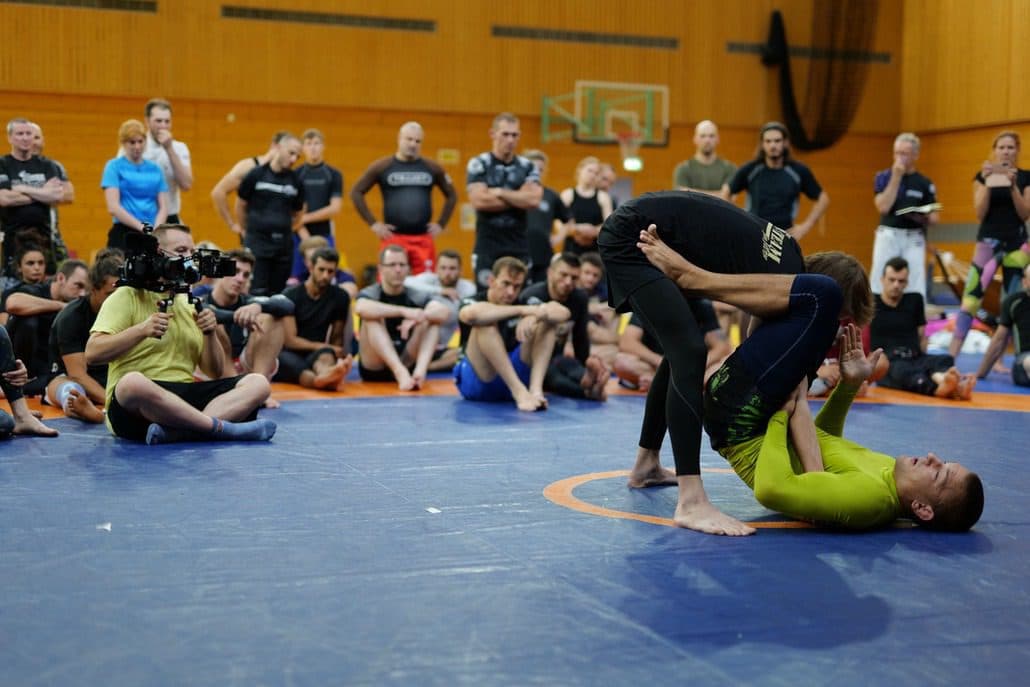
Being the demonstration partner in BJJ is a skill
Quick answer: A good BJJ demonstration partner gives the instructor the position and reaction being taught, stays attentive, and speaks up immediately about discomfort. Your job is to make the lesson visible, not to prove that the move can be stopped. Ask quietly if you are unsure how much resistance the coach wants.
The instructor calls you over. Thirty people move closer. A position you have practiced all week suddenly feels less familiar because you are now the person inside the demonstration.
There is no need to perform. The class needs a partner who can listen, hold a useful position, and respond predictably enough for the coach to explain what is happening. That contribution is more active than going limp and more cooperative than trying to win an exchange.
Learn what the coach needs before supplying resistance
The same technique can be demonstrated in several ways. A coach may first want a still starting position, then a particular defensive reaction, then a brief example against realistic movement. Moving directly to the last version can make the first explanation unnecessarily difficult.
Listen for the instruction that applies now. If the coach asks you to hold a sleeve, hold the sleeve. Do not quietly add a second grip, change your stance, or block the next movement because you know where the demonstration is going.
If the request is unclear, ask one short question about the action: should you keep the arm there, follow the movement, or try to recover your knee? That helps the coach without turning the explanation into a separate discussion.
The guide to being a good training partner applies here, too. Cooperation means contributing to the agreed task. It does not mean guessing what would make you look experienced in front of the room.
Give the position enough shape to teach from
Going completely limp can be as unhelpful as resisting everything. If the demonstration begins in a seated guard, collapsing backward may remove the position the coach is trying to explain. If you are asked to stand in a passing stance, wandering feet can change the distance during the explanation.
Hold a comfortable, recognizable version of the starting position. Avoid exaggerating a defensive posture unless the instructor asks for it. A normal elbow position is more useful than gluing your elbows together to make an attack artificially difficult or extending both arms to make it artificially easy.
There is a difference between keeping the shape of a position and tensing every muscle. The coach should be able to move through the demonstration at the intended pace. If you are unsure whether to brace or yield during a transition, ask before the transition becomes a wrestling match.
With experience, the task becomes easier to read. Until then, a clear question is more useful than an elaborate attempt to predict the whole lesson.
React to the movement you are actually given
Once a coach asks for a reaction, make that reaction clear enough for the class to see. If the example involves recovering a knee, try to recover the knee in the agreed way. Do not suddenly change to a different escape halfway through because another option occurs to you.
That predictability lets the instructor isolate one problem. Later, the coach may show why a different response changes the answer. It is difficult to explain that distinction if both responses happen at once.
Avoid helping so much that the movement no longer resembles the problem being taught. Falling over before your balance is affected or moving an arm into an attack without being asked can conceal the detail students need. Let the coach move you rather than completing the move for them.
This is a subtle role. You are neither an obstacle to be defeated nor a prop to arrange. You are a training partner helping another person make a sequence understandable.
Keep safety signals louder than the room
Tap when you need to tap. A demonstration is not a reason to tolerate a joint position, pressure, or a choke beyond your normal limit. If tapping is difficult because of how your hands are positioned, use a clear verbal signal.
Tell the coach about any relevant limitation before starting. You do not owe the class a personal medical history. A simple statement that a particular side or movement is unavailable gives the instructor a chance to choose a different partner or alter the demonstration.
If something feels wrong during a movement, say so immediately. Do not wait for a natural break in the explanation or assume the coach can infer your discomfort from a facial expression while looking toward the class.
There is also no obligation to accept the role. If you cannot safely demonstrate a position or are uncomfortable being in front of the room, a quiet decline is enough. The lesson can continue with someone else.
Help the class see without rearranging the lesson
A coach may pause to show a grip, ask you to turn, or repeat a movement from another angle. Follow that request carefully, especially when a limb is already controlled. Moving your whole body without warning can alter the pressure in a position.
If the coach is explaining a hand placement, keep that hand where it is until asked to move. A small adjustment that feels natural to you may hide the detail the students are trying to inspect.
You can help visibility by avoiding unnecessary gestures and conversation. Resist the urge to point at the grip while the coach is explaining it, since your hand may cover exactly what people need to see. If you notice that an angle is blocked, mention it at a pause rather than rotating both bodies yourself.
Students can also take responsibility for their view. The demonstration partner does not need to solve every sight line while maintaining the position. Let the instructor direct the room.
Separate a useful clarification from a public correction
Sometimes the demonstration raises a real question. Perhaps the coach has changed grips between repetitions, or the class appears unsure about which side to use. You can ask about that without making the exchange a contest over who noticed what.
Keep the question attached to the lesson. Asking whether the same hand stays on the collar is different from listing every counter you have seen online. The first may clarify the immediate task; the second can interrupt its sequence.
Save a longer technical disagreement for an appropriate conversation afterward. That does not mean an instructor cannot be questioned. It means the students currently trying to learn one movement need an explanation they can follow before the room explores every branch.
If you want help phrasing a specific technical question, the advice on asking a BJJ coach useful questions is a starting point. A small, accurately described uncertainty usually gets a better answer than a broad challenge.
A short routine makes the next demonstration easier
You do not need to memorize a set of ceremonial behaviors. A few practical habits cover most of the role and reduce the chance of guessing at an inconvenient moment.
Before a demonstration, check the immediate task:
Identify the starting position and which side the coach wants.
Mention a relevant limitation before the position is loaded.
Ask about resistance if the instruction leaves it unclear.
Stay ready to stop, reset, or repeat when asked.
After the first repetition, notice what the coach changes. They may slow one part, add a defensive reaction, or show the same action from another angle. Follow the new instruction rather than repeating your original response automatically.
If you make a mistake, reset without a long apology. A brief misunderstanding is easily corrected. Explaining at length why it happened usually takes more of the class’s attention than the mistake did.
The role should leave room for learning, too
Being inside a demonstration can make some details easier to feel and others harder to see. You may understand the direction of pressure while missing the exact foot placement that everyone else can watch. It is reasonable to ask to see that detail later.
Do not assume you should understand the entire technique because you were the partner. During the explanation, part of your attention was occupied by maintaining the position and following instructions. When students begin drilling, ask for a normal repetition as the person performing the move.
Coaches can support this by checking that the demonstration partner also gets time to practice. For students, the practical step is simply to say which part you could not see. That is a request for access to the lesson, not an admission that you failed to learn in public.
The role becomes less awkward when it is treated as an ordinary contribution to class. Sometimes you help make the movement visible. Then you join the group in learning how to do it.
Main photo: BJJ Globetrotters; illustrative archive photograph, not a reported visit or a named subject in this article.
The takeaway
A useful demonstration partner listens closely, maintains the requested position, and supplies the reaction the coach is teaching from. Neither surprise resistance nor exaggerated cooperation makes the lesson clearer.
Keep your normal safety boundaries, ask when the task is unclear, and allow yourself to learn the movement afterward. The class benefits from a partner who is attentive and comfortable enough to communicate.
Find a class that welcomes questions
Browse BJJ gyms on Let’s Roll, then ask a prospective academy how its beginner classes work and how students can get help during practice.
FAQ
Should I resist during a BJJ demonstration? Use the amount and type of resistance the instructor requests. If that is unclear, ask. A static explanation, a scripted reaction, and a live example are different tasks.
Can I tap while the coach is still explaining? Yes. Tap or speak clearly whenever you need the action to stop. The explanation does not take priority over your safety or comfort.
What if I do the wrong thing in front of the class? Stop and reset as directed. A short clarification is usually enough; there is no need for an extended apology or a defensive explanation.
Can I decline to be the demonstration partner? Yes. You can say that a position is unsuitable or that you would rather sit this one out. You do not need to give the whole room a detailed personal reason.

Owen Bellamy
Owen Bellamy writes for the person training twice a week around a job. Nothing he suggests requires quitting the job.
Related Posts
Jiu-jitsu in Montreal: build the visit around a real class
Plan BJJ training in Montreal around confirmed classes, language arrangements, winter travel, visitor policies, and equipment that is ready to use.
Competing in gi and no-gi on the same day takes two plans
Prepare for gi and no-gi competition on the same day with separate rule checks, complete outfits, schedule coordination, and a realistic second-bracket plan.
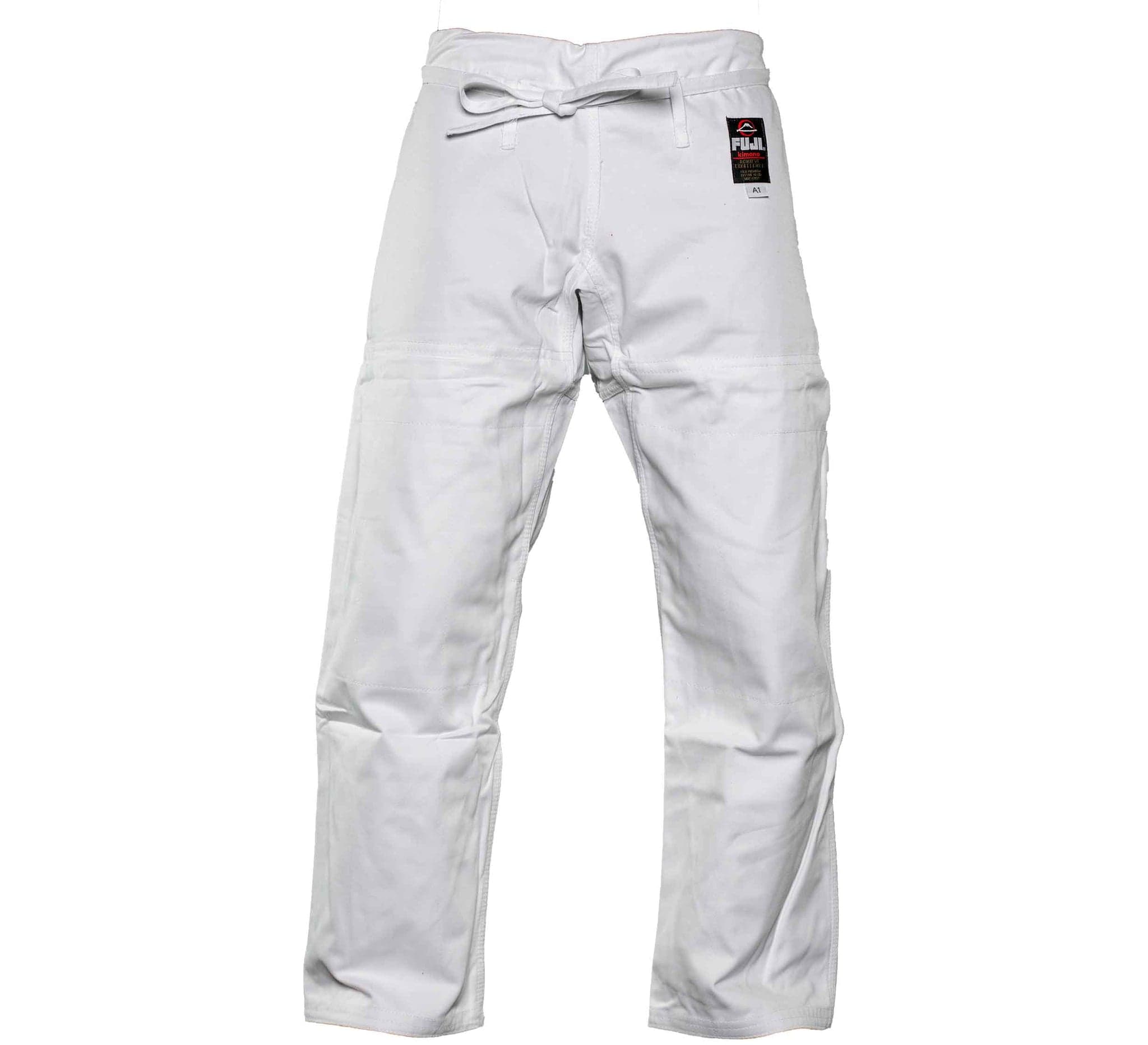
BJJ gi pants that fit standing up can still fail on the mat
Check BJJ gi pants at the waist, rise, knees, and cuffs so a good-looking size label becomes a uniform you can actually move in.
Comments (0)
Loading comments...