
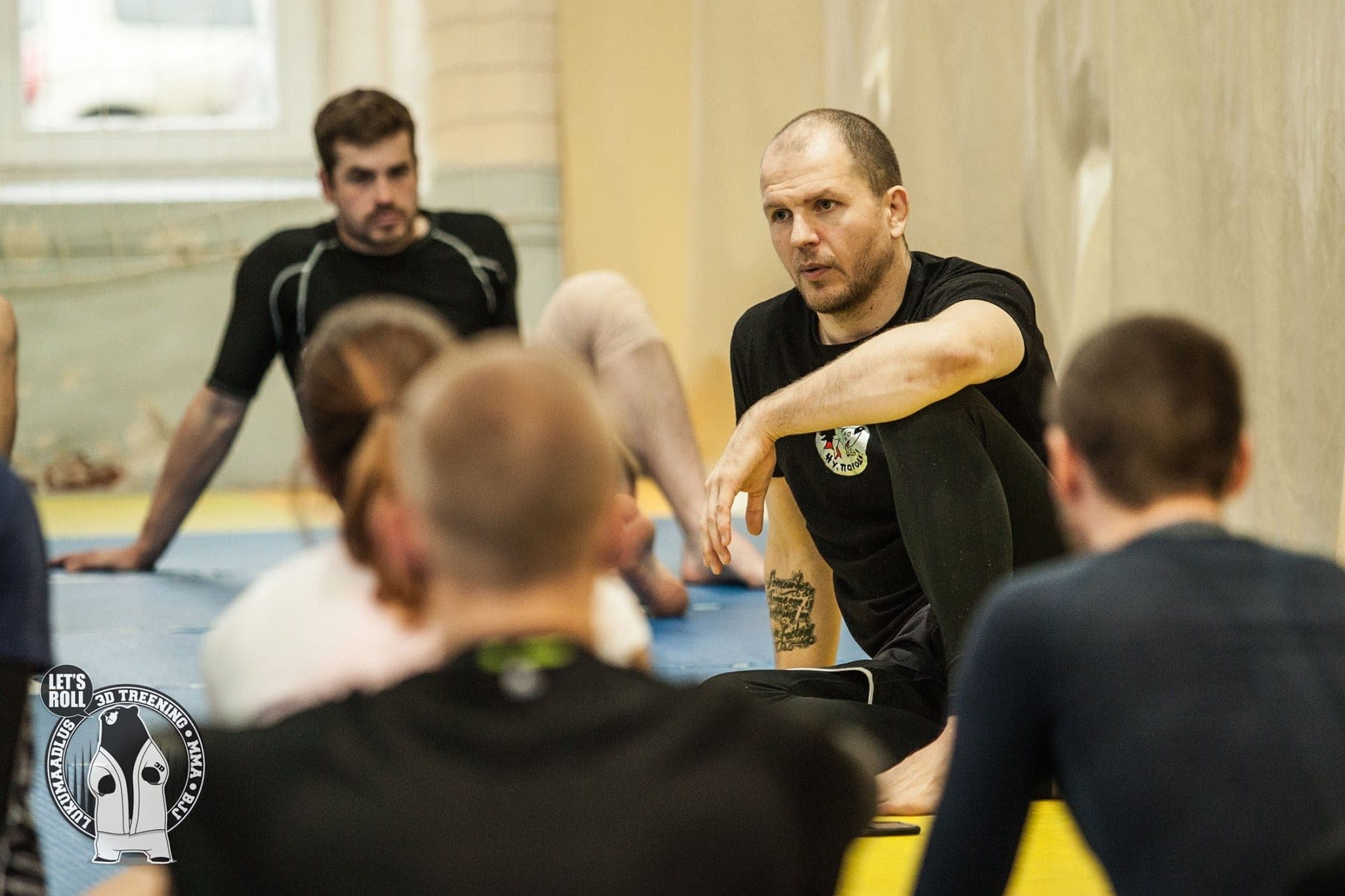
Different BJJ coaches can give you different useful answers
Quick answer: Different BJJ coaches may be solving different versions of the same position. Before treating their advice as contradictory, compare the starting grips, the opponent's response, and the intended outcome. Practice the version being taught in the current class, then ask a specific question about where the other version fits.
A notebook can contain two opposite instructions and still contain two useful lessons. Keep the elbow close. Move the elbow away. The missing line is often the one describing what the other person was doing.
That is an awkward discovery when you have already spent a week trying to become the student who remembers the details. You listened, wrote them down, and brought them back. Now another coach appears to be telling you to undo the whole thing.
Before choosing a side, give the position a closer look. You may have a real disagreement to discuss. You may also have removed the context from two explanations that were never intended to cover the same moment.
Put the missing opponent back into the note
A technique note that contains only your own movements is half a conversation. The partner's position gives those movements their purpose. Without it, instructions can become rules that follow you into situations where they no longer help.
Take a hypothetical guard-passing lesson. One coach wants the passer to keep a knee close to control space. Another wants the passer to move that knee away before changing direction. Those instructions could describe different stages, grips, or responses. The knee is the same body part; the task may have changed.
Before your next question, reconstruct the starting arrangement with a willing partner at a gentle pace. Show where both people begin. Point out the grip or frame that seems to create the problem. This gives the coach something they can inspect rather than a quotation they have to interpret.
You do not need perfect technical language. Saying that the partner's hand is blocking your hip is more useful than confidently naming the wrong variation. If you cannot remember the setup, say so. An incomplete memory is easier to repair when it is identified as incomplete.
Ask what each version is trying to achieve
Two demonstrations can begin in a similar shape and aim at different outcomes. One may prioritize staying on top. Another may accept a brief loss of position to enter an attack. Neither choice should be judged without its purpose.
Ask the coach what counts as success in the exercise. Is the goal to establish control, make the opponent move, or finish a transition? A student can execute the visible motion while missing the actual assignment.
A practical comparison might include:
The exact starting position for each version.
The response the opponent is expected or allowed to make.
The outcome the coach wants before the exercise ends.
Keep this comparison short. Turning every lesson into a seminar about competing interpretations can prevent you from practicing the lesson in front of you. You are trying to recover a distinction, not produce a complete history of the move.
If the two versions really do target the same situation and result, there may be a genuine preference to discuss. Coaches can prefer different options. That does not require a student to declare one person wrong before learning what each option asks of them.
Give the current class a fair attempt
When a coach demonstrates a version, practice that version unless you need a modification or clarification. Replacing it immediately with something from another class makes it difficult for the instructor to see whether their explanation worked.
This is a practical courtesy. The coach is trying to guide a room through a shared task. Your partner is trying to rehearse the same task. If you silently change the setup, both may spend the round solving a problem they did not agree to practice.
Tell the instructor if a movement is uncomfortable or unsuitable for you. Respecting the lesson does not mean ignoring pain or abandoning the right to stop. Ask for an alternative, and follow the academy's safety expectations.
Otherwise, give the demonstration enough patient repetitions to understand what it is meant to do. You can compare it with another version afterward. A new detail that feels awkward on the first attempt may simply be new; that awkwardness alone does not settle whether it is useful.
The notebook can wait beside the mat. It does not need to supervise every repetition like a tiny assistant coach with absolute confidence and no memory of the partner's grips.
Bring a question instead of a verdict
There is a difference between asking how two versions relate and reporting that another coach said the opposite. The first invites an explanation. The second can sound like a request to referee a dispute that may exist only in your notes.
Describe what you noticed in your own words. You might explain that another lesson kept a particular grip longer and ask which opponent response makes releasing it appropriate here. That is a proposed question, not a quote from a real student.
Avoid borrowing the other instructor's authority to defend a movement you have not yet understood. If the version is working poorly for you, show the failure. The useful information is what happens when your partner responds, not whose name you can attach to the attempt.
A good time matters as much as good wording. Ask during a designated question period or when the coach is checking your pair. If the explanation needs more time, ask whether it can wait until after class.
There is room for honest uncertainty. A coach may want to see the other demonstration before commenting. That is a reasonable answer, and it gives you a next step without manufacturing conflict between instructors.
Test one difference with a cooperative partner
If the coach agrees that both options fit your level, compare them in a narrow exercise. Keep the starting position and partner response similar enough that you can identify what changed. This is a practical experiment, not a scientific claim that one version has been proved superior.
For example, agree that the partner will offer one familiar frame at a controlled pace. Try the first response, reset, and try the second. Discuss where each attempt became difficult. If the exercise drifts into a full round, return to the agreed starting point.
Do not use a partner as an unwilling test subject. Explain what you are trying to examine, invite their input, and take turns. A few attentive repetitions can be more useful for this question than a long round in which neither person reaches the relevant position.
Stop if the comparison requires force, speed, or submissions outside your experience. Ask the coach to inspect it instead. You are trying to understand a decision, not force a result that makes one set of notes look correct.
Keep the conclusion modest. Perhaps one version was easier for you against that response today. That is enough to guide another practice session. It is not yet a universal rule about the technique.
Write down the boundary, not just the movement
The most useful revision to your notes may be a few words about when an instruction applies. Instead of recording a command without context, record the cue that made the coach choose it.
A simple note can contain the starting position, the obstacle, and the option you practiced. Add one unresolved question if needed. There is no obligation to transcribe the whole lesson before leaving the gym.
You could organize the next entry around:
Use this version when the partner does this.
Change the plan if this connection is lost.
Ask the coach about this part next class.
Those are prompts for your own notes, not claims that every position can be reduced to three rules. Some situations need more explanation. The value lies in preserving the reason for an action alongside the action itself.
Over time, review whether an old note has become misleading because your understanding improved. You are allowed to cross something out. A training notebook is a working document, not a sworn statement about the first explanation you ever heard.
If video would help, ask permission from everyone involved and follow the academy's recording policy. A clear written sketch is preferable to a useful clip obtained without consent.
Keep one workable plan for the next round
Learning from several people does not require carrying every option into every round. Choose a small focus for the session and tell your partner if it affects the way you want to begin. Leave the rest available for another day.
A regular class with one coach can provide the thread that connects occasional lessons elsewhere. If you attend seminars, bring back a specific question rather than trying to replace your whole game on Monday. The new material needs somewhere to attach.
There may also be a point when too many simultaneous inputs are making practice harder to organize. You can pause the extra instructionals, keep attending class, and work on the problem already in front of you. That is a scheduling choice, not a declaration that outside learning is bad.
When a competition approaches, ask the coach helping you prepare which choices deserve attention now. A fascinating variation may be worth studying later. You do not have to solve the entire position before using one dependable option within the relevant rules.
Main photo: BJJ Globetrotters; illustrative archive photograph.
The takeaway
Different coaching cues deserve context before comparison. Recover the starting position, identify the intended outcome, and give the current lesson a fair attempt. Then ask about the point where the other version might become useful.
Your job is to understand the choice well enough to practice it. You can respect more than one teacher while keeping a simple plan for the next round, and you can revise that plan when the mat gives you a clearer question.
Find a class you can return to
Explore local academies on Let's Roll and ask about a class schedule that gives you regular access to coaching and follow-up questions.
FAQ
Why do BJJ coaches teach the same move differently? They may be addressing different grips, stages, opponents' responses, or goals. There can also be genuine technical preferences. Reconstruct the setup before deciding what the disagreement is.
Should I tell a coach that another instructor taught a different version? Yes, if it helps clarify a specific question. Describe the difference and ask when each version applies rather than presenting one instructor's advice as a verdict on the other.
Can I practice my preferred variation during the demonstration drill? Ask first. The coach and your partner may be working toward a particular task. Request a modification when needed, but do not silently replace the shared exercise.
How many versions should I work on at once? Choose a manageable focus with your coach. There is no required number. If the choices are preventing you from practicing attentively, simplify the next session and return to the comparison later.

Owen Bellamy
Owen Bellamy writes for the person training twice a week around a job. Nothing he suggests requires quitting the job.
Related Posts

Mikey Musumeci gives up the belt to make room for MMA
Musumeci is vacating his UFC BJJ title to focus on MMA training. What he is leaving, what continues, and why the transition matters.
IBJJF membership: finish the paperwork before the deadline
IBJJF membership and tournament entry are separate steps. Plan documents, professor approval, renewals, and junior accounts before registration closes.
Choosing a BJJ seminar worth your time and travel
Choose a BJJ seminar by the subject, teaching format, access, and total cost. Know what to ask the host before buying a ticket.
Comments (0)
Loading comments...