

A 10-by-10 room can lose an entire strip of floor to the door. An advertised 5-by-10 roll may have a slightly different actual size. Those are two different measurements, and getting either one wrong can make the order awkward to use or return.
Use the tool to compare the shape you can actually set out with the mat you intend to buy. It gives you the spare width and length in each orientation. The result answers a question about floor space.
Check your mat footprint
Measure a clear floor rectangle after allowing for doors, furniture, walkways and any clearance you need. Use the finished assembled mat size from the maker.
Three worked floor plans
Narrow room and a single roll
Clear floor 84 × 126 in. Mat 60 × 120 in.
As entered
Fits the entered rectangle
- Width: 24 in remaining
- Length: 6 in remaining
Turned 90°
Exceeds the entered rectangle
- Width: 36 in short
- Length: 66 in remaining
Dashed outline shows the clear floor. Solid outline shows the mat. Remaining space is the total on each axis, before deciding where to place the mat.
The same roll fits when turned
Clear floor 122 × 73 in. Mat 60 × 120 in.
As entered
Exceeds the entered rectangle
- Width: 62 in remaining
- Length: 47 in short
Turned 90°
Fits the entered rectangle
- Width: 2 in remaining
- Length: 13 in remaining
Dashed outline shows the clear floor. Solid outline shows the mat. Remaining space is the total on each axis, before deciding where to place the mat.
A nominal square leaves no margin
Clear floor 300 × 300 cm. Mat 300 × 300 cm.
As entered
Fits on paper with zero margin on at least one axis
- Width: exact fit on this axis
- Length: exact fit on this axis
Turned 90°
Fits on paper with zero margin on at least one axis
- Width: exact fit on this axis
- Length: exact fit on this axis
Dashed outline shows the clear floor. Solid outline shows the mat. Remaining space is the total on each axis, before deciding where to place the mat.
This is rectangle arithmetic. Confirm the actual product, installation, clearance and intended practice separately. Measurements stay on this page.
Draw a rectangle inside the room you really have
Start with the space after moving only what can reliably be moved before each session. Open the door all the way. Trace where someone needs to walk, where the wall heater projects and where furniture leaves a hard edge. Draw a rectangle that stays clear of those features and leaves the access you need.
Measure its width and length at the narrowest points that bound your rectangle. Use inches or centimeters throughout. If the area is L-shaped, measure two usable rectangles separately. Their combined area is a poor comparison with one intact rectangular mat.
Think about the room above and around the floor as well. A low ceiling or a nearby corner still matters even when the floor measurement looks generous. Share the full room and the intended practice with your coach. Our home practice guide also covers study that needs no new flooring.
Ask for the assembled dimensions
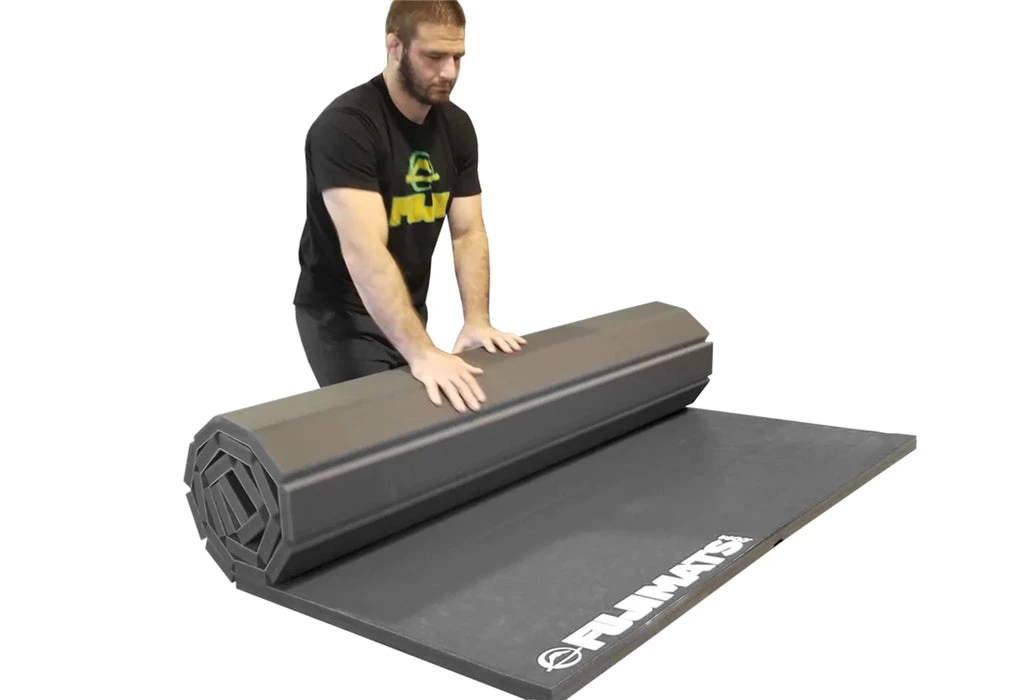
The gray FUJI Tatami Home Roll-Out listing calls one roll a nominal 5 × 10 feet and reports approximately 59.06 × 118.11 inches, with possible variation. Use the actual dimensions the seller can confirm when an edge would sit close to an obstacle.
Dollamur’s Smooth FLEXI-Connect home mat lists a 10 × 10-foot setup from two nominal 5 × 10-foot rolls. The maker allows a half-inch length variation for each roll. Ask what the finished joined rectangle will measure and how to check both rolls when they arrive.
The product name, the packaged roll and the footprint on the floor answer separate questions. For a multi-piece set, start with the assembled specification. For storage, measure where the rolls will stand or lie and the route they need to take.
Look at the two sides separately
Subtract the mat width from the clear floor width and do the same for length. Turn the layout by swapping the mat’s two dimensions, then subtract again. If either side is short, that orientation exceeds the rectangle.
A 60 × 120-inch mat and an 84 × 126-inch floor leave 24 inches across the width and 6 along the length. Those numbers are totals. Centering this arrangement would leave 12 inches on each side across the width and 3 at each end along the length. Choose clearance before you measure the rectangle. The calculation gives no clearance standard.
Zero remaining space deserves its own follow-up. A manufacturing tolerance, uneven wall or slightly different tape-measure reading could change the result. Confirm the exact product and room measurements before ordering for an exact fit.
Check the floor and the setup routine
Read the instructions for the actual joining system, surface and storage method. Dollamur’s installation and care library separates its product systems. Bring the floor material and room description to the manufacturer if you need advice on installation.
A room you reclaim for dinner needs a realistic place to put the rolls and a route out of the way. A permanent setup needs an accessible perimeter. Before buying, name the practice your coach considers appropriate for that room and keep the mat choice tied to it.
Common questions
Will a 10 × 10 BJJ mat fit in a 10 × 10 room?
Only if the actual assembled dimensions fit the clear rectangle on both axes. Measure after accounting for door swing, obstacles, walkways and any required clearance. Verify the seller’s dimensions if there is no margin.
Can I use square footage alone to choose a mat?
Compare both dimensions. Two areas can have equal square footage and incompatible shapes. The calculator tests the mat as entered and turned by 90 degrees.
Does a layout that fits mean I can roll at home?
The calculator checks the mat footprint. Ask your coach and the equipment maker about the activity, floor, equipment and surrounding space before deciding what you can practice there.
Sources & accuracy notes
Sources checked . The tool compares two rectangles using the dimensions you enter. Check the actual mat dimensions, clearance, floor and manufacturer’s setup instructions, and agree with your coach on what practice suits the space.
- FUJI Mats: Gray Tatami Home Roll-Out MatsDistinguishes the nominal single-roll size from its approximate actual dimensions.
- Dollamur: Smooth FLEXI-Connect home matLists a two-roll 10 × 10-foot assembly and the published length tolerance for each roll.
- Dollamur: Installation tutorials and care guidesProvides model-specific setup and care references for its different systems.
Found a factual error or a rule that has changed? Send a correction to support@letsroll.co.