

UFC BJJ 2 results: Tackett’s defense and Fowler’s first belt
Quick answer: Andrew Tackett defended his welterweight championship against Renato Canuto at UFC BJJ 2 on July 31, 2025. Mason Fowler submitted David Garmo to become the first 205-pound champion. The eight-match Las Vegas card produced six submissions and two unanimous decisions.
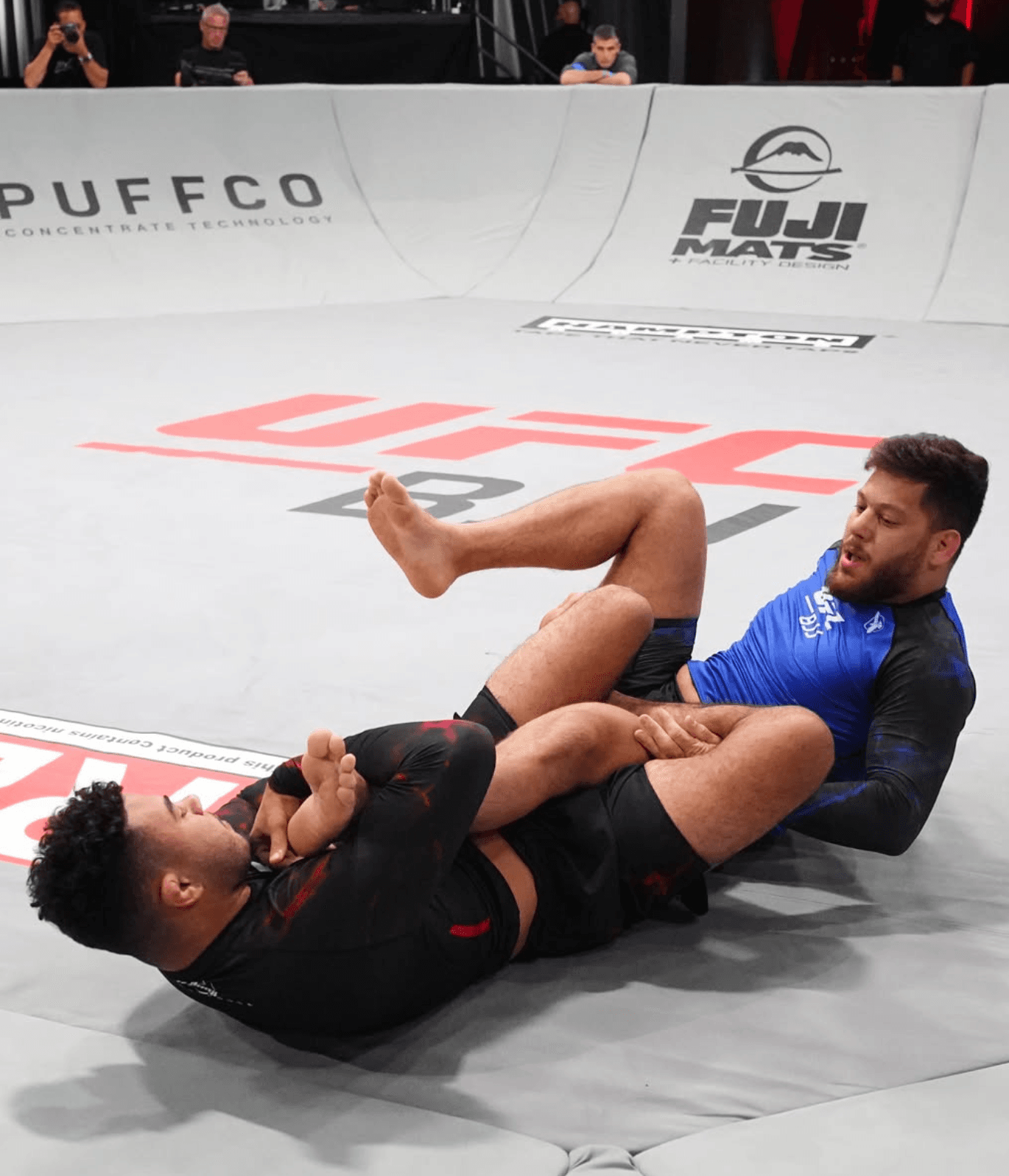
Andrew Tackett’s first defense ended with a different choke from the one that won him the belt. After taking the inaugural welterweight title with a rear-naked choke, he submitted Renato Canuto with a D’Arce at UFC BJJ 2.
The evening also expanded the championship roster. Mason Fowler left UFC APEX with the new light heavyweight belt, while two women’s 145-pound submissions and a pair of decisions gave the supporting card several directions beyond the headline matchup.
All eight UFC BJJ 2 results
The official UFC BJJ 2 recap records these outcomes from July 31, 2025. The two championship matches were the welterweight main event and the inaugural 205-pound title contest.
Welterweight title, 170 pounds: Andrew Tackett defeated Renato Canuto by D’Arce choke.
Light heavyweight title, 205 pounds: Mason Fowler defeated David Garmo by rear-naked choke in Round 1.
185 pounds: William Tackett defeated Kyle Chambers by rear-naked choke in Round 1.
Women’s 145 pounds: Raquel Canuto defeated Mo Black by kneebar in Round 1.
Lightweight, 155 pounds: Kennedy Maciel defeated Ademir Barreto by unanimous decision.
Women’s 145 pounds: Aurelie Le Vern defeated Maggie Lira by Americana in Round 1.
Women’s 125 pounds: Tammi Musumeci defeated Leilani Bernales by unanimous decision.
Bantamweight, 135 pounds: Jalen Fonacier defeated Everton Teixeira by inside heel hook in Round 1.
The main-event result heading identifies Tackett’s winning submission without providing a round or timestamp. Leaving those fields out is preferable to filling them from a different match or an undated highlight. The named method and championship outcome are established.
Tackett answered the first challenger
A first defense asks a different question from an inaugural championship. The first night identifies a champion; the next title match tests whether that athlete can keep the position when the division has a named target. Canuto was Tackett’s first opponent in that second situation.
The D’Arce gave Tackett another upper-body finish after his rear-naked choke over Andy Varela. Those two results share a family resemblance without being the same submission. One attacks from a different relationship to the opponent’s head and arm; the other depends on access behind the opponent.
For replay viewing, the useful comparison is the route to those finishing positions. A record saying two choke victories is accurate, but it hides the changing defensive problem. The challenger has to deal with the configuration actually present, rather than a generic reputation for attacking the neck.
The UFC BJJ introduction explains the promotion’s championship setting. This result added a smaller, concrete fact to that framework: the welterweight title remained with its first holder after one completed defense. It did not establish how later challengers would perform.
Fowler opened the 205-pound title record
Mason Fowler submitted David Garmo with a first-round rear-naked choke to become the inaugural light heavyweight champion. Unlike the main event, there was no existing champion defending this belt. Fowler’s victory supplied the division’s first championship result.
The round matters because it places the finish before the first interval. There was no need to compare multiple rounds on the scorecards, and no need for the championship-draw provision. A completed submission settled the title directly.
Fowler’s place on the card also broadened what a UFC BJJ champion could represent physically. The earlier championship lineup had stopped at welterweight. Adding a 205-pound title meant that the developing promotion was no longer building its entire title history around its lighter men’s divisions.
That observation concerns the program’s structure, rather than a claim that heavier matches necessarily follow a slower or more pressure-based style. The result itself was a quick submission. Weight tells the reader which division was being contested; it does not dictate the sequence that produced the win.
William Tackett had a separate assignment
William Tackett’s win over Kyle Chambers occurred at 185 pounds. He finished with a rear-naked choke in Round 1, on the same evening that Andrew defended at 170. The shared surname can flatten those results in a search summary, but the competitive stakes were different.
According to UFC’s account, William threatened an arm triangle before taking the back and finding the finish. That transition is worth noting because a failed or defended initial attack can create the position for a second. The arm triangle does not need to receive credit as the official method for it to belong in the explanation.
This was a non-title middleweight match. William did not win Andrew’s belt, and the result should not be described as another welterweight championship defense. A division label and a first name resolve most of that potential confusion.
The two wins nevertheless gave the card a clear connection. Both Tackett matches ended with chokes, but against different opponents, in different divisions, and with different championship consequences. Those details are more informative than treating the evening as an undifferentiated family result.
Two women’s featherweight finishes created options
Raquel Canuto defeated Mo Black with a first-round kneebar. Aurelie Le Vern defeated Maggie Lira with a first-round Americana. Both matches took place at 145 pounds, and neither was a championship contest on this card.
The submissions attacked different parts of the body. That matters for understanding the division as it appeared that evening: it was not populated solely by athletes winning through the same leg-entry exchange or the same top-position route. UFC’s account places Le Vern’s Americana in a half-guard exchange, giving a position to associate with the recorded method.
Two early finishes can make the next matchmaking question more interesting without answering it. They establish successful performances by Canuto and Le Vern. They do not, by themselves, prove that either had already been booked for a future title match or that a championship had been awarded off camera.
For a viewer following women’s UFC BJJ from the beginning, this is a useful card to retain. The results provide names, a common division, and distinct finishing methods before the later title history. A belt is one way a division becomes visible; repeated consequential matches are another.
Maciel and Tammi Musumeci went the distance
Kennedy Maciel defeated Ademir Barreto by unanimous decision at 155 pounds. Tammi Musumeci defeated Leilani Bernales by unanimous decision at 125. Together, those results accounted for the two matches on the card that reached the judges.
Unanimous tells the reader that all three judges selected the same winner. It does not establish that every judge awarded every round identically, or that either match lacked competitive exchanges. Without published numerical totals in the result heading, those additional claims should be left alone.
The professional scoring rules prioritize effective submission threats, offensive progression toward a finish, and then control. A match reaching the horn still has an offensive comparison for the judges to make. A decision is an anticipated outcome within the format.
Tammi’s result also needs its own identity. She competed against Bernales in a women’s 125-pound match. Mikey Musumeci’s championship was a separate record in the men’s bantamweight division. Similar surnames and familiar branding should not make an archive substitute one athlete’s achievements for another’s.
Fonacier made the opener count
Jalen Fonacier’s inside heel hook over Everton Teixeira ended their bantamweight match in the first round. It completed a card in which six of eight bouts produced submissions, with five result headings specifically identifying first-round finishes.
The opener offers a direct example of how quickly a match can become a finishing problem. A scheduled fifteen minutes does not promise an extended opening phase. Once a credible submission is applied, the relevant question is whether the defender can resolve it, rather than how much regulation time remains available.
That competitive fact should not be turned into a recommendation to delay a training tap or rush an unfamiliar heel hook. The professional result is useful for understanding the promotion’s match outcomes. Technical learning requires a suitable partner, explicit agreement, and informed supervision.
The name appears with a spelling variation in the event’s recap. Fonacier is the spelling used in the promotion’s subsequent official material. It is the same bantamweight whose result opens this card, rather than a second competitor with a near-identical name.
What changed after the second event
The welterweight title acquired its first defense, and the 205-pound division acquired its first champion. Those are the two lasting championship changes from UFC BJJ 2. The supporting card supplied contenders and successful performances without awarding additional belts.
For someone using results to choose a replay, a useful pairing is Tackett–Canuto followed by Maciel–Barreto or Musumeci–Bernales. The title finish shows the direct route to winning; one of the decisions supplies the alternative task of comparing offense over separate rounds.
A second viewing can connect the earlier card with this one. Tackett’s first two championship wins came through different chokes, while Fowler opened a new division. That is enough development to make the second event distinct without pretending that the entire roster or future hierarchy was already settled.
Readers who keep match notes can use the approach in the match-video review guide: record the starting position, the decisive change, and the resulting opportunity. Applied to professional viewing, that habit keeps a memorable submission connected to the exchange that made it possible.
Main photo: UFC; official event artwork.
The takeaway
UFC BJJ 2 kept the welterweight championship with Andrew Tackett and established Mason Fowler as the first light heavyweight champion. Six submissions gave the event a high finishing count, while the Maciel and Tammi Musumeci decisions kept the judging system in view.
The most useful way to read the card is division by division. Andrew and William Tackett had separate assignments; Raquel Canuto and Aurelie Le Vern won non-title featherweight bouts; Fowler’s win opened a championship record. Each result supplied a different piece of the growing promotion.
Follow competition beyond the broadcast
Check the tournament directory for events to watch or enter. Read each organizer’s rules independently, since a professional UFC BJJ match does not establish the format of an amateur bracket.
FAQ
Who won the UFC BJJ 2 main event? Andrew Tackett defeated Renato Canuto by D’Arce choke to retain the welterweight championship. This was Tackett’s first defense after winning the inaugural 170-pound title against Andy Varela at UFC BJJ 1.
How did Mason Fowler become UFC BJJ champion? Fowler submitted David Garmo with a rear-naked choke in Round 1 of their UFC BJJ 2 match. The contest awarded the inaugural light heavyweight championship at 205 pounds.
Did William Tackett fight for a title at UFC BJJ 2? No. William defeated Kyle Chambers in a non-title 185-pound match. Andrew Tackett, his separate entry on the card, defended the welterweight title at 170 pounds against Renato Canuto.
How many UFC BJJ 2 matches reached the judges? Two of the eight matches went to decisions. Kennedy Maciel defeated Ademir Barreto, and Tammi Musumeci defeated Leilani Bernales. Both results were unanimous decisions; the other six bouts ended in submissions.

Miles Serrano
Miles Serrano writes about competitors and the decisions that shaped their careers. He is more interested in the adjustment someone made in the third minute than in the medal count afterward.
Related Posts
UFC BJJ explained: the Bowl, the rules, and the money
The UFC runs its own grappling promotion now. The ruleset, the champions, where it streams free, and what those exclusive contracts are doing to the sport.
IBJJF advantages: near scores, submission threats, and ties
What IBJJF advantages measure, how they resolve equal points, why they are not fractional points, and the near-score situations that need context.

IBJJF Asian Championship 2026: adult black belt results
Asian Championship 2026 adult black belt podiums, Sak and Klay’s double golds, and the match counts confirmed by IBJJF’s recap.
Comments (0)
Loading comments...