
IBJJF advantages: near scores, submission threats, and ties
Quick answer: IBJJF advantages recognize qualifying near scores or genuine submission danger under the rulebook. They decide a match when points are equal, before penalties and a referee decision are considered. An advantage is not a fraction of a positional point, and effort alone does not guarantee one.
A scoreboard can show one athlete ahead on advantages while the other still leads the match. That is not a contradiction. The points column comes first, and advantages resolve equality in that column rather than being added to it.
The harder part is recognizing what earns an advantage. A near pass, an unstable sweep, or a submission attempt needs the relevant rule conditions. A movement can be energetic, useful, or close to a good position without automatically satisfying them.
Read the scoreboard in the correct order
The official IBJJF rulebook establishes the tie-breaking sequence. When points are equal, the athlete with more advantages wins. If points and advantages are equal, fewer penalties decide. If all those fields are equal, the referee or referees select the winner under the decision criteria.
Compare points first.
If points are tied, compare advantages.
If both are tied, compare penalties.
If all remain tied, apply the referee-decision rules.
This order means advantages are not fractional points. In a hypothetical 2–0 points match, several advantages for the athlete with zero points do not automatically erase the two-point lead. The points are not converted into a combined decimal total.
A useful note should therefore preserve the fields separately. Writing only 3–2 without identifying whether those are points or advantages can change the apparent result. The same numbers can describe very different competitive situations.
A near score needs a scoring context
The advantage rules address positions that come close to earning points but do not complete the required conditions. That is narrower than rewarding every attack or every moment of activity. The attempted action and the reason the full score was not completed both matter.
For example, an athlete may reach top through a qualifying sweep attempt but fail to stabilize for three seconds. The rulebook gives this as an advantage example. It does not make every reversal from every bottom position an advantage, because the sweep definition still needs the relevant origin.
The same distinction applies to passing. A sequence should be evaluated as a guard-pass attempt under the relevant definition, not simply as a moment spent near side control. The earlier position and the opponent’s recovery are part of the evidence.
These examples explain why a cropped clip can be insufficient. It may show the near position while omitting the guard, the start of the action, or the moment control was lost. A complete scoring discussion needs those parts of the sequence.
Submission advantages require real danger
The rulebook distinguishes a genuine submission threat from an attempt that never places the opponent in the relevant danger. Grabbing a limb or placing hands near a choke is not automatically an advantage. The referee assesses the actual attack under the rule’s criteria.
This is not an instruction to force a late finish in training. It is a description of competition scoring. A safe practice round should let partners release and tap appropriately rather than reproduce a high-stress moment to prove that an attack was dangerous enough.
For replay review, keep the setup, control, defensive response, and release in view. A still image of a grip does not establish the complete threat. A commentator’s excitement also does not replace the referee’s application of the rules.
The same caution belongs in a results article. A match ending with a one-advantage margin does not prove that the deciding advantage came from a submission. The actual match record or footage must identify the action before the method of the advantage is claimed.
Some familiar back positions are advantage examples
The rulebook’s examples include back control with crossed legs, a figure-four around the waist, or only one heel in the relevant position. These configurations do not automatically satisfy the full four-point back-control requirement.
That can differ from a viewer’s practical assessment of control. A body triangle may hold an opponent effectively, but the IBJJF positional score has its own definition. The question is which competition condition was met, not whether the position can be useful in grappling generally.
The examples are not a complete list of every possible advantage situation. They should be read within the broader rules and the referee’s assessment of the actual sequence. A brief appearance in a similar shape is not a universal guarantee of an award.
For athletes, this is a reason to practice recognizing the scoring configuration under the rules they will use. A coach can help separate a secure position, a possible submission, and the leg placement needed to complete the full positional points.
Half guard does not always produce an advantage
The rulebook specifically limits half-guard advantages. A top half-guard position that did not arise from a guard-pass attempt does not automatically earn one. The action’s origin matters, rather than the position name alone.
The rules also address a pass sequence that is completed. A temporary half-guard stage should not simply be counted as an extra advantage on top of the eventual full pass without regard to the relevant provision. The entire sequence needs to be assessed.
This is a useful counterexample to the idea that every named position has a fixed bonus. The same visible configuration can have a different scoring meaning depending on how it was reached and what happened next.
When reviewing a match, keep the preceding guard and the following control in the clip. If a camera angle or edit hides those details, the uncertainty should remain explicit. A confident claim about an omitted sequence is weaker than an honest statement of what the footage actually shows.
There are explicit situations with no advantage
The rulebook lists cases where advantages are not awarded. These include a sweep that starts and ends in a 50/50 guard situation and certain deliberate choices to abandon top position or force an action outside the combat area.
That list is a reason to avoid treating almost as a complete scoring rule. An athlete can come close to changing position while a specific exception still applies. The applicable article matters as much as the visual impression of effort.
A hypothetical sequence illustrates the point: two athletes remain in 50/50 through an attempted sweep that begins and ends there. The rulebook’s specific no-advantage provision is relevant; the fact that one athlete appeared briefly on top does not settle the award by itself.
A real match may contain additional details, so the example should not be used to decide a disputed clip without the full sequence. It explains the existence of an exception, not a universal verdict on every visually similar exchange.
An advantage lead can change late
Because points are compared first, a later positional score can change a match in which the opponent previously led on advantages. That is a consequence of the scoring order, not evidence that the earlier advantages were meaningless.
Consider a hypothetical match with equal points and one athlete ahead on advantages. If the other athlete then completes a qualifying two-point action, the points field changes. The previous advantage lead no longer decides while the points are unequal.
The practical lesson is to track the whole scoreboard and clock rather than a single favored column. It does not establish that every athlete should pursue the same late tactic. Available positions, legal actions, and remaining time differ from match to match.
The IBJJF rules overview supplies the broader competition context. A focused advantages review should retain the actual scoring action, the field it affected, and the match state before and after it.
A review note should also retain the referee’s signal and the moment it occurred. That separates the observed award from a later spectator interpretation of a similar-looking action.
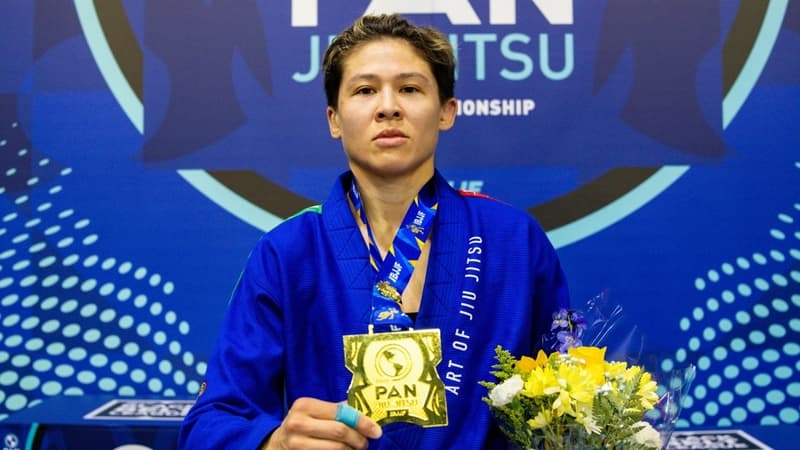
Main photo: Archive: Margot Ciccarelli at the 2026 Pans — IBJJF; photographer not identified on source page.
The takeaway
Advantages are a separate tie-breaking field for qualifying near scores and submission danger. They follow points in the result order and precede penalties and a referee decision when the earlier fields are equal.
Read the full sequence and the specific rule, including exceptions. That makes an advantage discussion more accurate than treating every attack as a reward or combining points and advantages into a number the scoreboard does not use.
Practice reading the score
Use open mats to find training opportunities, then agree with a coach and partner on the rules for a controlled scoreboard-focused round.
FAQ
How many advantages equal one point? There is no conversion. Points and advantages are separate fields, with advantages used to resolve equal points.
Does every submission attempt earn an advantage? No. The rulebook requires the relevant genuine threat, not merely a grip or an unsuccessful movement labeled as an attack.
Does reaching half guard automatically earn an advantage? No. The origin and continuation of the pass attempt matter, and the rulebook includes explicit limits on half-guard advantages.
When does the referee decide a tied match? When points, advantages, and penalties are all equal, the referee or referees apply the decision criteria, including greater offense and proximity to scoring or submission positions.

Tess Hanley
Tess Hanley reads the rulebooks, the entry fees and the fine print. When a federation or a gym changes something, her first question is who ends up paying for it.
Related Posts

Lucas “Hulk” Barbosa’s best work is in the details
Lucas Barbosa’s nickname explains the first impression. His gi world title, no-gi record, and 2022 ADCC final give viewers more to study.

João Miyao’s record deserves its own first name
João Miyao’s adult world title and 2026 Master1 results tell a distinct story, even when his brother appears beside him on the podium.

Jena Bishop made time for a second sporting life
Jena Bishop’s 2026 PFL title followed a deliberate move from championship jiu-jitsu into learning a different sport.
Comments (0)
Loading comments...