
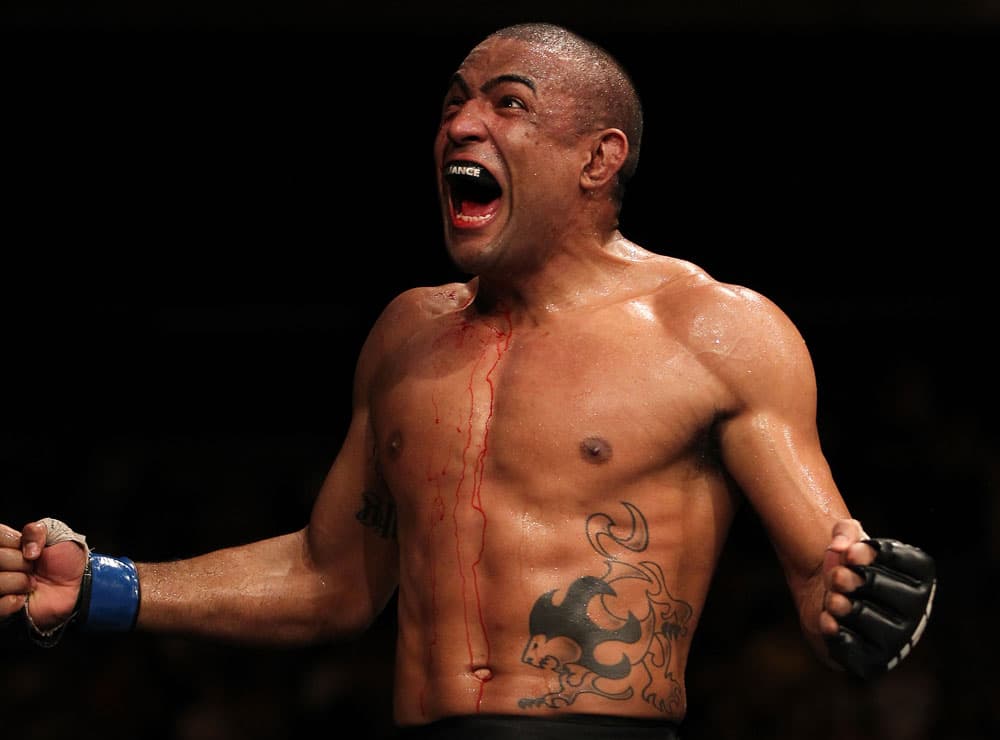
Sérgio Moraes: the world champion behind the MMA name
Quick answer: Sérgio Moraes won adult black-belt IBJJF world titles at middleweight in 2008 and medium-heavyweight in 2011 before reaching the UFC. His move to MMA is interesting because an established grappler still had new work to do. Read the gi results alongside his contemporary interviews rather than treating his jiu-jitsu as a footnote to the cage career.
In October 2012, Sérgio Moraes described his development to the UFC’s Thomas Gerbasi in terms of becoming a more complete mixed martial artist. The interview looked back at a fight in which the decorated grappler had found a striking opportunity against Cezar Ferreira.
That is the useful tension in his story. He arrived with achievements that deserved respect and entered a sport that would not let those achievements answer every question. To understand the transition, start with the championships that made him an established name before the UFC introduction.
The 2008 result puts the gi career in focus
The IBJJF’s 2008 Worlds results list Sergio Morais of Alliance first in the adult male black-belt middleweight division. Willian Cooper is second, with Victor Estima and Otavio Souza in the bronze positions. The spelling in the archive differs from the name more commonly used in later coverage.
That is a specific title: adult black belt, middleweight, at the IBJJF World Championship. Keeping those details together avoids the loose championship counting that can make combat-sports biographies difficult to follow.
It also gives the reader a useful picture of the field. Moraes and Cooper appear under Alliance, while Estima and Souza appear under Gracie Barra. The standings establish the result; they should not be expanded into an account of how every match unfolded.
For someone who first encountered Moraes in MMA, this is the earlier page worth opening. His grappling reputation was attached to a result at the highest belt level, not merely to a training background mentioned during a walkout.
Three years later, the title came in another division
At the 2011 Worlds, the federation lists Sergio De Moraes first at adult black-belt medium heavy, again representing Alliance. Romulo Barral finished second, with Eduardo Santoro and Rogel Monsalve sharing third.
The change from middle to medium heavy is part of the record. It should not be converted into a claim about a particular weight cut, diet, or physical transformation without evidence. The useful fact is that the two named world titles came in different divisions at different editions.
The gap between them also keeps the story from becoming a single tournament recollection. Moraes had a major result in 2008 and another in 2011. A profile that begins only with his arrival in the UFC skips a substantial competitive credential immediately preceding it.
Our Alliance history gives additional context for the academy name attached to those results. It is one connection in the story, rather than a substitute for looking at the athlete’s own record.
The route into the UFC was not a straight line
In a June 2012 UFC interview, Carlos Eduardo Ozorio reported that Moraes had lost to Daniel Sarafian in the semifinals of The Ultimate Fighter Brazil. When Sarafian could not take his place in the final because of injury, Moraes received the opportunity to face Cezar Ferreira at UFC 147.
That sequence is more specific than saying Moraes simply won his way into the final. It contains both the setback and the later opportunity. Neither has to be removed to make the arrival compelling.
The same contemporary account describes Moraes working on his stand-up in Curitiba with help from André Dida and Mauricio Shogun’s team. That detail matters because it identifies practical work on another part of the sport rather than assuming a famous jiu-jitsu résumé would carry the whole assignment.
The opportunity did not erase the learning. It placed the learning in public, against an opponent who was preparing for a mixed martial arts fight rather than a gi match.
A grappling specialist still had to choose how to fight
Gerbasi’s October 2012 UFC feature describes Moraes hurting Ferreira with an elbow during their fight, even though Ferreira went on to win by unanimous decision. Moraes discussed wanting to test his stand-up and gaining confidence from the experience.
Those observations belong to that reported interview. They do not justify writing that Moraes had stopped valuing jiu-jitsu or wanted to reject his earlier identity. Developing another part of a sport does not require disowning the part in which an athlete is already accomplished.
The interesting question is what the new rules and opponent demand. A grappler entering MMA needs a route into useful positions and a response when the contest remains elsewhere. Prior success can establish skill without guaranteeing how a different contest will develop.
That makes the transition worth following on its own terms. It is not merely a test of whether one martial art works. It is an athlete adapting an existing set of skills to a wider competitive task.
Keep each sport’s result sheet in its own context
A gi world title and an MMA record describe different competitions. Putting them beside one another helps explain a career; adding them together into a single measure of ability usually creates more confusion than insight.
The opponent, equipment, permitted actions, and scoring environment affect the contest. A result under one set of conditions cannot be used as an automatic prediction under another. That is a general reading principle, not a reason to downplay either sport.
Moraes offers a useful example because the earlier gi achievements are concrete. You can acknowledge the 2008 and 2011 titles fully while also taking the MMA development seriously. There is no need to choose between respecting the grappler and examining the mixed martial artist.
For another perspective on that transition, Demian Maia’s career provides a separate case. The value of comparison lies in the differences between individual careers, rather than assuming every accomplished grappler follows the same route.
Watch the entry, not only the submission
When watching a grappler in MMA, the finish can draw attention away from the work required to reach it. A useful viewing question is how the athlete arrives at a position where their grappling can matter. Sometimes that question is more instructive than replaying the last few seconds.
Keep the prompt descriptive. Watch the distance, the exchange that precedes contact, and whether the position changes because of an attack or an opponent’s response. Avoid assigning a private plan to the athlete unless a sourced account supports it.
A small viewing checklist can keep the exercise focused:
Identify the sport and rules context before comparing footage.
Follow how the first meaningful grappling connection is established.
Notice what happens when the initial route is unavailable.
Separate what the camera shows from what you are inferring.
This does not turn a viewer into an MMA coach. It simply provides a more useful way to watch than treating every unsuccessful entry as a verdict on a black belt’s entire grappling ability.
The earlier titles do not need a later excuse
An athlete’s later results can dominate memory because they are more recent or more widely broadcast. That is understandable, but it can shrink the earlier career into a phrase. In Moraes’s case, the phrase world-class jiu-jitsu should lead somewhere specific.
The 2008 middleweight and 2011 medium-heavyweight titles remain accomplishments in their own events. They do not require a particular later UFC outcome to retain their meaning. Equally, the titles should not be used to explain away every challenge encountered in MMA.
A fair profile allows both forms of competition to have consequences. The grappling record establishes what Moraes achieved in the gi. The MMA record and contemporary reporting show another phase with its own opponents, choices, and results.
That gives a reader more than a verdict about whether the transition was worthwhile. It gives them an athlete whose competitive history has more than one setting, and enough detail to explore each setting without confusing them.
Read the old interview as a moment in time
The 2012 interviews are especially useful because they capture what Moraes said while the transition was unfolding. They should be read as contemporary accounts, with the expectations and circumstances of that moment still attached.
Do not silently turn an old statement of ambition into a later accomplishment. An athlete saying what they hope to achieve is evidence of the stated goal, not proof that the goal was reached. Keeping that distinction visible makes an archive interview more informative.
It also prevents hindsight from doing all the writing. The person preparing for the next fight did not have access to the later result sheet. A profile can know what came afterward without pretending the whole career was already settled in the athlete’s mind.
For Moraes, the earlier world titles and those first UFC-era accounts make a strong introduction. They show an established competitor entering a new phase and talking about the work it required, rather than arriving as an anonymous beginner or a finished product.
Main photo: UFC; archive photograph from Ferreira vs. Moraes at UFC 147.
The takeaway
Sérgio Moraes’s gi career deserves to be read in full sentences: adult black-belt world gold at middleweight in 2008 and medium heavyweight in 2011, representing Alliance. Those results give substance to the reputation he brought into MMA.
The contemporary UFC interviews add the next part: new training demands, a changed opportunity in The Ultimate Fighter Brazil, and a competitor working to broaden his game. Keep the achievements and the adaptation together without asking one sport’s record to stand in for the other.
Bring the viewing question to a coach
Find BJJ gyms on Let’s Roll and ask a qualified coach about the positional detail that caught your attention. Competition footage is a starting point for learning, not a substitute for supervised practice.
FAQ
Which IBJJF world titles did Sérgio Moraes win? The official records cited here show adult black-belt middleweight gold in 2008 and medium-heavyweight gold in 2011. Both entries list Alliance as his academy.
Was Moraes already an accomplished grappler before the UFC? Yes. Those world titles preceded his 2012 UFC appearance and provide specific evidence for the jiu-jitsu reputation mentioned in his MMA coverage.
How did Moraes reach the TUF Brazil final? Contemporary UFC reporting says he replaced the injured Daniel Sarafian after previously losing to Sarafian in the semifinals. He then faced Cezar Ferreira at UFC 147.
Can an MMA result measure someone’s entire BJJ ability? It reflects a contest under MMA conditions. It can inform discussion of that performance, but it does not replace the athlete’s separate grappling record or explain every technical detail on its own.

Miles Serrano
Miles Serrano writes about competitors and the decisions that shaped their careers. He is more interested in the adjustment someone made in the third minute than in the medal count afterward.
Related Posts
Competing in gi and no-gi on the same day takes two plans
Prepare for gi and no-gi competition on the same day with separate rule checks, complete outfits, schedule coordination, and a realistic second-bracket plan.
Jiu-jitsu in Montreal: build the visit around a real class
Plan BJJ training in Montreal around confirmed classes, language arrangements, winter travel, visitor policies, and equipment that is ready to use.
BJJ gi pants that fit standing up can still fail on the mat
Check BJJ gi pants at the waist, rise, knees, and cuffs so a good-looking size label becomes a uniform you can actually move in.
Comments (0)
Loading comments...