

Alliance Jiu-Jitsu: the team behind the patch
Quick answer: Alliance Jiu-Jitsu is an international team and academy network associated with founders Romero Cavalcanti, Alexandre Paiva, and Fabio Gurgel. Its identity includes both championship competitors and an organized teaching system for students at different levels. To evaluate an Alliance school, look at its local instruction and beginner pathway as well as the team's history.
A team patch makes a complicated history portable. It can appear on a world champion's gi and on the uniform of someone still learning which way to turn during an escape. The symbol is shared. The two people wearing it are doing very different work.
Alliance is a useful example of that distinction. Its public story includes prominent competitors, founding academies, and a method for organizing ordinary classes. The competition footage is easy to find. The teaching structure deserves attention too, particularly if you are searching for a school rather than a highlight reel.
Understanding the team means following both threads. One explains why the name carries weight in jiu-jitsu. The other helps explain what that name could mean to a person attending twice a week after work.
Three founders, several centers of gravity
Alliance's official account of its founders identifies Romero “Jacaré” Cavalcanti with Atlanta, Alexandre “Gigi” Paiva with Rio de Janeiro, and Fabio Gurgel with São Paulo. The organization presents those founding schools as distinct parts of the same team history.
That geography helps explain why searching for Alliance does not lead to one room. A team can connect academies while leaving each with a particular instructor, student population, and local history. The relationship matters without making the locations interchangeable.
Read a school's biography with that distinction in mind. A founder's name may explain the lineage. A current staff page should explain who actually teaches there. Those are complementary pieces of information, and a useful academy profile gives you enough context to tell them apart.
The distinction also protects the history from becoming vague praise. A named teacher, a documented connection, and a specific academy tell you more than a general claim of tradition. If the connection interests you, follow it. There is a human teaching relationship behind the logo worth understanding on its own terms.
The classroom became part of the system
Alliance's methodology page dates the development of its organized teaching approach to 2000. It describes techniques grouped into modules according to level. The published pathway also includes introductory private lessons before group instruction and a defined beginner stage.
Those details are relevant because a competition team and a beginner school have different immediate tasks. A competitor may need to refine a familiar position against a difficult opponent. A new student may need to understand what that position is called and where each person's limbs begin.
Organizing instruction by level attempts to address that gap. For a prospective student, the question is how the local academy applies the structure. Ask what the introductory lessons cover and how the group curriculum is introduced afterward.
Do not turn published attendance numbers into a personal promotion promise. The school should explain its current assessment process and how it applies to someone joining, returning, or transferring. A framework can make expectations clearer without removing the need for an instructor to understand the individual student.
Famous athletes do not all play the same game
The official team history lists competitors including Bruno Malfacine and Lucas Lepri. Their presence is part of Alliance's sporting identity, but a list of names should be the start of watching, not the end of analysis.
Choose one athlete and one complete match. Notice the position they return to, the circumstances that produce it, and what the opponent does in response. A full match offers more context than a compilation of successful finishes because it includes the attempts that do not immediately work.
Then resist the urge to treat the athlete's preferences as a compulsory style for everyone wearing the patch. A team relationship is not evidence that every student uses the same guard, passes the same way, or learns at the same pace.
The Lucas Lepri profile provides one individual starting point. Keep that individual scale when you move from reading to watching. The interesting question is how a particular competitor solves a problem. The answer will be more useful than an unsupported claim that an entire international network has one game.
Team success and personal learning measure different things
A championship result records what happened in a defined competition. It does not directly tell a beginner what they will understand after six lessons. Both pieces of information can matter, but they answer different questions.
If competition is your aim, ask about the local preparation process. Who helps students choose an event? Which classes are appropriate? How are coaching arrangements handled? These questions connect a team's sporting reputation to an actual service you may need.
If competition is not your aim, say that clearly too. You may want technical practice, a demanding hobby, or a class you can sustain around other commitments. There is no need to borrow a tournament goal merely because the school's champions are visible on its website.
During a trial, evaluate the lesson in front of you. Can you identify the problem being taught? Is the partner's role clear? Can you get a correction when the movement goes wrong? These observations are modest, but they are closer to your likely experience than trying to infer teaching quality from a medal photograph alone.
A founder's connection can outlast a daily teaching role
Alliance Atlanta's lineage page says Cavalcanti retired from day-to-day teaching in 2018 while continuing to participate through visits and seminars. That is a concrete example of why lineage and the weekly instructor roster should be read separately.
For a visitor hoping to learn from a particular person, confirm their presence before booking travel. A founder's biography on an academy website does not promise that they will teach the session that fits your flight.
There is no need to view that distinction negatively. An academy can have a meaningful founding relationship and a capable current teaching staff. You simply want to know which experience you are arranging: an ordinary class, a special seminar, or a lesson with a named instructor.
If the ordinary class is the one available, investigate it on its own merits. Ask who leads it and what experience it assumes. A clear understanding of the actual visit is more satisfying than arriving with an expectation built from a historic biography and discovering that the timetable meant something else.
Inspect the local pathway before joining
The most useful questions concern the transition from inquiry to regular attendance. A school should be able to tell you how to begin and what happens after the introduction. You do not need a complete technical syllabus before your first class, but you should know the next practical step.
Use a short set of checks:
Which introductory session applies to your experience?
Who teaches the classes you can regularly attend?
How are students placed into the different levels?
What uniform and equipment does the academy require?
What does the membership include, and how is it ended or paused?
Keep the reply with the local school's name and address. If you are comparing several affiliates, this prevents one location's policy from quietly becoming an assumption about all of them.
At the trial, notice how a student asks for help. You may not yet have the technical knowledge to assess every explanation, but you can observe whether questions have a place in the lesson. That matters more to a first month of training than knowing the entire network's championship record by memory.
Use the network to make a more informed visit
An affiliation can give a traveler a sensible place to begin a search. It may provide shared references and a reason to contact an academy you would otherwise overlook. It still does not establish visitor access or membership reciprocity on its own.
Contact the receiving school with dates, rank, training background, and the class you hope to attend. Ask about charges and uniform requirements. If your home instructor can introduce you, that may help the conversation, but let the host confirm the actual arrangement.
Keep the first visit manageable. One confirmed session is enough to learn how the room works. You can ask about additional training after you understand the schedule and the expectations. A long list of planned classes has little value if the first booking was never agreed.
The same principle applies to special events. A seminar connected to the team should have its own registration and attendance information. Check who is teaching, the subject, and the intended level. The affiliation explains the connection; the event details explain what you are buying and where you need to be.
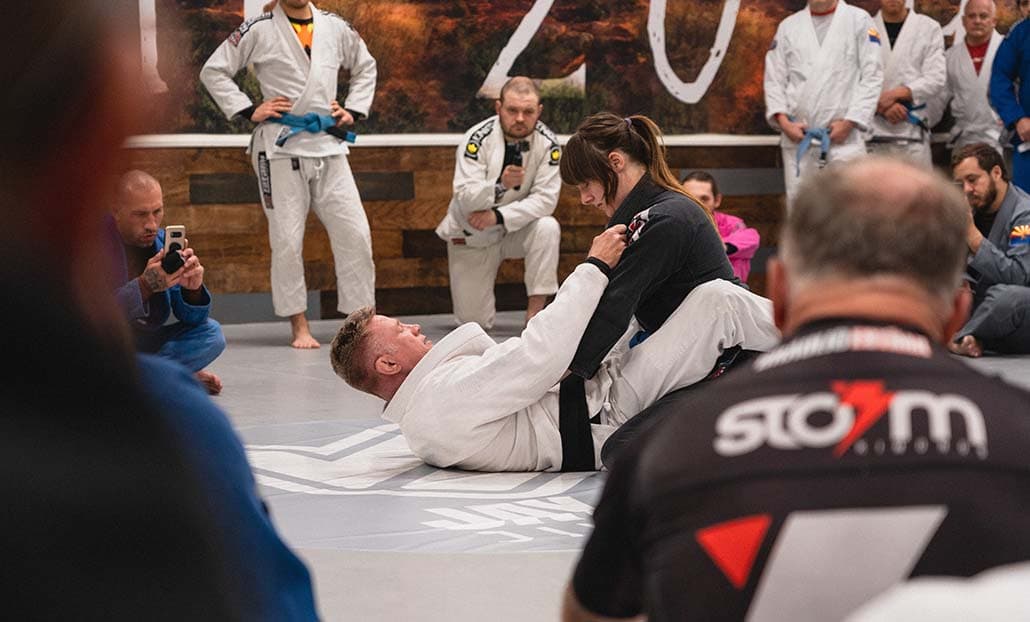
Main photo: Alliance Jiu-Jitsu.
The takeaway
Alliance's patch connects founding teachers, documented competitors, and an organized approach to instruction. Those strands belong together, but they should not be collapsed into one claim that a famous team automatically answers every question about a local class.
Learn enough of the history to understand the connection, then investigate the academy you can attend. The most meaningful version of a team identity is the one you can see working in a lesson: a clear task, appropriate practice, and an instructor who helps you understand the next step.
Find an academy to investigate
Use the gym directory to locate schools, then verify the current affiliation and introductory arrangements with the academy itself.
FAQ
Who are the founders associated with Alliance Jiu-Jitsu? Alliance's official history identifies Romero Cavalcanti, Alexandre Paiva, and Fabio Gurgel. It connects them with founding academies in Atlanta, Rio de Janeiro, and São Paulo respectively.
Can beginners train at Alliance? The organization publishes a beginner pathway, including introductory instruction. Ask the local academy how that pathway works, which session to book, and what clothing is required for the first visit.
Will every Alliance school teach the same daily lesson? Do not assume identical timetables or daily content. The organization describes a shared methodology, but the local academy should explain its current classes, instructors, and placement process.
Does an Alliance membership include visits to other affiliates? Confirm this with both schools. A shared team connection does not by itself establish free visits, booking priority, or access to every class at another location.

Miles Serrano
Miles Serrano writes about competitors and the decisions that shaped their careers. He is more interested in the adjustment someone made in the third minute than in the medal count afterward.
Related Posts

Mikey Musumeci gives up the belt to make room for MMA
Musumeci is vacating his UFC BJJ title to focus on MMA training. What he is leaving, what continues, and why the transition matters.

IBJJF membership: finish the paperwork before the deadline
IBJJF membership and tournament entry are separate steps. Plan documents, professor approval, renewals, and junior accounts before registration closes.
Choosing a BJJ seminar worth your time and travel
Choose a BJJ seminar by the subject, teaching format, access, and total cost. Know what to ask the host before buying a ticket.
Comments (0)
Loading comments...