
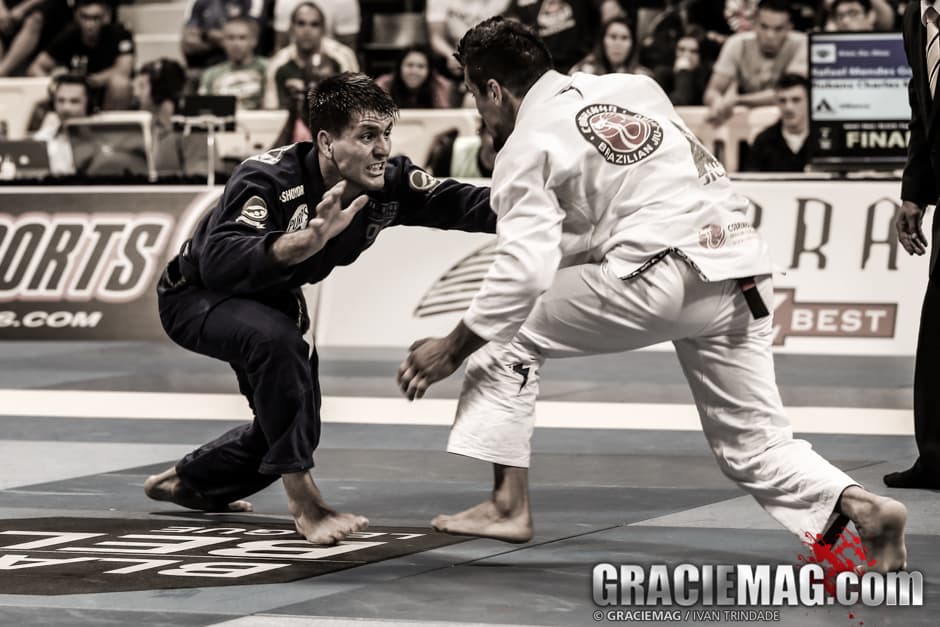
Rafael Mendes: six Worlds titles and a life after competing
Quick answer: Rafael Mendes won six adult black-belt IBJJF world titles and two ADCC championships. He co-founded Art of Jiu Jitsu with his brother Guilherme and PM Tenore in 2012, then announced his competitive retirement in May 2017 at age 27. His influence belongs to both the competition record and the academy that grew alongside it.
Six featherweight world titles, followed by retirement at 27. That is an unusual pair of facts to put in the same sentence. Rafael Mendes left spectators with plenty of matches to revisit and plenty of hypothetical matches that would never happen.
The temptation is to make the whole career a discussion about what he might have won next. The work he actually completed is more interesting. It includes two different championship formats, a long competitive rivalry with Rubens Cobrinha Charles, and a California academy that was already operating while Mendes was still chasing titles.
Rio Claro came before the white mats in California
Mendes grew up in Rio Claro, Brazil, and trained under Ramon Lemos. His brother Guilherme, usually called Gui, was part of that development. The AOJ biography records world championships at blue, purple, and brown belt before Rafael's adult black-belt success.
Those earlier results matter because the familiar images of a polished black belt omit the colored-belt years. He did not arrive at the senior level with only a talent label. He had already competed through several stages of the belt system.
BJJ Heroes' career account identifies an older cousin, Thiago Mendes, as the person who introduced the brothers to training. It also places Leonardo Santos and Lemos in the early coaching story. That is a more useful origin than suggesting an athlete simply appeared fully formed.
There is no need to reconstruct private family conversations to make those relationships meaningful. The named teachers, the brothers' shared training, and the recorded competition progression give the story a beginning without invented scenes on a Brazilian mat.
ADCC success arrived before the first black-belt gi Worlds title
The sequence is easy to reverse in memory. Mendes won his first adult black-belt gi world championship in 2010. His first ADCC championship came in 2009, before that gi title.
The official 2009 ADCC results put him first at under 66kg, with Cobrinha second, Ryan Hall third, and Jeff Glover fourth. Read those names together. The podium gives a new viewer a better sense of the event than a highlight caption calling Mendes unbeatable.
Two years later, he won the same ADCC division again in Nottingham. The 2011 results again list Cobrinha as runner-up. Mendes' no-gi achievements were therefore not an occasional side note attached to a gi specialist's biography. They included consecutive titles at that championship.
This is also why labeling him only through a jacket-dependent position leaves out part of the record. A viewer can study his gi footage and his ADCC appearances as separate bodies of work. Our gi and no-gi comparison explains the basic distinction; his results show success on both sides of it.
The six gi titles were spread across seven championships
AOJ lists Mendes' adult black-belt world titles in 2010, 2011, 2012, 2014, 2015, and 2016. Notice the missing year. A six-title career does not mean six uninterrupted wins, and smoothing out the gap makes the history less accurate.
In 2016, the IBJJF's official results list Mendes first in adult black-belt featherweight, Marcio Andre second, and Osvaldo Moizinho and Cobrinha in the bronze positions. That final title belongs to a specific bracket. It was not simply the next installment of the same final against the same opponent.
For someone discovering this era, the dates provide a manageable way in. Pick one championship and read its bracket before watching. You will learn who was actually present instead of assuming every famous featherweight met in every event.
The total still deserves attention. Six adult black-belt world championships is the central number in the gi record. It just becomes more informative when the years and opponents remain attached, rather than turning into a decorative line beneath a photograph.
Cobrinha was a rival with his own answers
The 2012 Pan final is one obvious place to start watching. Mendes submitted Cobrinha with an armbar, a result documented in Graciemag's coverage of the match. It is a memorable finish between two athletes whose other meetings did not all end that way.
That qualification is part of respecting the rivalry. In 2013, ADCC's official results reverse their earlier order: Cobrinha took gold at under 66kg and Mendes took silver. The record refuses a simple story in which one athlete solved the other permanently.
A rivalry article can become an excuse to diminish the runner-up. That would make this one worse. A major win carries meaning partly because of the opponent across the mat. Reducing Cobrinha to the man caught in one armbar strips away the competitive context that made the finish worth remembering.
Watch a complete meeting when possible. The result tells you who won. The unedited exchanges show the time and work between the opening contact and that result, including the parts a short compilation has no reason to keep.
AOJ opened while Rafael was still winning titles
Art of Jiu Jitsu dates its founding to the summer of 2012. Its own account of the brand's origins names Rafael, Gui, and RVCA founder PM Tenore as co-founders. The academy was not a project first conceived after Rafael stopped competing.
That overlap changes the shape of the biography. From 2012 through his final world title in 2016, the competition career and the academy existed at the same time. Retiring from competition meant changing his priorities within a life that already included teaching and a school.
Gui also deserves his own place in this account. AOJ's profile of Gui records four black-belt world titles and his role in building the academy. Referring casually to the Mendes brothers is convenient, but the phrase should not erase that they had separate competitive careers.
For readers choosing a gym, the distinction is practical. A celebrated competitor, an academy founder, and the instructor teaching your particular class may be different people. Ask who will be on the mat at the time you can attend. A famous history is interesting; the actual class is where your membership gets used.
The kids' team was part of the story early
Graciemag's 2014 report on AOJ at Kids Worlds recorded an academy contingent of 82 children at the July 19–20 event. The article includes the brothers discussing their work on curricula and training programs. That was two years after AOJ's founding, not a later detail added to a retirement biography.
The number is striking, but it should not become a promise to parents. An academy's competition team and an individual child's reasons for attending are different things. Some children want tournaments. Others want to enjoy class without an immediate competitive plan.
What the early report establishes is that teaching younger students was already part of the brothers' public work. It gives the academy chapter a date and a concrete event, rather than relying on the vague claim that every great competitor eventually gives back.
It also offers a different set of photographs from the usual adult podium. Coaches and children at an event tell a part of the AOJ story that cannot be reduced to Rafael's own medal total.
Retirement was an announced decision, not a puzzle to solve
On May 22, 2017, Graciemag reported Mendes' retirement announcement. He was 27. The report describes his stated intention to focus on his academy and family.
That is enough to explain the public decision. An athlete stopping younger than spectators expected does not give a writer permission to invent private motives. Nor does a fan's desire for another season create an obligation for the competitor to supply it.
The age invites a counterfactual: how many more titles could he have won? Nobody knows. Opponents would have changed, preparation would have required time, and future brackets were not guaranteed. Adding imagined medals to a real record is a poor way to appreciate it.
The more grounded question concerns what remained after competition. There were matches to study and an academy already several years old. Neither required him to register for another Worlds to continue existing. Retirement ended one role in the sport, not every connection to it.
A short viewing list is better than an endless highlight queue
Start with a few dated reference points rather than trying to consume the entire archive in an evening:
The 2009 ADCC under-66kg campaign, where the first ADCC title enters the record.
The 2012 Pan final with Cobrinha, for a complete match surrounding the familiar armbar finish.
The 2016 Worlds featherweight bracket, which places the final gi world title in its actual competitive field.
These are viewing suggestions, not a claim that the three events contain everything Mendes knew. They offer different moments in the career and make it easier to distinguish a match result from a reputation.
The IBJJF added Mendes to its Hall of Fame in 2022, as recorded in the federation's year in review. That recognition gives the competition story a later marker. The older footage remains available for a less ceremonial purpose: seeing the athlete work through an opponent who was trying to stop him.
The guide to learning from BJJ instructionals can help turn that viewing question into a manageable study habit.
Main photo: Ivan Trindade / Graciemag.
The takeaway
Rafael Mendes' career has enough substance without imaginary future titles or an argument that every recreational grappler should copy his game. The verified record includes six gi world championships, two ADCC titles, and a retirement announcement made while he was still 27.
AOJ belongs inside that history, not in a paragraph tacked onto the end. It opened during his title-winning years and gave him an established place to direct his attention afterward. Read the competition dates beside the academy dates and the decision to stop competing becomes easier to understand on its own terms.
Look beyond the name on the academy wall
Explore jiu-jitsu gyms near you, then check the instructors and timetable for the classes you would actually attend. An academy's history can start the conversation; a visit can tell you what training there involves today.
FAQ
How many IBJJF world titles did Rafael Mendes win at black belt? He won six adult featherweight titles, in 2010, 2011, 2012, 2014, 2015, and 2016. Those are separate from his earlier colored-belt world titles.
Did Rafael Mendes win ADCC? Yes. The official records list him as the under-66kg champion in 2009 and 2011. He was runner-up to Rubens Cobrinha Charles in that division in 2013.
When did Rafael Mendes retire from competition? His retirement announcement was reported on May 22, 2017, when he was 27. The stated focus was his academy and family. Speculation about additional reasons is not needed to describe the decision.
Who founded Art of Jiu Jitsu? AOJ names Rafael Mendes, Guilherme Mendes, and PM Tenore as its co-founders in the summer of 2012. The academy therefore existed for several years before Rafael announced his retirement.
Related Posts

Training with women in BJJ: listen before you roll
Be a better BJJ training partner with women: agree on intensity, provide honest resistance, ask before coaching or filming, and respect a declined round.
Bia Mesquita: the grappling record behind the MMA newcomer
Follow Bia Mesquita's path from 2014 Worlds double gold and a 2017 ADCC title to her 2025–2026 UFC results, with dated sources and match context.

Ffion Davies: winning across gi and no-gi
Explore Ffion Davies's 2022–2023 championship results, from gi Worlds and ADCC gold to a World No-Gi double, with context for the matches behind the medals.
Comments (0)
Loading comments...