
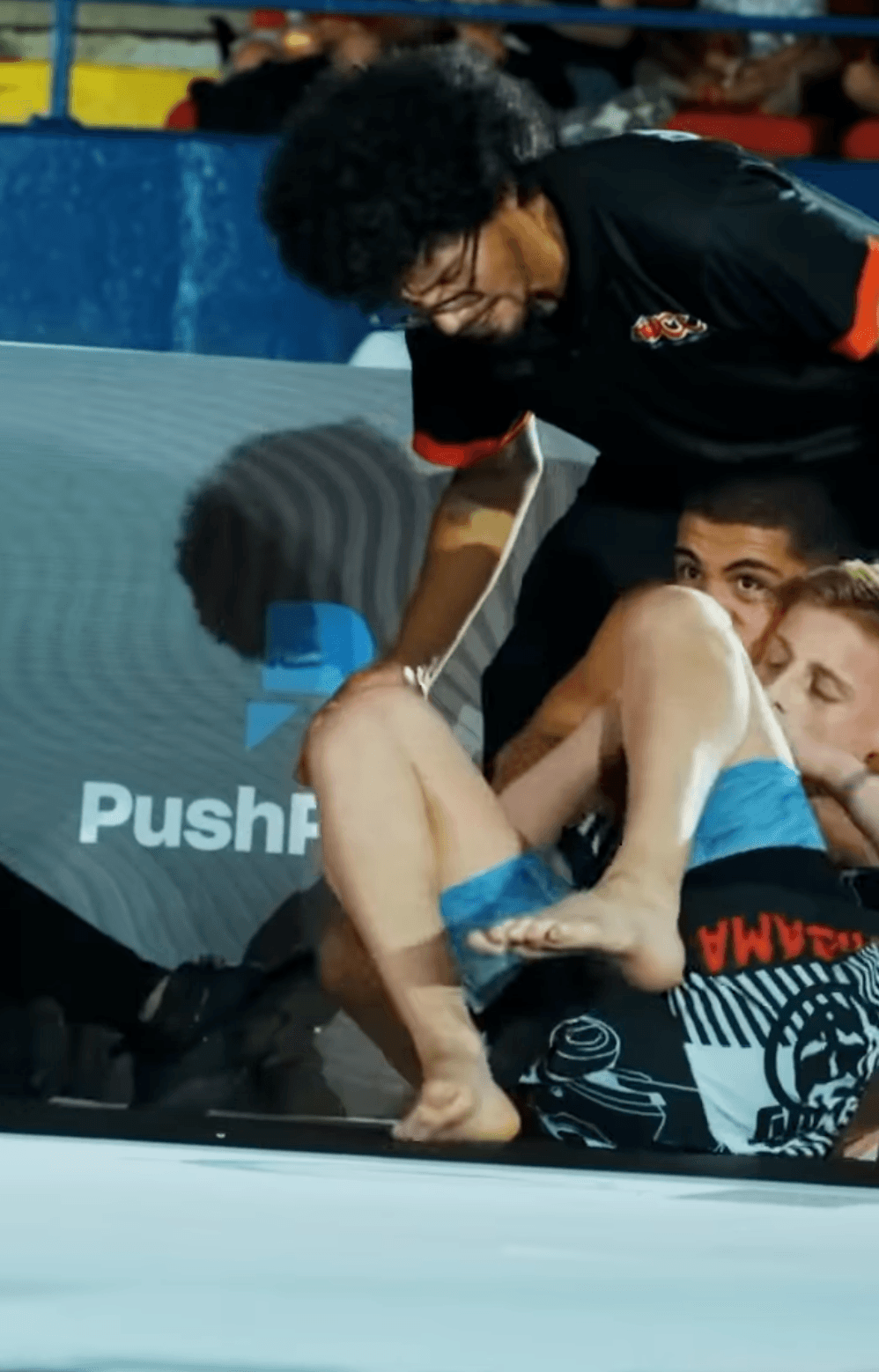
Pro grappling in 2026: who runs what, and where to watch
Quick answer: Professional grappling in 2026 is spread across roughly eight promotions running eight different rulesets. ADCC is still the sport's most prestigious title, with its 2026 Worlds set for Kraków on September 12-13. Polaris scores rounds with judges, FloGrappling's WNO and Fight to Win fill the weekly calendar, UFC BJJ is signing athletes to exclusive deals, and the IBJJF has finally started paying real prize money. Almost none of it lives on one channel, and almost no one survives on purses alone.
Try explaining this sport to a training partner who just started. They saw a leg lock highlight, they want to know where the "league" is, and the honest answer takes twenty minutes and four browser tabs.
There is no league. There are promotions, each with its own scoring, its own stars, its own streaming home, and in a few cases its own contract lawyers. Here is the map as it stands in the summer of 2026.
ADCC is still the crown, and it just doubled the money
The Abu Dhabi Combat Club World Championship runs every two years and everything else in no-gi orbits it. The 2026 edition lands at the TAURON Arena in Kraków, Poland on September 12-13, the first Worlds outside Las Vegas since 2019 and the first in Europe since Finland in 2017.
You cannot enter. Half the field wins a spot at continental Trials, the other half is invited. The ruleset is the reason ADCC matches look like nothing else, and it takes longer to explain than it does to watch: we went through it in ADCC explained, and the Kraków field, the doubled purses and the names missing from it in the 2026 preview.
In February the organisation doubled its champion purses. Men's division winners now take $20,000, women's $10,000, the absolute champion $50,000, and the superfight winner $50,000. That is a real raise for a tournament whose men's champions earned $10,000 as recently as 2024. Measured against how hard the thing is to win, it is still less than a mid-card UFC prelim fighter makes to show up.
Polaris rebuilt its rules around the person watching
Polaris is the UK's flagship, and in 2026 it moved onto FloGrappling under a new broadcast deal, starting with Polaris 35 in Ebbw Vale in January.
Their format deserves attention because it is the most opinionated ruleset in grappling. Main card superfights run three five-minute rounds scored on a 10-point-must system, the same idea as boxing. Grand Prix bracket matches run two rounds with a three-minute overtime if the rounds split; the final runs three. A submission ends it, otherwise judges decide, and Polaris publishes criteria that openly favour the aggressor: legitimate submission attempts, pace, and risk-taking.
The clever part is how they punish stalling. Warning, then a point, and if you keep doing it your opponent is simply given the position of their choice: back, side control, or mount. A stalemate rule also lets the referee reset any position where nothing is happening, justified in the rulebook with the blunt admission that Polaris is entertainment with paying viewers.
Polaris 38 in Bath on July 11 ran an eight-man welterweight Grand Prix. Mateusz Szczeciński won it and $30,000, submitting Deandre Corbe and Michael Liera Jr before taking a split decision over PJ Barch in the final. Polaris 39 goes to the Doncaster Dome on October 3, and a Polaris PSG event at Sports Dock in London on August 30 is an all-levels championship rather than a pro card, though its Contenders bracket sends its winner to a Polaris main card.
WNO, Fight to Win, and the FloGrappling pipeline
FloGrappling functions less like a promotion than the sport's cable package. It streams ADCC, IBJJF, Polaris, and its own signature event, Who's Number One.
WNO books superfights and title matches under a round-based system where rounds are scored individually rather than pooled into one running score, with a submission ending things regardless. WNO 32 ran at Austin PBS on March 31. It is the most reliable source of "these two specific people finally fight" in the sport.
Fight to Win is the opposite proposition: volume. F2W runs numbered cards nearly every week across the United States, and by September the counter reaches 324. Pro matches are submission-only with a decision if neither person finishes, which produces both the best five minutes of your month and the worst. F2W is also the most accessible thing in this article. You can apply to be on a card.
Then there is the regional layer, which most fans skip and shouldn't. The Long Island Jiu Jitsu Network runs Challenge Series, Team Series and Brew Jitsu cards that stream on Flo next to the majors. LIJJN is not a pro league in the ADCC sense. It is a local circuit that gives good black belts somewhere to compete for money and a camera, and the sport would be healthier with twenty more of them.
CJI blew up the pay conversation, then went quiet
The Craig Jones Invitational is the most consequential thing to happen to grappling economics this decade. It lasted two events.
Jones, a two-time ADCC silver medallist, built CJI in 2024 as an explicit protest. Every invited athlete received $10,001 to compete, one dollar more than ADCC's men's champion earned at the time. Each divisional winner took $1 million. Nick Rodriguez won +80kg, Kade Ruotolo won -80kg, and the free YouTube stream drew more than 100,000 concurrent viewers on both days.
CJI 2 in August 2025 switched to a Quintet-inspired team format, $1 million to the winning squad, plus a $100,000 women's openweight bracket won by Helena Crevar. It also produced a muddled final and a decision controversy, and Jones later described the event as breaking even.
In March 2026 he floated a $10 million prize pool for something billed as CJI 2.5. By May, asked about CJI 3, he said it was cancelled and that he had decided to keep the money. Joke or business update, that version never produced a card, a venue or a date. Reporting since points at two pressures: the cost of clearing that bar twice, and a talent pool increasingly locked into exclusive deals elsewhere.
UFC BJJ is the new money, with strings attached
The UFC launched its own submission grappling promotion in June 2025 and has run nine events since, all at the UFC Apex in Las Vegas.
The ruleset is built for television: three five-minute rounds, no positional points, judges ranking submission attempts above control time, and a curved-wall mat called the Bowl that makes backing away difficult. It streams free on YouTube and Fight Pass. The full version, including what the contracts pay, is in how UFC BJJ works.
The catch is contractual. UFC BJJ signs athletes to exclusive deals, and executive Claudia Gadelha has said the promotion intends to enforce them strictly. That policy is quietly reshaping every other promotion's card, ADCC's included.
The IBJJF finally started paying
The IBJJF spent decades as the sport's governing body and almost none of it as a payer. That is changing.
The Absolute No-Gi Grand Prix in Costa Mesa on February 27 carried a $50,000 top prize, the largest in the federation's history. Victor Hugo won it, closing with a 15-2 final over Pedro Marinho. The Crown, the IBJJF's invitational gi event launched in 2023, pays $15,000 to division winners and $3,000 for second across six divisions.
Both run under IBJJF scoring, with all the tactical caution that points and advantages produce. If you already understand IBJJF rules, you can watch these without a translator.
Eight rulesets, no rankings, and champions who never meet
Eight promotions, eight rulesets, four streaming homes, no rankings anyone agrees on, and champions who never meet because their contracts forbid it. A new fan cannot answer "who is the best welterweight in the world" without building a spreadsheet.
Boxing has the same disease and survives on star power. Grappling has fewer stars and less money, so it costs more here. The optimistic reading: competition between promotions raised athlete pay faster than any governing body ever did. ADCC doubled its purses the same year the UFC started writing five-figure cheques, and that is not a coincidence.
What the money looks like below the top
Here is the floor. Winning an ADCC men's weight class in 2026 pays $20,000, for the hardest day of matches in the sport, available once every two years. Winning a Polaris Grand Prix paid $30,000 this month. Most professionals outside the top thirty work for a few thousand per appearance, when they get one.
The people you watch on Saturday earn their living Monday through Friday: teaching classes, running seminars, selling instructionals. That was true in 2014 and it is still mostly true. What changed is that a small group, the exclusive UFC BJJ roster and the biggest instructional sellers, can now clear six figures. The sport did not get rich. A few people in it did.
The takeaway
If you watch one thing this year, watch ADCC in September. It is the only event where the winner's claim survives contact with every other promotion's fans.
After that, pick by taste. Polaris if you like action legislated into existence by judges and stalling penalties. Fight to Win if you want submission-only chaos on a Friday night in a hotel ballroom. UFC BJJ if you want the best production in the sport and can live with a chunk of the best grapplers alive being contractually elsewhere. The IBJJF if you like points, and there is no shame in that.
Keep some perspective about the business. Grappling is watched by more people than ever and still pays fewer of its athletes than a mid-sized regional MMA promotion. Both are true at once. Anyone telling you the sport has arrived has not looked at what the median competitor earns.
Watch one live, or go compete in one
Streams are fine. Sitting matside at a local tournament, close enough to hear the tap land, is a different sport. Find a tournament near you on Let's Roll → and go see one.
FAQ
What is the biggest grappling competition in the world? ADCC, the Abu Dhabi Combat Club World Championship, held every two years. The 2026 edition runs September 12-13 at the TAURON Arena in Kraków, Poland. Entry is by continental Trials or direct invitation only, which is a large part of why the title carries the weight it does.
Where can I watch professional BJJ for free? UFC BJJ streams free on YouTube, as did the Craig Jones Invitational in 2024 and 2025. Almost everything else, including ADCC, IBJJF, Polaris, WNO, Fight to Win and LIJJN, sits behind a FloGrappling subscription.
Do professional grapplers make good money? A few do. ADCC men's champions earn $20,000 as of 2026, the Polaris Grand Prix winner took $30,000 in July, and CJI paid $1 million to divisional winners in 2024. Below that layer, most elite competitors still fund their careers through teaching, seminars and instructional sales rather than purses.
Why do grappling promotions all use different rules? Because no single body governs the sport. ADCC uses delayed and negative points, the IBJJF uses points and advantages, Polaris and UFC BJJ score rounds with judges, and Fight to Win runs submission-only. Each ruleset is an argument about what grappling should reward, and no organisation has the authority to settle it.
Related Posts
Mikey Musumeci gives up the belt to make room for MMA
Musumeci is vacating his UFC BJJ title to focus on MMA training. What he is leaving, what continues, and why the transition matters.
IBJJF membership: finish the paperwork before the deadline
IBJJF membership and tournament entry are separate steps. Plan documents, professor approval, renewals, and junior accounts before registration closes.
Choosing a BJJ seminar worth your time and travel
Choose a BJJ seminar by the subject, teaching format, access, and total cost. Know what to ask the host before buying a ticket.
Comments (0)
Loading comments...