
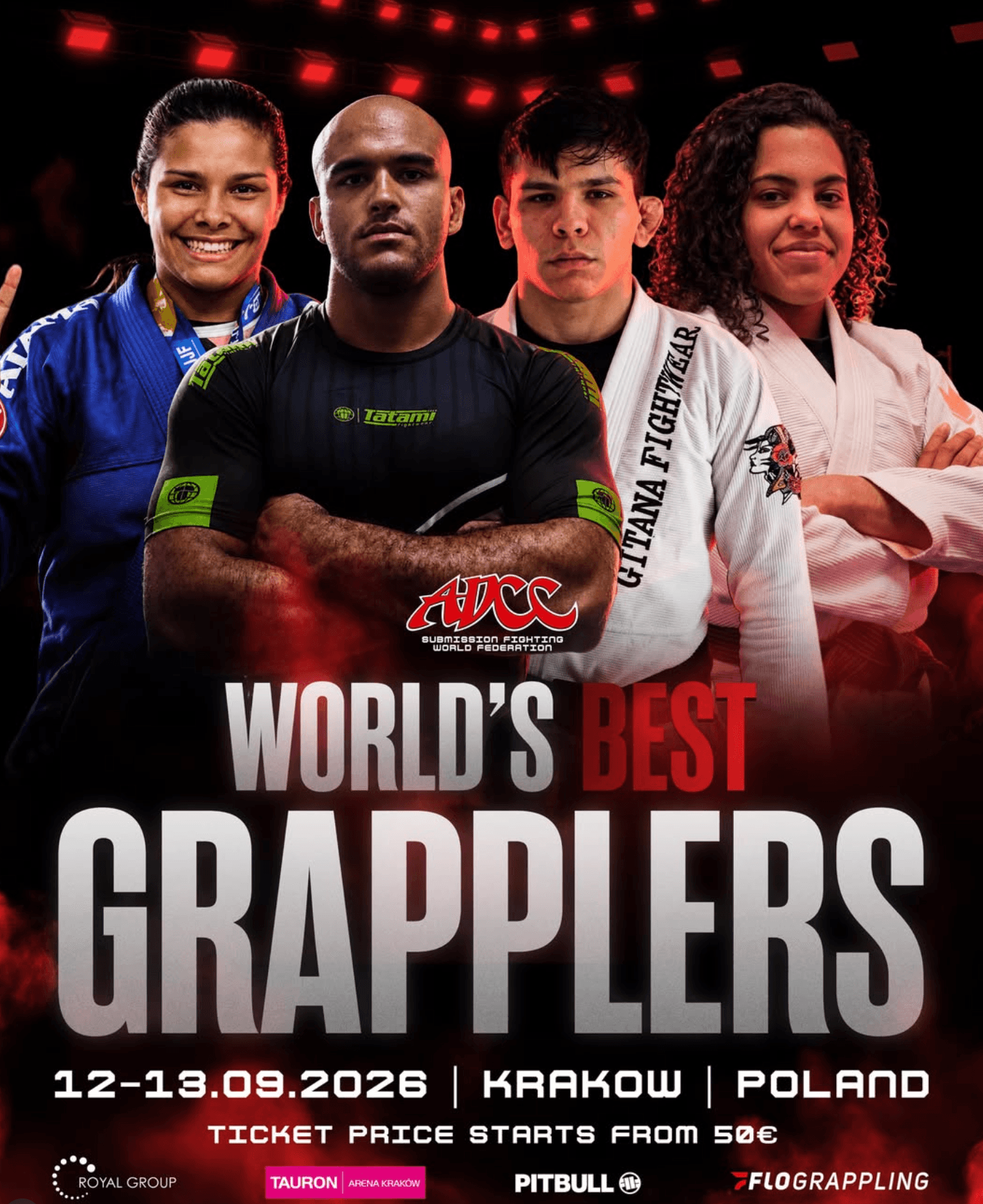
ADCC 2026 preview: Kraków, a vacant belt, and a thinner field
Quick answer: The 2026 ADCC World Championship runs September 12-13 at the TAURON Arena in Kraków, Poland, streaming on FloGrappling. Nine brackets: five men's weight classes, three women's, and a men's absolute, plus a superfight between Kaynan Duarte and Yuri Simões for a title left vacant by Gordon Ryan's retirement. Champion purses doubled this year, and several of the sport's biggest names are not on the invite list.
Four weeks out, and the most interesting thing about ADCC 2026 is who is not going.
That is not the usual way to open a preview of the most prestigious tournament in submission grappling, but this cycle has been strange. The reigning superfight champion retired. Three of the eight reigning division champions came off the invite list in July, and one has since reappeared. The two most marketable young no-gi athletes in the world are absent, and so is every champion from the UFC's new grappling promotion.
It is still ADCC. The field is thinner than it should be. Here is what to watch, and what is genuinely unsettled going in.
The basics, and how you get in
The TAURON Arena in Kraków seats a little over 15,000 for sport and up to 22,000 for a full house. It is the first ADCC Worlds outside Las Vegas since 2019 and the first in Europe since Finland in 2017.
There are two ways in and no third. Win a continental Trials tournament, or get invited. Roughly half the field arrives each way: eight Trials spots per men's division, four per women's, with the rest invited. It is also customary, though not guaranteed, for the top four in each division from the previous edition to be invited back.
The 2026 weight classes, per ADCC's own event listing: men at -65.9kg, -76.9kg, -87.9kg, -98.9kg and +99kg plus an absolute; women at -55kg, -65kg and +65kg. Nine brackets. The 2024 edition ran a women's absolute; the 2026 listing does not include one, so treat it as absent unless ADCC says otherwise.
If you have never watched one of these, start with what ADCC is and how you get into it. The format explains most of the weirdness you are about to see.
A vacant superfight belt, for the first time in a long time
The superfight is ADCC's headline act, traditionally contested between the reigning superfight champion and the previous edition's absolute champion.
Gordon Ryan held that belt. In February he announced his retirement from sport jiu-jitsu, citing the health problems that have shadowed his career, and said he would focus on coaching. That left the belt vacant, which by most accounts had not happened in seventeen years.
So the main event is Kaynan Duarte vs. Yuri Simões for the vacant title: the last two ADCC absolute champions. Duarte took double gold in 2024, winning -99kg and the absolute, and was named the event's best athlete. Simões won the 2022 absolute for his third world title, then lost his 2024 superfight to Ryan on points. They met once before, at ADCC 2019, where Duarte won on points on his way to a first title.
Duarte is also listed in the -99kg division. Whether he competes in both is unclear, and I have not seen it confirmed either way.
Who is coming back to defend
In February, ADCC announced that all eight of its 2024 division champions had accepted invitations. That did not hold.
By early July, three had been removed from the official list: Diogo Reis at -66kg, Micael Galvão at -77kg, and Giancarlo Bodoni at -88kg. Reis and Galvão were teammates, and reporting linked their absence to the collapse of their former academy after the April arrest of head coach Melqui Galvão on allegations involving minors. Reis appears again at -66kg on the most recent published invite list I can find. Galvão and Bodoni do not.
That leaves a confirmed list of Kaynan Duarte at -99kg, Felipe Pena at +99kg, Ana Vieira at women's -65kg and Rafaela Guedes at women's +65kg, with Reis best described as unsettled. Adele Fornarino, double gold at -55kg and the women's absolute in 2024, is not listed. Treat every name as provisional until the bracket reveal on September 11.
The names who are not in Kraków
Kade Ruotolo and Tye Ruotolo are not on the list, having competed at every edition since 2019. Nick Rodriguez, the CJI +80kg winner, is not either. Nor is any current UFC BJJ champion.
There is no single confirmed reason, and it is worth saying so: no one has published a clean accounting of who declined, who was not invited, and who was contractually blocked. What is on the record is that UFC BJJ executive Claudia Gadelha has said the promotion intends to enforce its exclusive contracts, and that athletes on those deals will not be permitted at ADCC after 2026. We went through how UFC BJJ is built in more detail elsewhere. The Ruotolos are signed to ONE Championship, which has historically let its grapplers compete here.
The visible result is a tournament missing several of the ten most recognisable no-gi competitors alive, in the year its purses finally became worth something.
The divisions with the best stories
Men's -77kg is the deepest bracket on the card even without its missing champion. Mateusz Szczeciński arrives having just won the Polaris welterweight Grand Prix in July, submitting two opponents and beating PJ Barch by split decision in the final. Barch is here too, along with Tommy Langaker, Vagner Rocha, Dante Leon, Oliver Taza, Elijah Dorsey and Taylor Pearman. Mateusz Gamrot, the UFC lightweight, holds an invite as well, and a Polish crowd watching a Polish MMA fighter in a Kraków arena is a fun subplot.
Men's +99kg has Felipe Pena defending against a field including Victor Hugo, who won the IBJJF Absolute No-Gi Grand Prix and its $50,000 top prize in February, plus Trials winners Roosevelt Sousa and Haisam Rida. Big-man ADCC is where the ruleset bites hardest, because a stalled first half of a heavyweight match is a long ten minutes.
Men's -88kg lost its champion and gained chaos: Jozef Chen, Gustavo Batista, Marlon Tajik, Pedro Marinho and Matheus Diniz in one bracket with no favourite.
Women's +65kg is the one I would clear my schedule for. Rafaela Guedes defends against a field including Gabi Garcia and Helena Crevar, who won the $100,000 CJI women's openweight bracket in 2025 and has been the most improved competitor in women's grappling two years running.
Women's -55kg is worth watching for one name: Mayssa Bastos, a decorated IBJJF world champion, qualified through Trials rather than an invite. That is what the Trials are for, and it rarely happens at that level.
The ruleset that makes ADCC look wrong at first
If you are new to it, ADCC matches will confuse you for ten minutes, then make more sense than anything else in the sport.
Weight-class matches at Worlds run ten minutes, finals twenty. No positive points are scored in the first half. In that opening period the only thing that can move the scoreboard is a penalty: pull guard, back away or stall, and you take a minus point. Positive scoring switches on for the second half — three for a guard pass, two for mount or knee-on-stomach, three for back control with hooks, two for a takedown or sweep, four if either lands past the guard. Tied after regulation and you go to overtime, where the first score wins.
The last wrinkle catches everyone. Minus points are not deducted as they happen; they are applied at the final bell, so a competitor can appear to be winning 5-3 and lose 4-3 once the penalties land. It is the most-complained-about rule in grappling and it does exactly what it was built to do: it makes stalling expensive and guard-pulling a bad idea. Leg locks are all legal. Neck cranks and slamming to break a submission are not.
The money doubled
In February, ADCC increased purses across the board. Men's division winners now take $20,000, up from $10,000. Women's winners take $10,000. The absolute champion takes $50,000, and so does the superfight winner. Second in the men's divisions is $10,000, with superlative awards of $3,000 each for best fighter, best takedown and fastest submission.
Context: in 2024, ADCC paid its men's champions $10,000, and every competitor received show money of at least $2,500 for the first time in the event's history. The Craig Jones Invitational, running the same weekend, paid every entrant $10,001. Read those two numbers together and you understand why the purses moved.
Read the invite list in pencil
Between February and July this roster moved three separate times: eight defending champions confirmed, three removed, one restored. Names appear and disappear from ADCC's published lists without explanation, and the organisation rarely says why. That is not new and it is not unique to this cycle. It is just more visible in a year when the field is already thin.
Which is the practical reason to wait for September 11 before building any expectations around this card. The bracket reveal is the first document all year that ADCC treats as final. Until it exists, every name above is provisional, including the ones I have written down as confirmed.
How to watch
Both days stream on FloGrappling, where all ADCC coverage lives. Day one runs the weight-class brackets, day two the finals, absolute and superfight. A bracket reveal show goes out on September 11, the same day as the ADCC Amateur World Championship, and it is worth watching: seeding is where half the storylines get made. Central European time means an early start for North American viewers, so set an alarm or accept spoilers.
The takeaway
ADCC 2026 is still the most important weekend in no-gi. The ruleset is the sport's best argument with itself, the field runs deep in the middle weights, and the superfight puts two absolute champions in a match that would headline anywhere.
It is also a tournament with holes in it, and the holes were made by contracts rather than injuries or upsets. That is a new problem for a competition that spent decades being the one place everyone showed up. Whoever wins in Kraków will be a legitimate world champion. A few will also be asked, fairly, who wasn't there.
Watch it live if you can. Every ADCC produces two or three matches people argue about for the next two years.
Follow the medals back to the teams
Individual gold rolls up. If you want to see which academies produce competitors at this level year over year, we track it in the team power index. And if Kraków has you itching to compete, find a tournament near you.
FAQ
When and where is ADCC 2026? September 12-13, 2026, at the TAURON Arena in Kraków, Poland. It is the first ADCC World Championship held outside Las Vegas since 2019 and the first in Europe since 2017.
How do you qualify for ADCC? Two routes only: win a continental Trials tournament, or receive a direct invitation. Roughly half of each division qualifies through Trials, and top finishers from the previous edition are customarily invited back, though that is not guaranteed.
What is the ADCC superfight in 2026? Kaynan Duarte vs. Yuri Simões for the vacant title. Gordon Ryan held the belt and retired in February 2026, leaving it open for the first time in roughly seventeen years. The two are the last two ADCC absolute champions.
How much does an ADCC champion earn? As of 2026, $20,000 for a men's weight-class title, $10,000 for a women's title, and $50,000 for the absolute or superfight. Those figures doubled from the previous cycle.
Related Posts
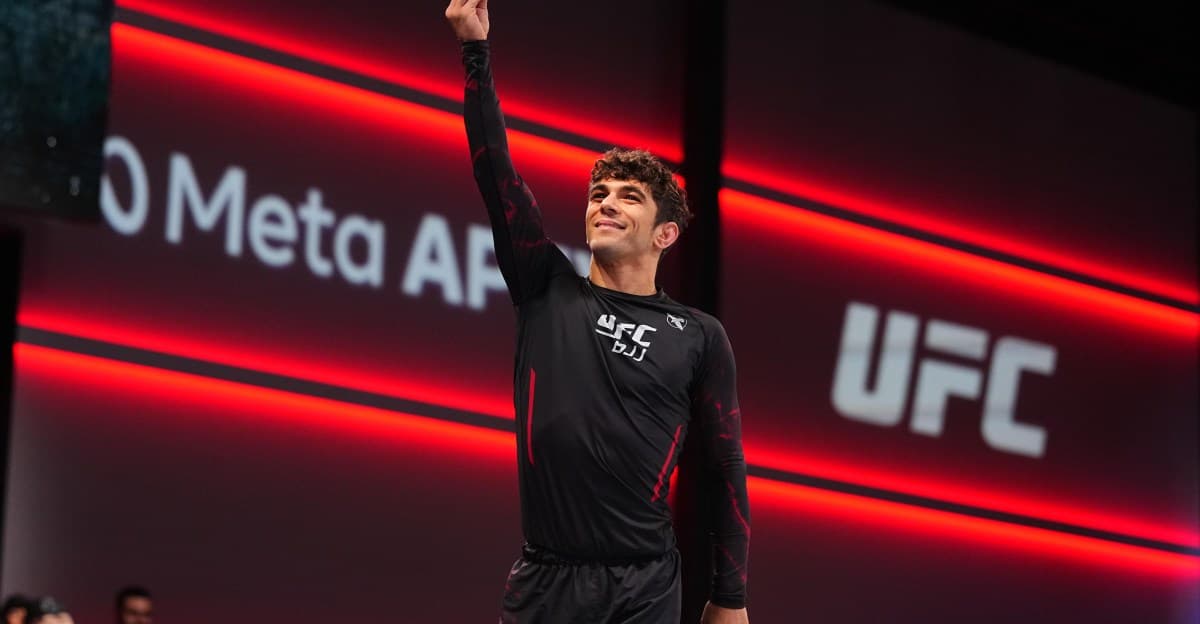
Mikey Musumeci gives up the belt to make room for MMA
Musumeci is vacating his UFC BJJ title to focus on MMA training. What he is leaving, what continues, and why the transition matters.
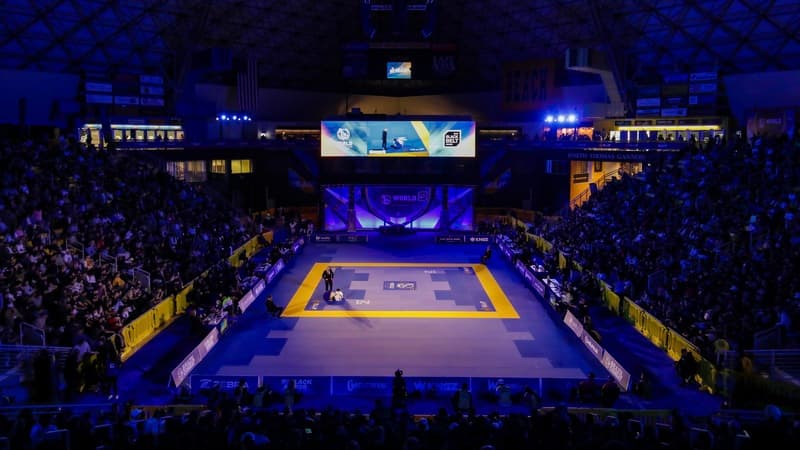
IBJJF membership: finish the paperwork before the deadline
IBJJF membership and tournament entry are separate steps. Plan documents, professor approval, renewals, and junior accounts before registration closes.
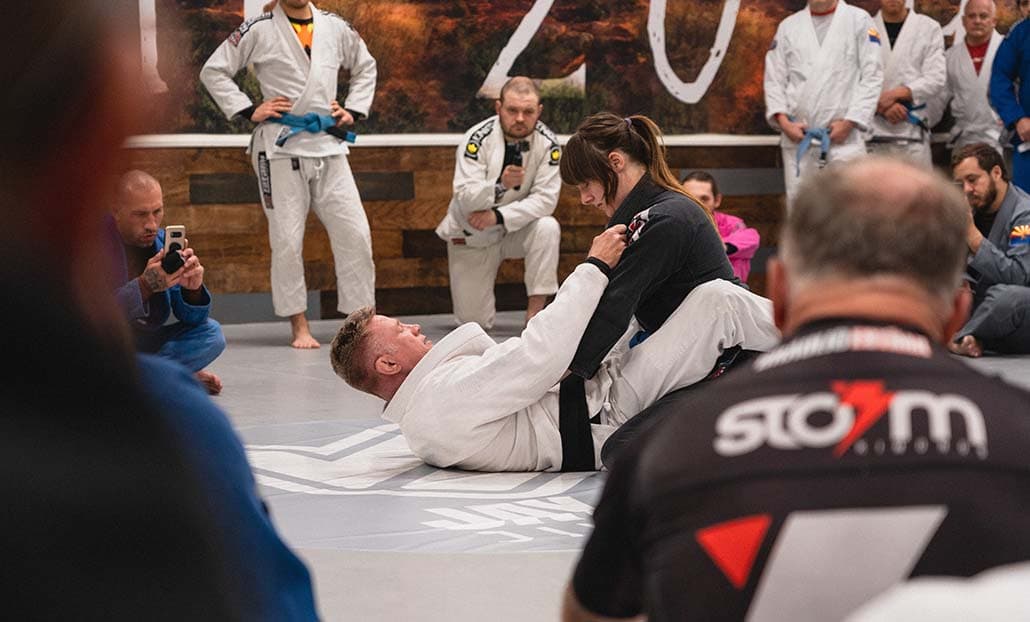
Choosing a BJJ seminar worth your time and travel
Choose a BJJ seminar by the subject, teaching format, access, and total cost. Know what to ask the host before buying a ticket.
Comments (0)
Loading comments...