
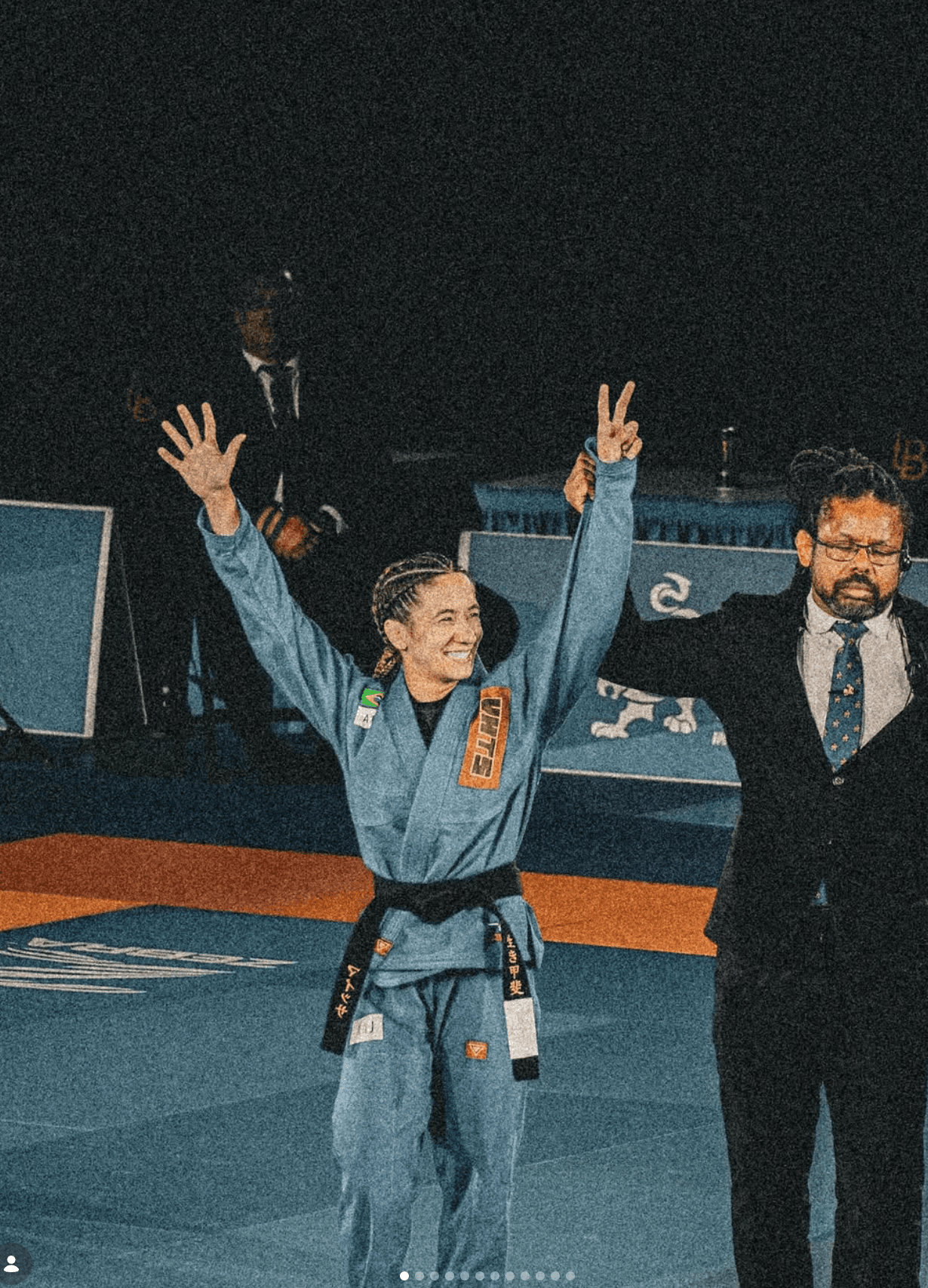
Mayssa Bastos: the most precise jiu-jitsu on the planet
Quick answer: Mayssa Bastos is a Brazilian black belt competing for Art of Jiu-Jitsu and the winningest roosterweight in the history of the IBJJF World Championship. At the 2026 Worlds in Long Beach she took her seventh straight title at 48.5 kg, a division she has never lost in as a black belt. Her career record is listed at roughly 146 wins against 15 losses, with 74 wins by submission and zero losses by submission.
The 2026 roosterweight final took a little over two minutes. Bastos established a lasso grip, hit an arm drag off it, turned her opponent's shoulders far enough to expose the back, and finished with a lapel choke. Seventh World title, seven years running, still undefeated at black belt at the event she cares most about.
That is the part of her career that gets written up. The more interesting part is the mechanism. Bastos competes at 48.5 kg, which is 107 pounds in a gi. There is no version of her game where she survives a bad exchange by being stronger, and no version where she wins a scramble by being heavier. Everything she does has to work on the first attempt, against someone the same size who has also spent a decade making sure nothing works on the first attempt.
What she did in Long Beach
The 2026 Worlds ran May 28-31 at the Pyramid in Long Beach, California, the 30th edition of the event. Bastos opened her bracket with a lapel choke from the back against Melody Wong in the quarterfinals. In the semifinal she met Mariana Rolszt of Gracie Humaitá, an opponent she had already beaten at the Worlds twice before, and per the IBJJF's own recap she piled up thirteen points off her berimbolo entries before closing with a rear-naked choke. The final against Jessica Caroline lasted just over two minutes.
Three matches, three finishes, all of them ending at the back. That is not a coincidence and it is not a hot streak. It is the whole design.
Judo in Maricá, then the Fadda line
Bastos was born on October 23, 1997, in Niterói, across the bay from Rio. Judo came first, through her father and older brother, and she moved into jiu-jitsu at around twelve under coach Jair Court in Maricá. She eventually became a fixture at GF Team's Meyer headquarters and was promoted to black belt by Júlio César Pereira on June 4, 2018, on the podium at the World Championship.
Her lineage is worth noting because it is not the one people assume. BJJ Heroes traces her back through Júlio César to Monir Salomão, Oswaldo Fadda, and Luiz França. That is the Fadda line, the branch of Brazilian jiu-jitsu that grew up outside the Gracie academies and in the working-class suburbs north of Rio. The most technically exacting small competitor of her generation came out of the school that was historically dismissed as the poor people's jiu-jitsu.
Why she moved to Costa Mesa
In May 2023 the Mendes brothers announced that Bastos was joining Art of Jiu-Jitsu in Costa Mesa, California. Until then she had only ever represented GF Team, plus long training stints at Murilo Santana's Unity in New York when she was preparing for East Coast events.
The fit is almost too neat. Rafael and Guilherme Mendes built their competitive identity on the berimbolo and the back-take chains that come off it, and the berimbolo is listed as Bastos's favorite technique. AOJ also gave her something a roosterweight cannot manufacture on her own: a room full of world-class training partners in her size range. Jessa Khan was already there. Since her arrival the academy has stacked up an absurd run of Worlds golds across the lighter divisions, and Bastos is now the most decorated athlete in that group.
Everything funnels to one place
Here is the number that explains her jiu-jitsu better than the title count. Of her 74 career submission wins, 53 are chokes from the back. Add the nine rear-naked chokes recorded separately and the picture gets even more lopsided. She has a handful of armbars, five tarikoplatas, four inside heel hooks in no-gi, an omoplata, a baratoplata. Those are the exceptions.
The sequence usually runs like this. She plays a lasso or de la Riva hook, buys a sleeve or a collar grip that stops the opponent from posturing, and then inverts. The berimbolo is not there to look good on Instagram. It is there because rolling underneath someone's base is the only reliable way for a 107-pound athlete to get behind a 107-pound athlete who is expecting it. From the back she is not hunting a scramble finish. She is hunting the lapel, which is why so many of her wins are logged as chokes from the back rather than rear-naked chokes.
If you want the general version of that position and its escapes, we wrote a whole guide on back control and escapes. Bastos is the ceiling of what that chapter looks like when someone spends fifteen years on it.
The 2026 final is a good tell. She did not berimbolo. She took a lasso, saw the arm drag, and used it instead. Same destination, different door. That is the difference between a game and a sequence.
What 107 pounds demands
Talk to anyone who competes at roosterweight or light feather and they will tell you the same thing: at the top of the small divisions, no one is bad at anything. Strength differentials that decide matches at 88 kg barely exist at 48.5 kg. No one gets stapled by pressure. No one muscles out of a submission.
What replaces it is grip fighting and timing, played at a pace most heavier athletes could not hold for ten minutes. Bastos wins the grip exchange before she starts the technique, which is why so many of her finishes look inevitable on video and are nearly impossible to copy. The sweep is not the move. The three grips that made the sweep unavoidable are the move.
There is a second demand, and it is less romantic. She has to be perfect for ten minutes, four or five times in a weekend, at a bodyweight that leaves almost no room for a bad weight cut or a missed meal. Roosterweight punishes disorganization more than any other division.
The losses tell you as much as the wins
Fifteen losses in a career that long is remarkable. What is stranger is the shape of them:
Seven on points.
Five on advantages.
Three on referee decisions.
Zero by submission.
In more than 160 recorded matches, nobody has finished her.
She also loses. In January 2026 she dropped the European Championship final to Thais Loureiro 2-0, and she has been beaten at the Pan more than once by athletes she is favored against. When she loses it is almost always because someone made the match ugly, defensive, and low-scoring, and then held a single takedown or sweep. That is the real counter to her whole style: precision needs something to work on, and a determined opponent who refuses to engage can take that away for ten minutes.
ADCC, twice, and the one gap on the résumé
ADCC. She has qualified, moved up in weight to do it, and come up short twice. At ADCC 2022 she entered the -60 kg bracket, giving up more than ten kilos to most of the field, and lost 3-0 to Beatriz Mesquita in the quarterfinals. In 2024 she lost a quarterfinal referee decision to Adele Fornarino at -55 kg.
She qualified again in March 2026 by winning the second ADCC South American Trials, and the 2026 ADCC World Championship is scheduled for September in Poland. It is the one gap on a résumé that otherwise includes four IBJJF No-Gi World titles, the 2021 WNO Championship, an EBI strawweight tournament win, and a 2023 season in which she took the European, Pan, Brasileiro, and Worlds titles in the same year.
Her no-gi record also answers the obvious objection about a lapel-dependent game. Strip the gi and she still wins, with inside heel hooks appearing in the record where the collar chokes used to be. It is the same map with different grips.
The takeaway
Seven consecutive World titles at black belt in the same division is the kind of run that gets flattened into a statistic. The more useful way to look at Bastos is as a proof of concept: a complete, high-percentage game built entirely around getting to one position, executed by someone who has no physical margin for error whatsoever.
That has a practical implication for anyone reading this who is not 107 pounds and not a professional. Her game is not wide. It is deep. She does not have an answer for everything, she has an overwhelming answer for one thing and enough entries into it that opponents cannot close all the doors. Small competitors, older competitors, and anyone who has ever been told they are too light to compete should be studying the structure rather than the berimbolo.
The women's game at the top is deeper than it has ever been, and the divisions Bastos competes in are the deepest of all. She has been beating them for seven years without ever being finished. If you want to argue about the greatest women's competitor of all time you will end up in a conversation about Beatriz Mesquita and Gabi Pessanha and their absolute titles, and that is fair. But no one in the sport has dominated a single division this completely, for this long, at this size.
Watch her division and then go train
Roosterweight is the best division in jiu-jitsu to learn from, because nothing in it works by accident. Look up how the light divisions stack up on the team Power Index, read our piece on BJJ for women if you are thinking about starting, and then go find a room. Find a BJJ gym near you on Let's Roll and get on the mat this week.
FAQ
How many World titles does Mayssa Bastos have? Seven at black belt in the gi, in the roosterweight division: 2019, then every year from 2021 through 2026. She has never lost at the IBJJF World Championship as a black belt. She also holds four IBJJF No-Gi World titles, won in 2018, 2021, 2023, and 2024.
What team does Mayssa Bastos train with? Art of Jiu-Jitsu in Costa Mesa, California, under Rafael and Guilherme Mendes. She joined AOJ in May 2023 after representing GF Team her whole career, and she received her black belt from Júlio César Pereira in June 2018.
What is Mayssa Bastos's best technique? The berimbolo and the back attacks that come off it. Of her 74 career submission wins, 53 are recorded as chokes from the back, which is a stronger concentration than almost any elite competitor in the sport. Her secondary weapons include the tarikoplata and, in no-gi, the inside heel hook.
Has Mayssa Bastos ever been submitted? No. Her public record shows 15 losses across more than 160 matches, all of them by points, advantages, or referee decision. Seven of her losses came on points and five on advantages, which fits a competitor who is very hard to finish and occasionally hard to score on.
Related Posts
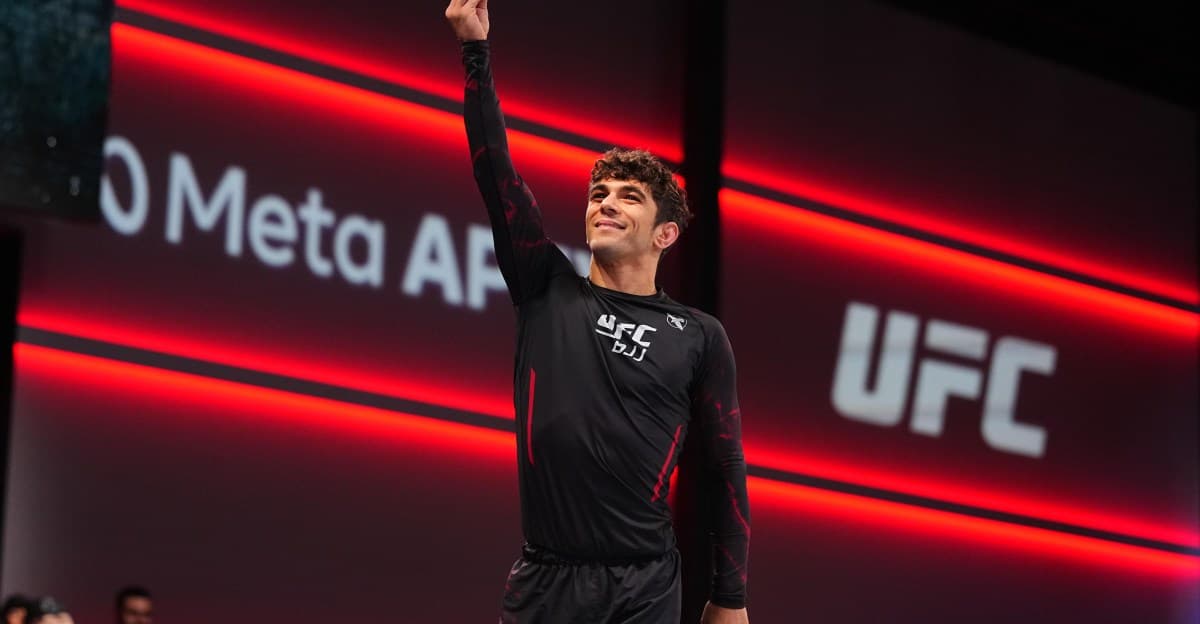
Mikey Musumeci gives up the belt to make room for MMA
Musumeci is vacating his UFC BJJ title to focus on MMA training. What he is leaving, what continues, and why the transition matters.
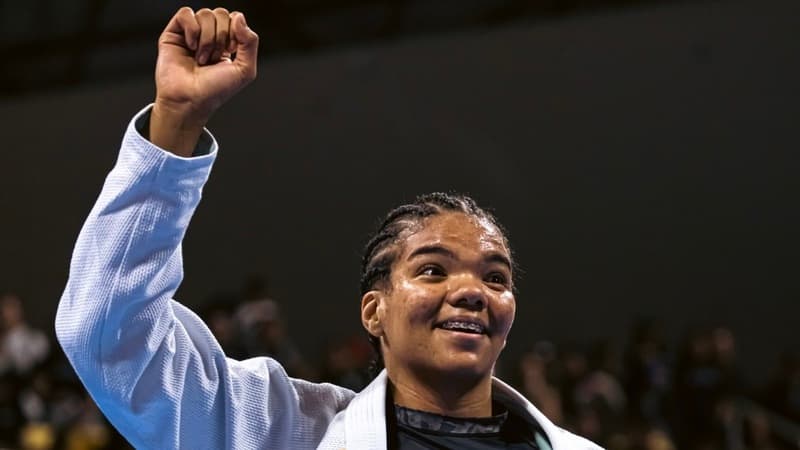
IBJJF membership: finish the paperwork before the deadline
IBJJF membership and tournament entry are separate steps. Plan documents, professor approval, renewals, and junior accounts before registration closes.
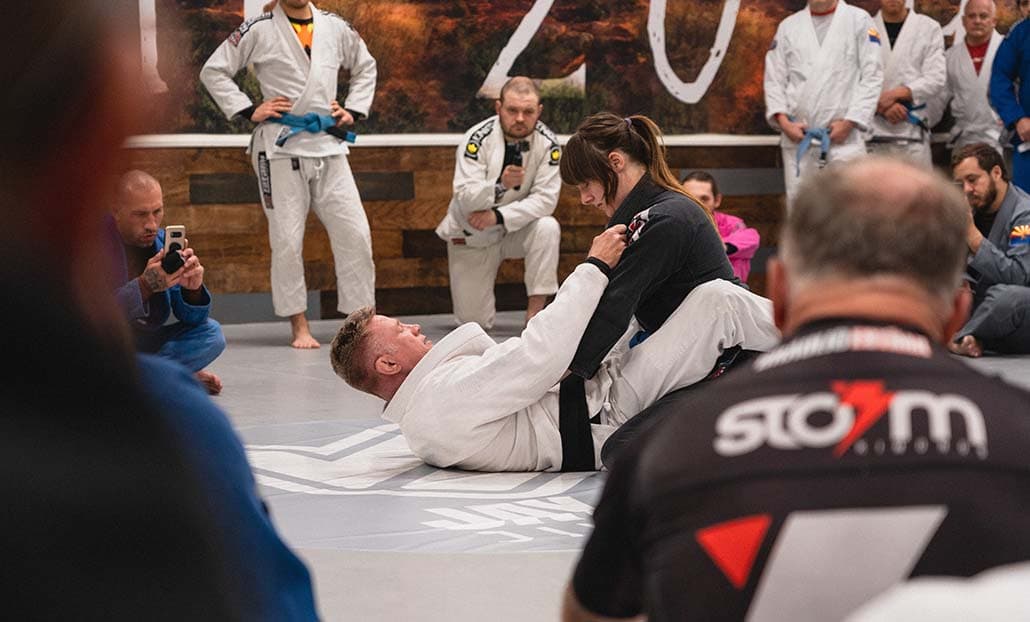
Choosing a BJJ seminar worth your time and travel
Choose a BJJ seminar by the subject, teaching format, access, and total cost. Know what to ask the host before buying a ticket.
Comments (0)
Loading comments...